







Question: 1) Max Zx+ 3x2 s.t. 2x1 + 4x2 14 6x1 + 2x2 12 2) Max Zx+X2 s.t. 2x1 + 4x2 14 6x1 + 2x2
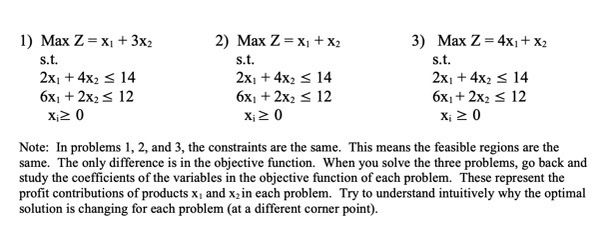
1) Max Zx+ 3x2 s.t. 2x1 + 4x2 14 6x1 + 2x2 12 2) Max Zx+X2 s.t. 2x1 + 4x2 14 6x1 + 2x2 12 3) Max Z=4x1 + x2 s.t. 2x + 4x2 14 6x1 + 2x2 12 x; 0 Note: In problems 1, 2, and 3, the constraints are the same. This means the feasible regions are the same. The only difference is in the objective function. When you solve the three problems, go back and study the coefficients of the variables in the objective function of each problem. These represent the profit contributions of products x; and x2 in each problem. Try to understand intuitively why the optimal solution is changing for each problem (at a different corner point). 1) Max Zx+ 3x2 s.t. 2x1 + 4x2 14 6x1 + 2x2 12 2) Max Zx+X2 s.t. 2x1 + 4x2 14 6x1 + 2x2 12 3) Max Z=4x1 + x2 s.t. 2x + 4x2 14 6x1 + 2x2 12 x; 0 Note: In problems 1, 2, and 3, the constraints are the same. This means the feasible regions are the same. The only difference is in the objective function. When you solve the three problems, go back and study the coefficients of the variables in the objective function of each problem. These represent the profit contributions of products x; and x2 in each problem. Try to understand intuitively why the optimal solution is changing for each problem (at a different corner point).
Step by Step Solution
3.33 Rating (147 Votes )
There are 3 Steps involved in it
Lets solve each of the three linear programming problems and analyze the optimal solutions Problem 1 Max Z x 3x2 Subject to 2x 4x2 14 6x 2x2 12 x 0 To ... View full answer

Get step-by-step solutions from verified subject matter experts
 Study Help