







Question: A small satellite has a high power data transmitter that it needs to power briefly each time it completes an orbit. The transmitter electronics
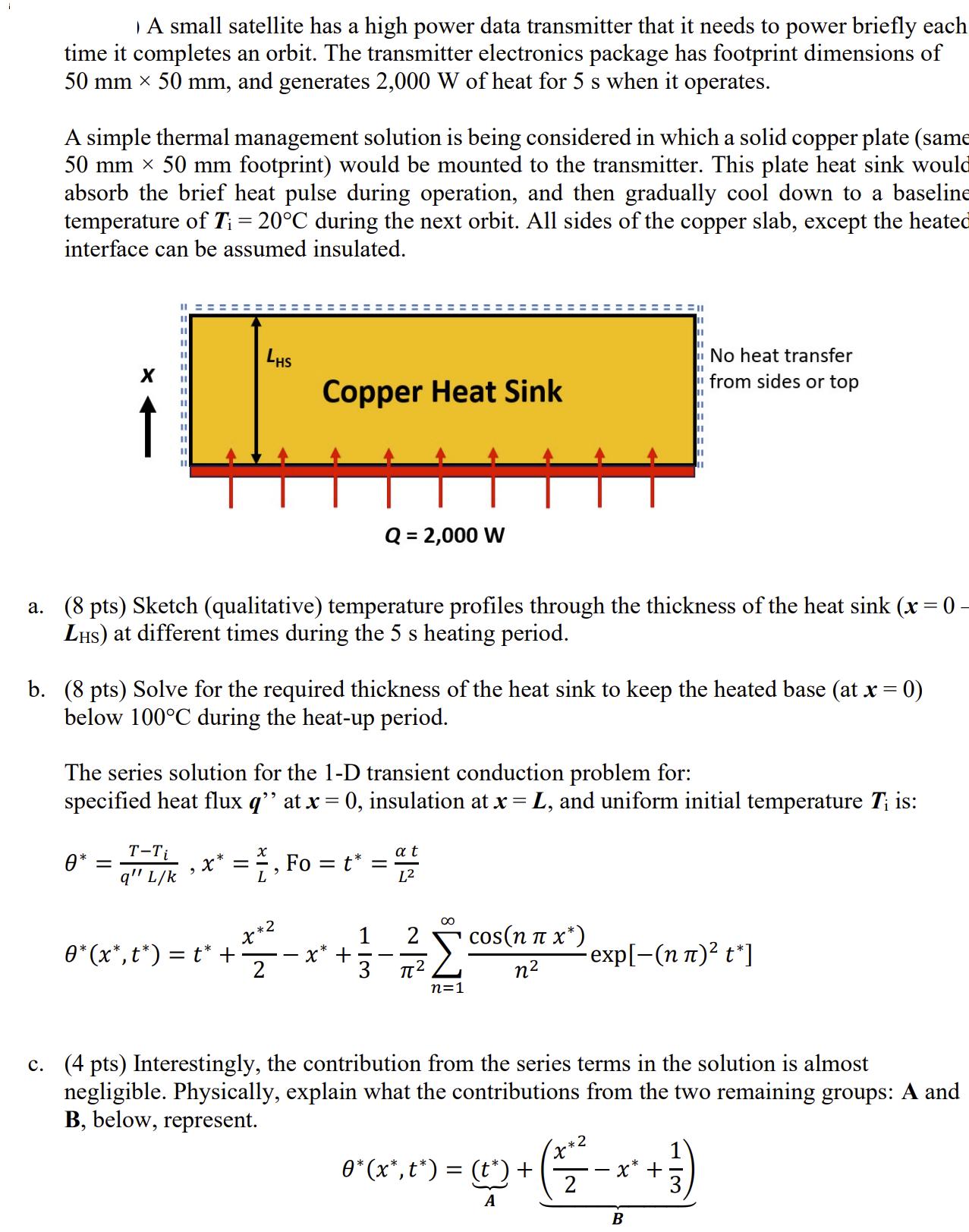
A small satellite has a high power data transmitter that it needs to power briefly each time it completes an orbit. The transmitter electronics package has footprint dimensions of 50 mm 50 mm, and generates 2,000 W of heat for 5 s when it operates. A simple thermal management solution is being considered in which a solid copper plate (same 50 mm 50 mm footprint) would be mounted to the transmitter. This plate heat sink would absorb the brief heat pulse during operation, and then gradually cool down to a baseline temperature of T = 20C during the next orbit. All sides of the copper slab, except the heated interface can be assumed insulated. X 11 11 " 0* = 11 "1 11 " T-Ti q" L/k 11 " 11 3 11 11 11 11 LHS a. (8 pts) Sketch (qualitative) temperature profiles through the thickness of the heat sink (x = 0 - LHS) at different times during the 5 s heating period. b. (8 pts) Solve for the required thickness of the heat sink to keep the heated base (at x = 0) below 100C during the heat-up period. 0*(x*,t*) = t* + The series solution for the 1-D transient conduction problem for: specified heat flux q" at x = 0, insulation at x = L, and uniform initial temperature Ti is: X X x = Fo = t* t* = at L Copper Heat Sink 2 9 *2 - Q = 2,000 W x + 1 3 11 11 11 11 II n=1 cos(n x*) n No heat transfer from sides or top 0* (x*,t*) = (t*) + -exp[(n ) t*] c. (4 pts) Interestingly, the contribution from the series terms in the solution is almost negligible. Physically, explain what the contributions from the two remaining groups: A and B, below, represent. *2 X ( - x + 1) 2 B
Step by Step Solution
3.49 Rating (152 Votes )
There are 3 Steps involved in it
Qualitative temperature profiles through the thickness of the heat sink x 0 LHS at different times during the 5 s heating period Time Temperature Prof... View full answer

Get step-by-step solutions from verified subject matter experts
 Study Help