







Question: 1. Model 1: OLS, using observations 1-706 Dependent variable: RST coefficient sid. error t-ratio p-value const 3586.38 38.9124 92.17 0.0000*# TOTWRK -0.150746 0.0167403 -9.005 1.99e-18*#
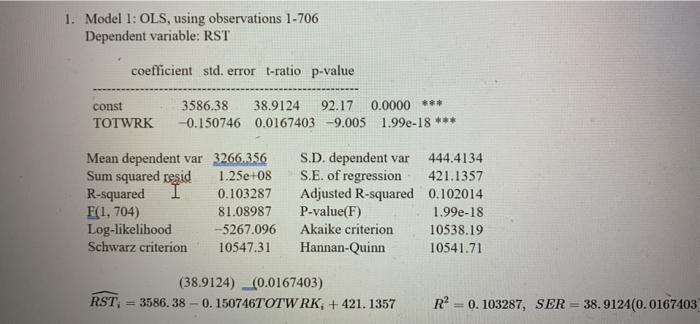
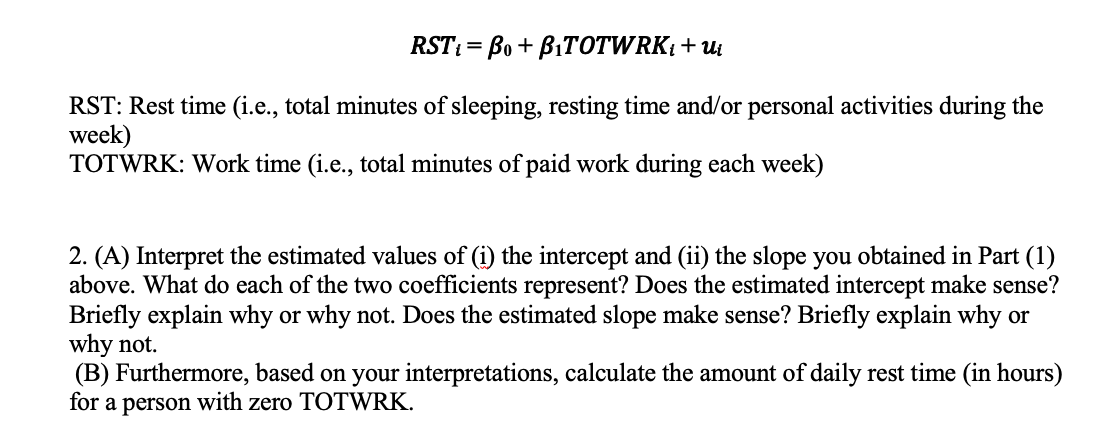
1. Model 1: OLS, using observations 1-706 Dependent variable: RST coefficient sid. error t-ratio p-value const 3586.38 38.9124 92.17 0.0000*# TOTWRK -0.150746 0.0167403 -9.005 1.99e-18*# Mean dependent var 3266.356 S.D. dependent var 444.4134 Sum squared resid 1.25e+08 S.E. of regression 421.1357 R-squared 0.103287 Adjusted R-squared 0.102014 F(1. 704) 81.08987 P-value(F) 1.99e-18 Log-likelihood -5267.096 Akaike criterion 10538.19 Schwarz criterion 10547.31 Hannan-Quinn 10541.71 (38.9124) (0.0167403) RST. = 3586. 38 - 0. 150746TOTWRK, + 421. 1357 R = 0. 103287, SER = 38. 9124(0. 0167403EST: = n + 31T01WRK1+ w RST: Rest time (i.e., total minutes of sleeping, resting the and/or personal activities during the week) TOTWRK: Work we (i.e., total minutes of paid work during each week) 2. (A) Interpret the estimated values of (i) the intercept and (ii) the slope you obtained in Part (1) above. What do each of the two coefcients rcpresent? Does the estimated intercept make sense? Briey explain Why or why not. Does the estimated slope make sense? Briey explain why or Why not. (B) Furthermore, based on your interpretations, calculate the amount of daily rest time (in hours) for a person with zero TOTWRK
Step by Step Solution
There are 3 Steps involved in it

Get step-by-step solutions from verified subject matter experts
 Study Help