







Question: 1. Multiple Choice: Circle the correct numerical response to each of the following. [1 or 2 marks each] a. All samples of a given compound,
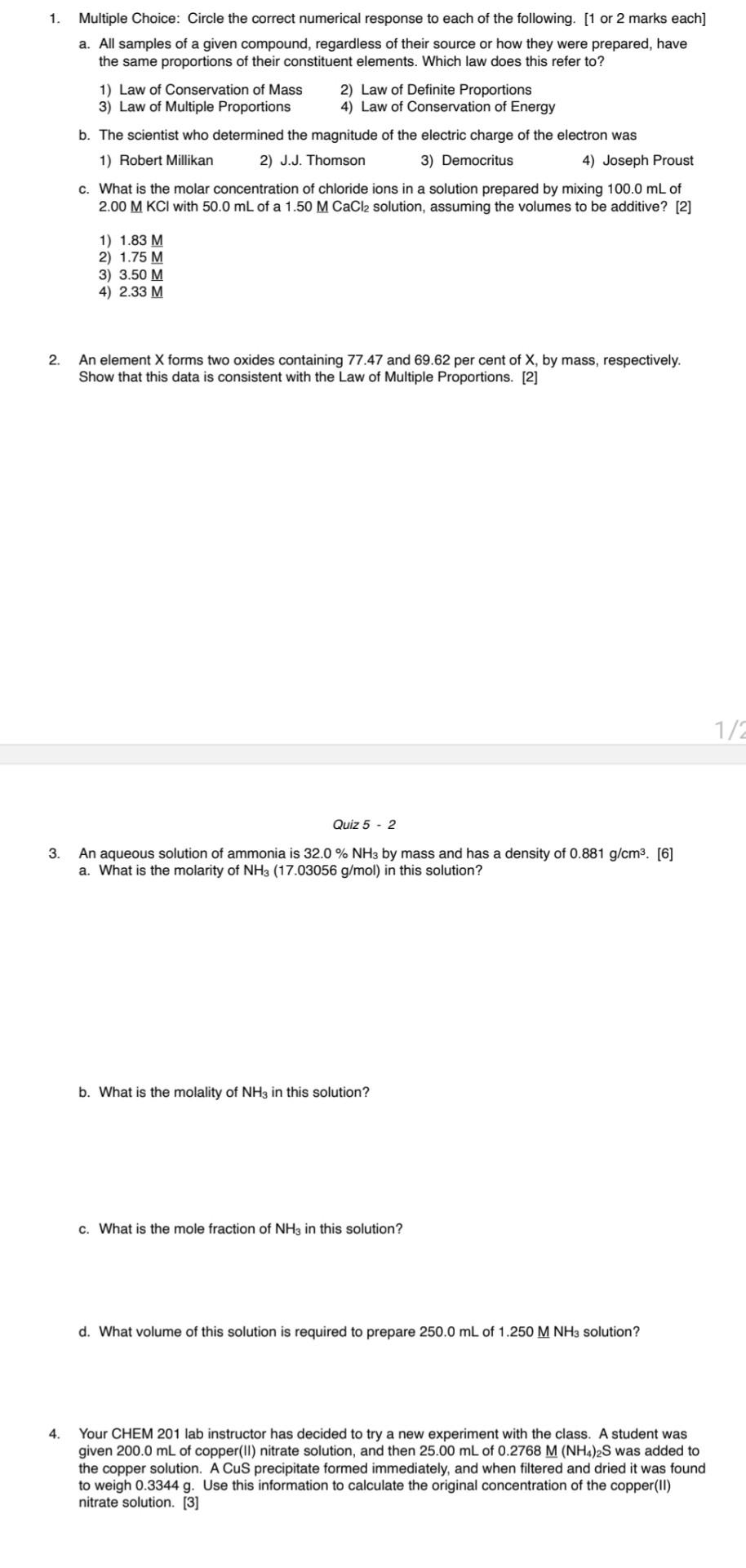
1. Multiple Choice: Circle the correct numerical response to each of the following. [1 or 2 marks each] a. All samples of a given compound, regardless of their source or how they were prepared, have the same proportions of their constituent elements. Which law does this refer to? 1) Law of Conservation of Mass 2) Law of Definite Proportions 3) Law of Multiple Proportions 4) Law of Conservation of Energy b. The scientist who determined the magnitude of the electric charge of the electron was 1) Robert Millikan 2) J.J. Thomson 3) Democritus 4) Joseph Proust c. What is the molar concentration of chloride ions in a solution prepared by mixing 100.0mL of 1) 1.83M 2) 1.75M 3) 3.50M 4) 2.33M 2. An element X forms two oxides containing 77.47 and 69.62 per cent of X, by mass, respectively. Show that this data is consistent with the Law of Multiple Proportions. [2] Quiz 5 - 2 a. What is the molarity of NH3(17.03056g/mol) in this solution? b. What is the molality of NH3 in this solution? c. What is the mole fraction of NH3 in this solution? d. What volume of this solution is required to prepare 250.0mL of 1.250MNH3 solution? 4. Your CHEM 201lab instructor has decided to try a new experiment with the class. A student was given 200.0mL of copper(II) nitrate solution, and then 25.00mL of 0.2768M(NH4)2S was added to the copper solution. A CuS precipitate formed immediately, and when filtered and dried it was found to weigh 0.3344g. Use this information to calculate the original concentration of the copper(II) nitrate solution. [3]
Step by Step Solution
There are 3 Steps involved in it

Get step-by-step solutions from verified subject matter experts
 Study Help