





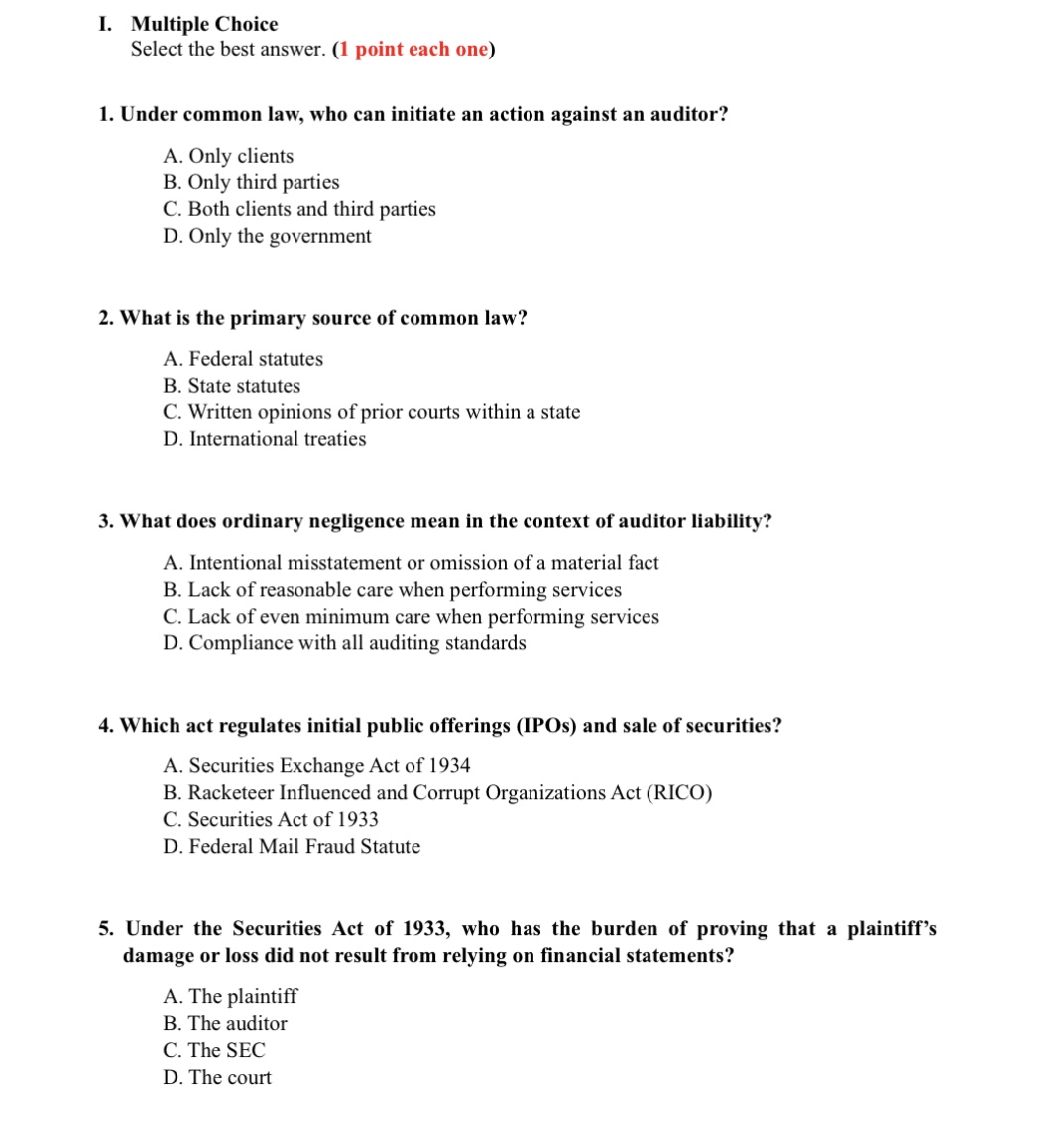
Question: 1. Multiple Choice Select the best answer. (1 point each one) 1. Under common law, who can initiate an action against an auditor? A. Only
1. Multiple Choice Select the best answer. (11. Multiple Choice Select the best answer. (1
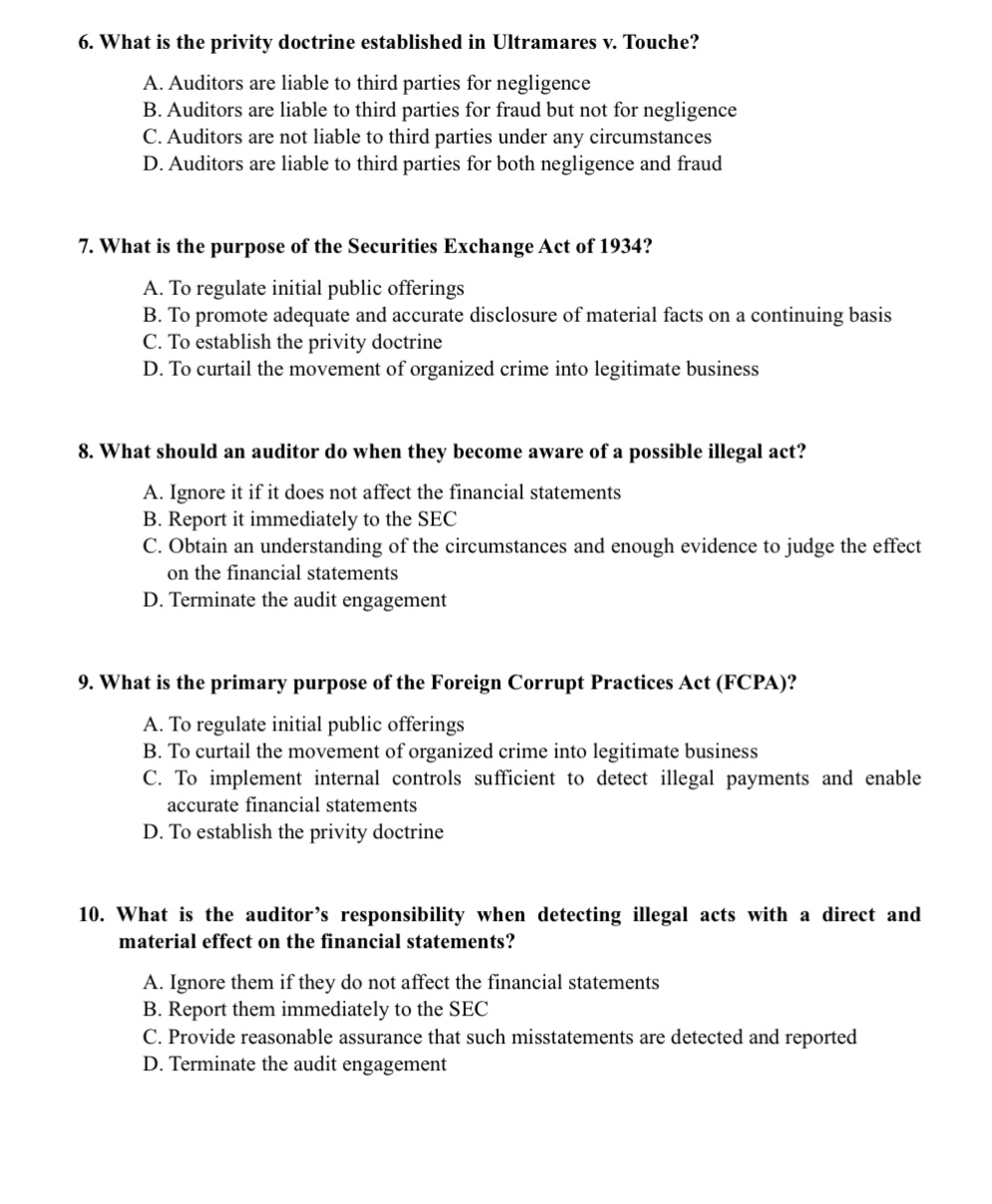
1. Multiple Choice Select the best answer. (1 point each one) 1. Under common law, who can initiate an action against an auditor? A. Only clients B. Only third parties C. Both clients and third parties D. Only the government 2. What is the primary source of common law? A. Federal statutes B. State statutes C. Written opinions of prior courts within a state D. International treaties 3. What does ordinary negligence mean in the context of auditor liability? A. Intentional misstatement or omission of a material fact B. Lack of reasonable care when performing services C. Lack of even minimum care when performing services D. Compliance with all auditing standards 4. Which act regulates initial public offerings (IPOs) and sale of securities? A. Securities Exchange Act of 1934 B. Racketeer Influenced and Corrupt Organizations Act (RICO) C. Securities Act of 1933 D. Federal Mail Fraud Statute 5. Under the Securities Act of 1933, who has the burden of proving that a plaintiff's damage or loss did not result from relying on financial statements? A. The plaintiff B. The auditor C. The SEC D. The court 6. What is the privity doctrine established in Ultramares v. Touche? A. Auditors are liable to third parties for negligence B. Auditors are liable to third parties for fraud but not for negligence C. Auditors are not liable to third parties under any circumstances D. Auditors are liable to third parties for both negligence and fraud 7. What is the purpose of the Securities Exchange Act of 1934? A. To regulate initial public offerings B. To promote adequate and accurate disclosure of material facts on a continuing basis C. To establish the privity doctrine D. To curtail the movement of organized crime into legitimate business 8. What should an auditor do when they become aware of a possible illegal act? A. Ignore it if it does not affect the financial statements B. Report it immediately to the SEC C. Obtain an understanding of the circumstances and enough evidence to judge the effect on the financial statements D. Terminate the audit engagement 9. What is the primary purpose of the Foreign Corrupt Practices Act (FCPA)? A. To regulate initial public offerings B. To curtail the movement of organized crime into legitimate business C. To implement internal controls sufficient to detect illegal payments and enable accurate financial statements D. To establish the privity doctrine 10. What is the auditor's responsibility when detecting illegal acts with a direct and material effect on the financial statements? A. Ignore them if they do not affect the financial statements B. Report them immediately to the SEC C. Provide reasonable assurance that such misstatements are detected and reported D. Terminate the audit engagement

Step by Step Solution

There are 3 Steps involved in it

1 Expert Approved Answer
Step: 1 Unlock blur-text-image

Question Has Been Solved by an Expert!

Get step-by-step solutions from verified subject matter experts

Step: 2 Unlock
Step: 3 Unlock

Students Have Also Explored These Related Accounting Questions!