







Question: 1. Nishimura Problem 5.4: Dr. Dre designs a 2DFT imaging sequence in which the amplitude of thegradient is varied from measurement to measurement for phase
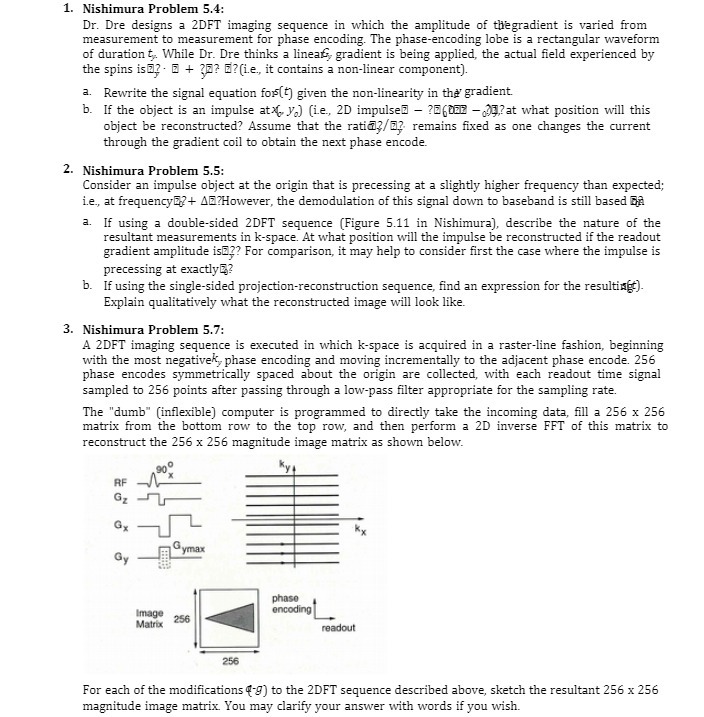
1. Nishimura Problem 5.4: Dr. Dre designs a 2DFT imaging sequence in which the amplitude of thegradient is varied from measurement to measurement for phase encoding. The phase-encoding lobe is a rectangular waveform of duration to While Dr. Dre thinks a lineand gradient is being applied, the actual field experienced by the spins is? - D + (0? 6?(ie., it contains a non-linear component). a. Rewrite the signal equation for (t) given the non-linearity in the gradient. b. If the object is an impulse at*( ),) (ie., 2D impulse@ - 706082 - 24?at what position will this object be reconstructed? Assume that the ratio,/27 remains fixed as one changes the current through the gradient coil to obtain the next phase encode. 2. Nishimura Problem 5.5: Consider an impulse object at the origin that is precessing at a slightly higher frequency than expected; i.e., at frequency87+ Am?However, the demodulation of this signal down to baseband is still based GA a. If using a double-sided 2DFT sequence (Figure 5.11 in Nishimura), describe the nature of the resultant measurements in k-space. At what position will the impulse be reconstructed if the readout gradient amplitude is6?? For comparison, it may help to consider first the case where the impulse is precessing at exactly? b. If using the single-sided projection-reconstruction sequence, find an expression for the resultin(). Explain qualitatively what the reconstructed image will look like 3. Nishimura Problem 5.7: A 2DFT imaging sequence is executed in which k-space is acquired in a raster-line fashion, beginning with the most negative , phase encoding and moving incrementally to the adjacent phase encode. 256 phase encodes symmetrically spaced about the origin are collected, with each readout time signal sampled to 256 points after passing through a low-pass filter appropriate for the sampling rate. The "dumb" (inflexible) computer is programmed to directly take the incoming data, fill a 256 x 256 matrix from the bottom row to the top row, and then perform a 2D inverse FFT of this matrix to reconstruct the 256 x 256 magnitude image matrix as shown below. RF ymax Gy phase Image encoding Matrix 250 readout 256 For each of the modifications (-9) to the 2DFT sequence described above, sketch the resultant 256 x 256 magnitude image matrix. You may clarify your answer with words if you wish
Step by Step Solution
There are 3 Steps involved in it

Get step-by-step solutions from verified subject matter experts
 Study Help