







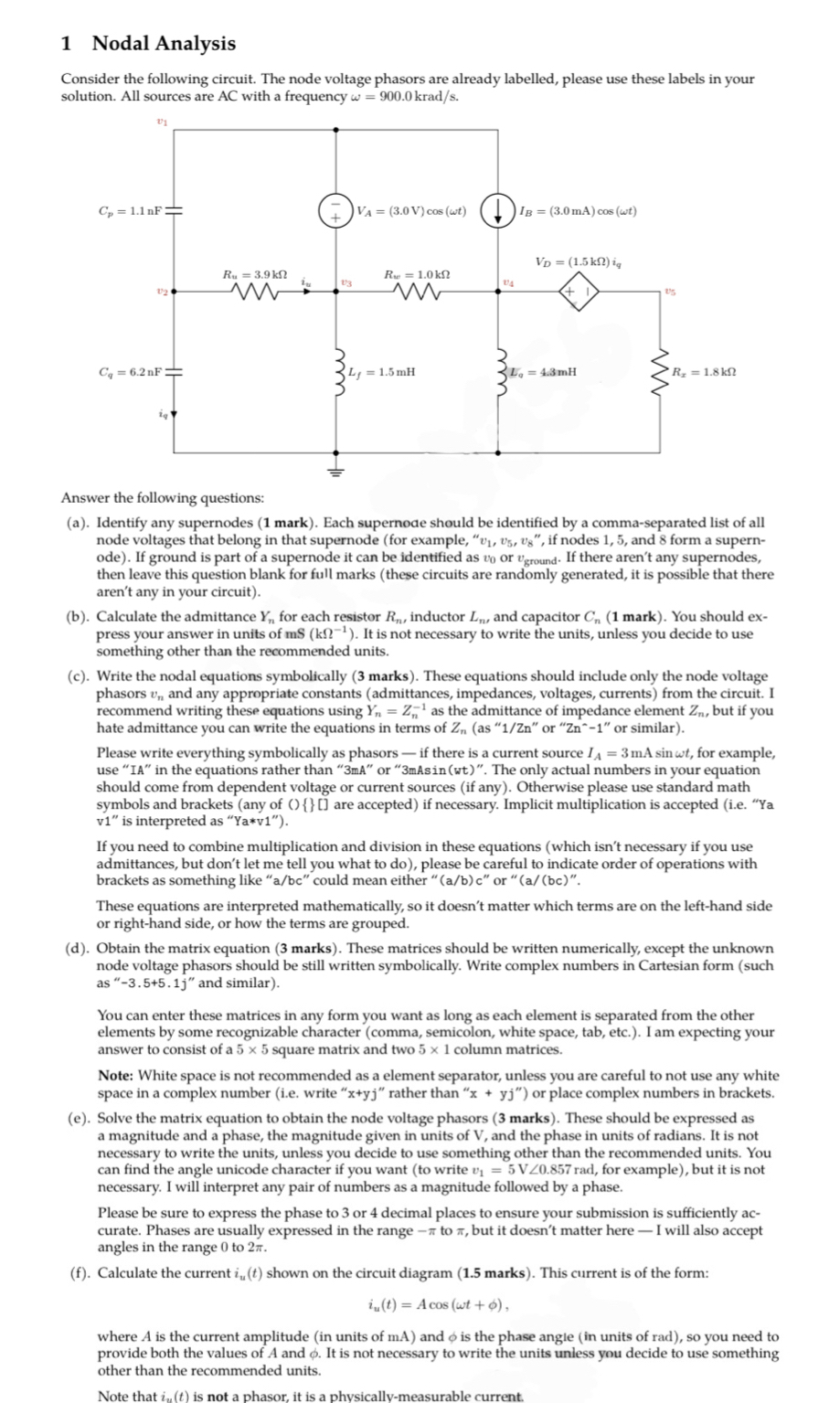
Question: 1 Nodal Analysis Consider the following circuit. The node voltage phasors are already labelled, please use these labels in your solution. All sources are AC
Nodal Analysis
Consider the following circuit. The node voltage phasors are already labelled, please use these labels in your solution. All sources are AC with a frequency kra
Answer the following questions:
a Identify any supernodes mark Each supernode should be identified by a commaseparated list of all node voltages that belong in that supernode for example, if nodes and form a supernode If ground is part of a supernode it can be identified as or If there aren't any supernodes, then leave this question blank for full marks these circuits are randomly generated, it is possible that there aren't any in your circuit
b Calculate the admittance for each resistor inductor and capacitor mark You should express your answer in units of It is not necessary to write the units, unless you decide to use something other than the recommended units.
c Write the nodal equations symbolically marks These equations should include only the node voltage phasors and any appropriate constants admittances impedances, voltages, currents from the circuit. I recommend writing these equations using as the admittance of impedance element but if you hate admittance you can write the equations in terms of as or or similar
Please write everything symbolically as phasors if there is a current source mAsin for example, use in the equations rather than mA or The only actual numbers in your equation should come from dependent voltage or current sources if any Otherwise please use standard math symbols and brackets any of are accepted if necessary. Implicit multiplication is accepted ieYa v is interpreted as Yav
If you need to combine multiplication and division in these equations which isn't necessary if you use admittances, but don't let me tell you what to do please be careful to indicate order of operations with brackets as something like abc could mean either or
These equations are interpreted mathematically, so it doesn't matter which terms are on the lefthand side or righthand side, or how the terms are grouped.
d Obtain the matrix equation marks These matrices should be written numerically, except the unknown node voltage phasors should be still written symbolically. Write complex numbers in Cartesian form such as and similar
You can enter these matrices in any form you want as long as each element is separated from the other elements by some recognizable character comma semicolon, white space, tab, etc. I am expecting your answer to consist of a square matrix and two column matrices.
Note: White space is not recommended as a element separator, unless you are careful to not use any white space in a complex number ie write rather than or place complex numbers in brackets.
e Solve the matrix equation to obtain the node voltage phasors marks These should be expressed as a magnitude and a phase, the magnitude given in units of V and the phase in units of radians. It is not necessary to write the units, unless you decide to use something other than the recommended units. You can find the angle unicode character if you want to write rad, for example but it is not necessary. I will interpret any pair of numbers as a magnitude followed by a phase.
Please be sure to express the phase to or decimal places to ensure your submission is sufficiently accurate. Phases are usually expressed in the range to but it doesn't matter here I will also accept angles in the range to
f Calculate the current shown on the circuit diagram marks This current is of the form:
Step by Step Solution
There are 3 Steps involved in it
1 Expert Approved Answer
Step: 1 Unlock

Question Has Been Solved by an Expert!
Get step-by-step solutions from verified subject matter experts
Step: 2 Unlock
Step: 3 Unlock
 Study Help