





Question: 1. Often, ows in nature involve an upper surface that can move as the uid does. This includes landslides, lava and ice sheets. In general,
1. Often, ows in nature involve an upper surface
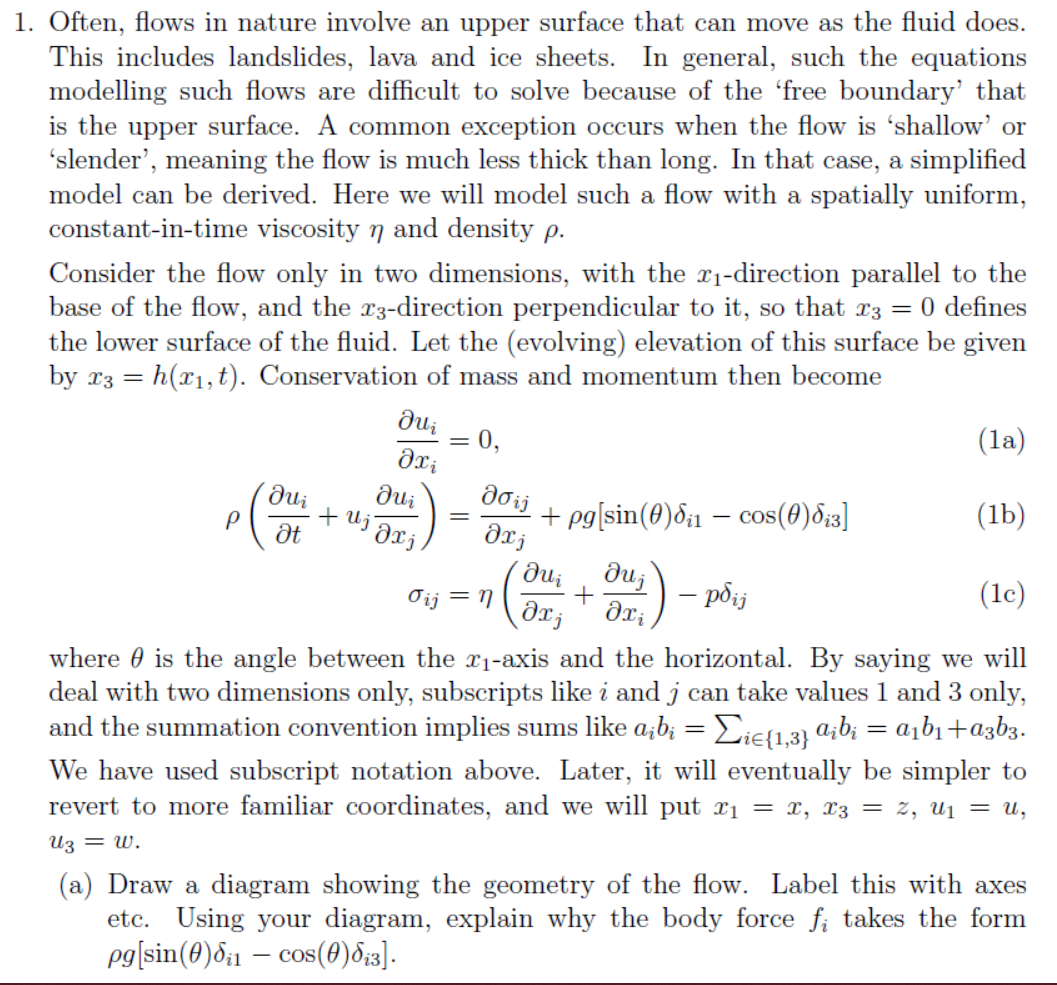
1. Often, ows in nature involve an upper surface that can move as the uid does. This includes landslides, lava and ice sheets. In general, such the equations modelling such ows are difcult to solve because of the \"free boundary" that is the upper surface. A common exception occurs when the ow is 'shallow' or 'slender', meaning the ow is much less thick than long. In that case, a. simplied model can be derived. Here we will model such a ow with a spatially uniform, constant-in-tirne viscosity 7} and density p. Consider the ow only in two dimensions, with the Il-direction parallel to the base of the ow, and the ragdirection perpendicular to it, so that $3 : 0 denes the lower surface of the uid. Let the (evolving) elevation of this surface be given by T3 = h(:r1, 1'). Conservation of mass and momentum then become au- 1 = U 1 6331' l ( 3\") 6\"\"!- 6ui 60'1" _ P ( at + W613) = 81?: +pg[sm(9)6,1 c05(9)5,3] (1b) 611-,- all} O'j Ti(6$j + 61\

Step by Step Solution

There are 3 Steps involved in it

1 Expert Approved Answer
Step: 1 Unlock blur-text-image
Question Has Been Solved by an Expert!

Get step-by-step solutions from verified subject matter experts

Step: 2 Unlock
Step: 3 Unlock

Students Have Also Explored These Related Mathematics Questions!