







Question: 1. On Problem Set 2, you interpreted the results from a simple linear regression model with concentration of cement in concrete mix (in kg/m3) as
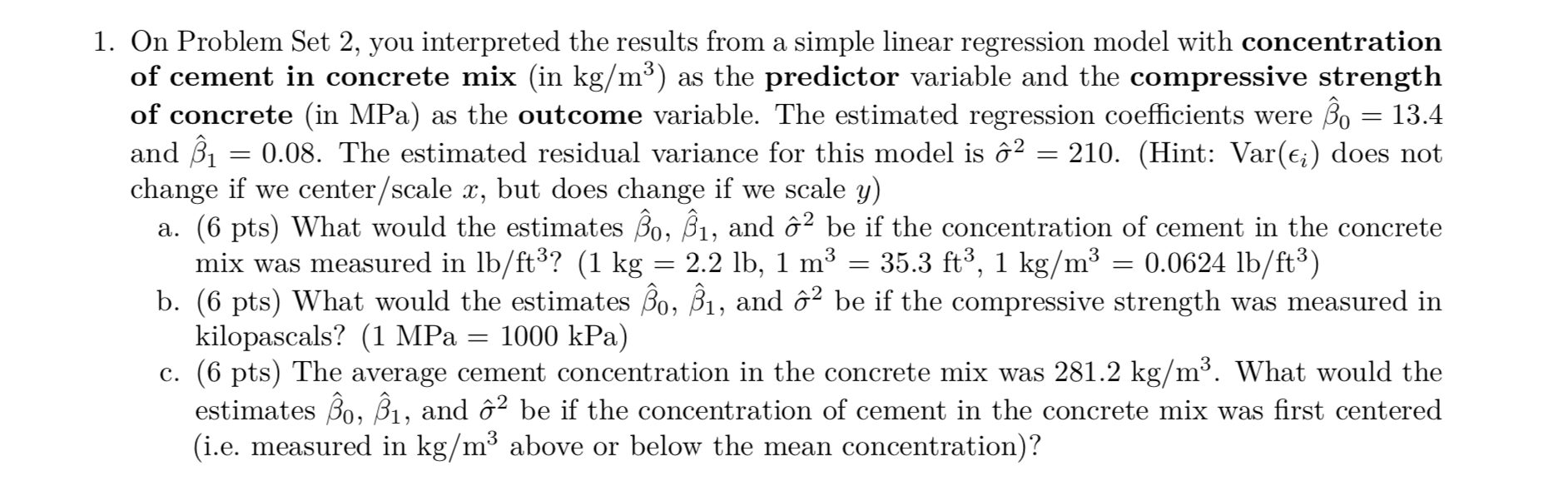
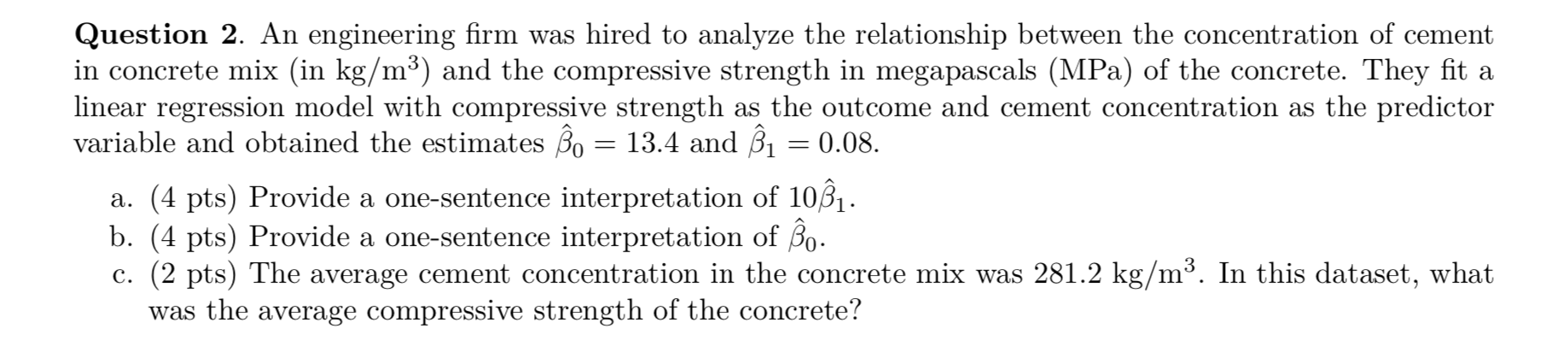
1. On Problem Set 2, you interpreted the results from a simple linear regression model with concentration of cement in concrete mix (in kg/m3) as the predictor variable and the compressive strength of concrete (in MPa) as the outcome variable. The estimated regression coefcients were 80 = 13.4 and 01 = 0.08. The estimated residual variance for this model is 62 = 210. (Hint: Var(ei) does not change if we center/ scale as, but does change if we scale y) a. (6 pts) What would the estimates g, 31, and 62 be if the concentration of cement in the concrete mix was measured in lb/ft3? (1 kg: 2. 2 lb, 1 m3 .35 3 ft3, 1 kg/m3 0. 0624 lb/f't3) b. (6 pts) What would the estimates [30, ,81, and 0'2 be if the compressive strength was measured In kilopascals? (1 MPa 1000 kPa) c. (6 pts) The average cement concentration in the concrete mix was 281.2 kg/m3. What would the estimates BO, 81: and 62 be if the concentration of cement in the concrete mix was rst centered (i.e. measured in kg/m3 above or below the mean concentration)? Question 2. An engineering firm was hired to analyze the relationship between the concentration of cement in concrete mix (in kg/m3) and the compressive strength in megapascals (MPa) of the concrete. They fit a linear regression model with compressive strength as the outcome and cement concentration as the predictor variable and obtained the estimates Bo = 13.4 and B1 = 0.08. a. (4 pts) Provide a one-sentence interpretation of 1031. b. (4 pts) Provide a one-sentence interpretation of Bo. c. (2 pts) The average cement concentration in the concrete mix was 281.2 kg/mo. In this dataset, what was the average compressive strength of the concrete
Step by Step Solution
There are 3 Steps involved in it

Get step-by-step solutions from verified subject matter experts
 Study Help