





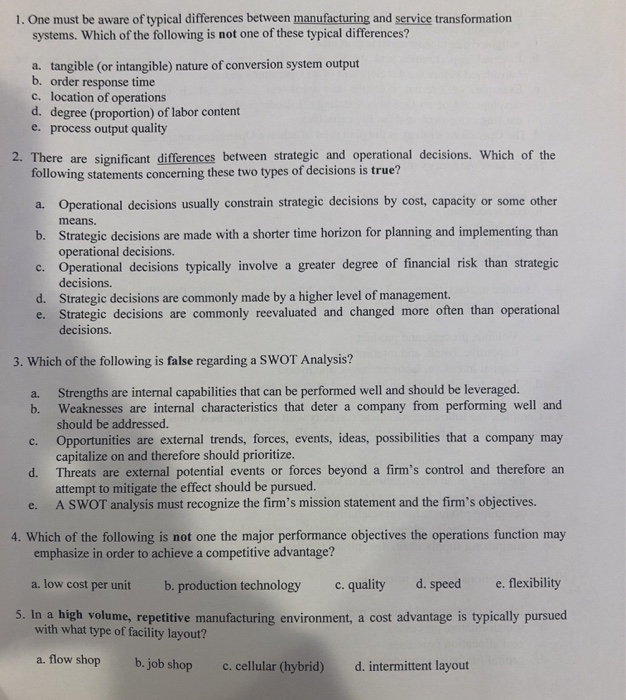
Question: 1. One must be aware of typical differences between manufacturing and service transformation systems. Which of the following is not one of these typical differences?
1. One must be aware of typical differences
1. One must be aware of typical differences between manufacturing and service transformation systems. Which of the following is not one of these typical differences? a. tangible (or intangible) nature of conversion system output b. order response time c. location of operations d. degree (proportion) of labor content e. process output quality 2. There are significant differences between strategic and operational decisions. Which of the following statements concerning these two types of decisions is true? a. Operational decisions usually constrain strategic decisions by cost, capacity or some other means. b. Strategic decisions are made with a shorter time horizon for planning and implementing than operational decisions. c. Operational decisions typically involve a greater degree of financial risk than strategic decisions. d. Strategic decisions are commonly made by a higher level of management. e. Strategic decisions are commonly reevaluated and changed more often than operational decisions. 3. Which of the following is false regarding a SWOT Analysis? a. b. c. Strengths are internal capabilities that can be performed well and should be leveraged. Weaknesses are internal characteristics that deter a company from performing well and should be addressed. Opportunities are external trends, forces, events, ideas, possibilities that a company may capitalize on and therefore should prioritize. Threats are external potential events or forces beyond a firm's control and therefore an attempt to mitigate the effect should be pursued. A SWOT analysis must recognize the firm's mission statement and the firm's objectives. d. e. 4. Which of the following is not one the major performance objectives the operations function may emphasize in order to achieve a competitive advantage? a. low cost per unit b. production technology c. quality d. speed e. flexibility 5. In a high volume, repetitive manufacturing environment, a cost advantage is typically pursued with what type of facility layout? a. now shop b. job shop c. cellular (hybrid) d. intermittent layout

Step by Step Solution

There are 3 Steps involved in it

1 Expert Approved Answer
Step: 1 Unlock blur-text-image

Question Has Been Solved by an Expert!

Get step-by-step solutions from verified subject matter experts

Step: 2 Unlock
Step: 3 Unlock

Students Have Also Explored These Related General Management Questions!