







Question: 1 Overview In this assignment we will use inheritance to represent several different kinds of card payment methods. You will implement classes representing: 1. A
1 Overview
In this assignment we will use inheritance to represent several different kinds of card payment methods. You will implement classes representing:
1. A pre-paid gift card 2. A credit card with a hard credit limit 3. A debit card with opt-in overdraft (and a $35 fee) 4. A debit card with overdraft protection linked to a secondary account
A test driver has been supplied for you. No user input or output will be necessary for this program.
2 Requirements
You will first need to implement an Account class, which will be linked to two kinds of debit cards (opt-in overdraft and overdraft protection). You should implement this class according to the following UML diagram. Be sure to include a small comment for at least each non-trivial method.
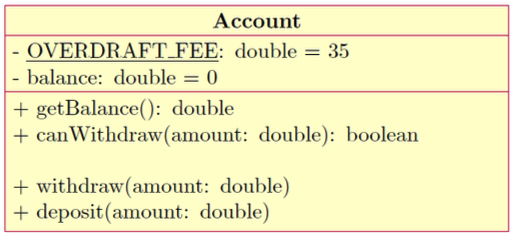
The canWithdraw method returns true if there are sufficient funds to with- draw $amount. The deposit and withdraw methods are basic mutator methods, except you will charge an additional $35 fee when there are insufficient funds for a withdrawl. Notice that we have a static member OVERDRAFT_FEE. This is used to give a self-documenting name to an otherwise magic constant. Do not have numeric literals floating around in your program. They are hard to track down and are not easily explained by context. Give them a name, as we do here.
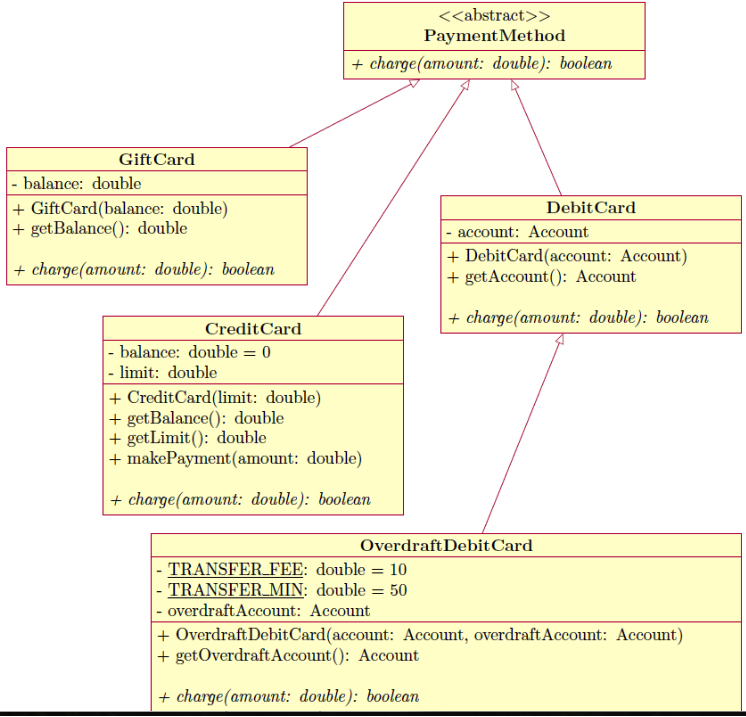
Next, you must implement a class hierarchy for payment methods described by the following UML diagram. Notice that all the concrete classes (directly or indirectly) inherit PaymentMethod. Also notice that PaymentMethod is marked as abstract (as it has no implementation for the charge method without knowing what kind of payment method it is). Since this class has only abstract members and no data, you could convert this abstract class into an interface (but is not required).
The charge method for every concrete class will either successfully charge the given amount (and possibly some related fee) and return true, or realize that theres a problem (insufficient funds, reached credit limit, etc) and return false. If false is returned no other observable changes should have taken place (if a card is declined, no funds should have moved).
The GiftCard payment method is pre-loaded with some amount set in the constructor. Charging a gift card is only successful if there is a sufficient balance on the card.
The CreditCard payment method starts with a zero-balance and a hard limit set in the constructor. Charging a credit card is successful if the balance after the charge does not exceed the credit limit.
The DebitCard payment method is linked to a bank account. A charge is successful always, but the charge may incur an (opt-in) overdraft fee if the balance of the account becomes (or remains) negative.
The OverdraftDebitCard payment method is the most complex. The charge method will first check if there are insufficient funds in the primary account (the one defined in the superclass). If the primary account would overdraft, we attempt to move some amount of funds from the overdraft account to the primary account, and then process the charge as a normal debit card would.
Remember that you can call a superclass method from a subclass - do not duplicate the logic in DebitCards charge method in the subclass.
Suppose that we are charging $150 to an account with only $35. We need an additional $115 so that we do not overdraft. In this specific case, we transfer $150 dollars from the overdraft account to the primary account, and charge the overdraft account a $10 fee. We transfer $150 because we must transfer at least $115, but must always transfer a multiple of $50. Notice that if the overdraft account has insufficient funds for the transfer (and the fee) it does not do it, and instead charges a regular overdraft fee to the primary account. This behavior is identical to the superclass behavior.
Account OVERDRAFT FEE: double 35 balance: double=0 balance: ddouble- + getBalance(): double +canWithd raw amount: double): boolean + withdraw(amount: double) + deposit (amount: double)
Step by Step Solution
There are 3 Steps involved in it

Get step-by-step solutions from verified subject matter experts
 Study Help