







Question: (1 page in length) Chapter 11 (Global Shift) points out to types of code of conduct related to the corporate social responsibility (CSR) and then
(1 page in length) Chapter 11 (Global Shift) points out to types of code of conduct related to the
corporate social responsibility (CSR) and then enumerates 10 principles associated with the UN Global Compact. Carefully discuss and carefully elaborate issues involved.
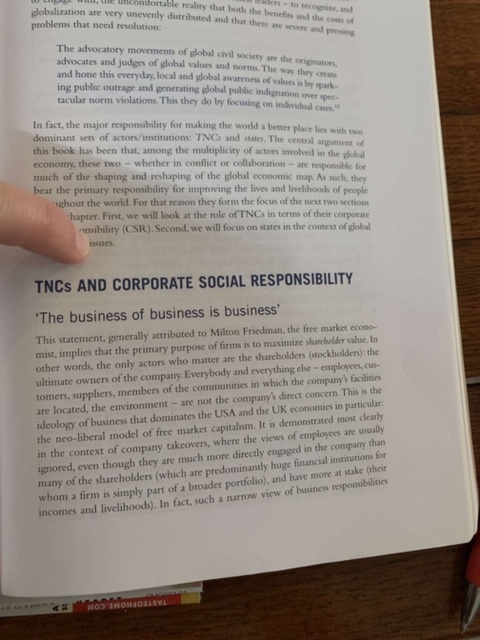
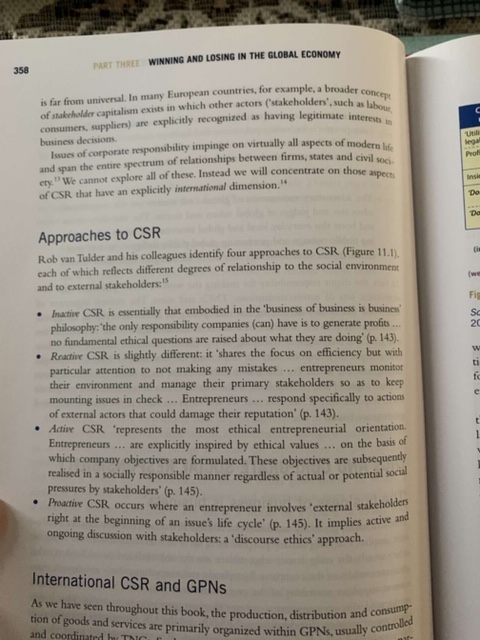
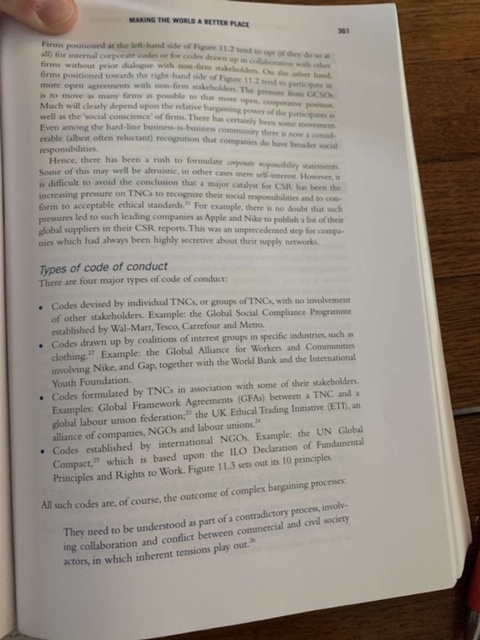
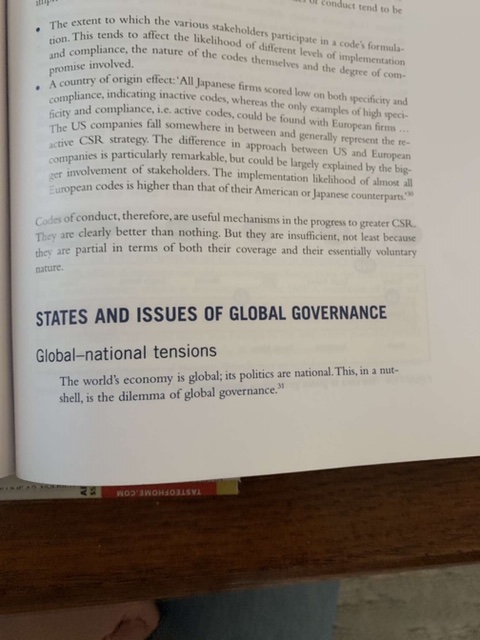
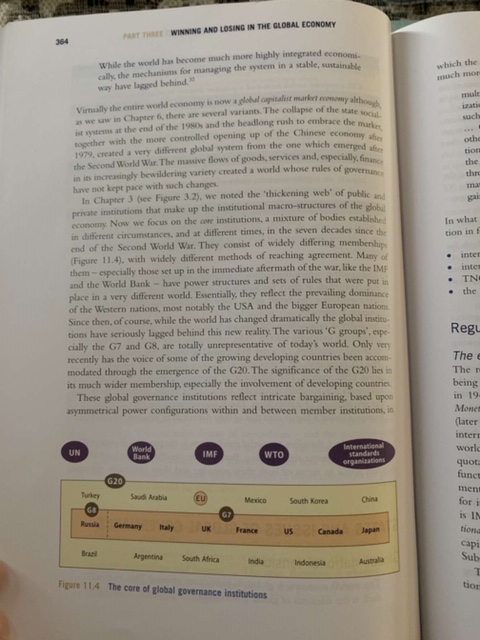
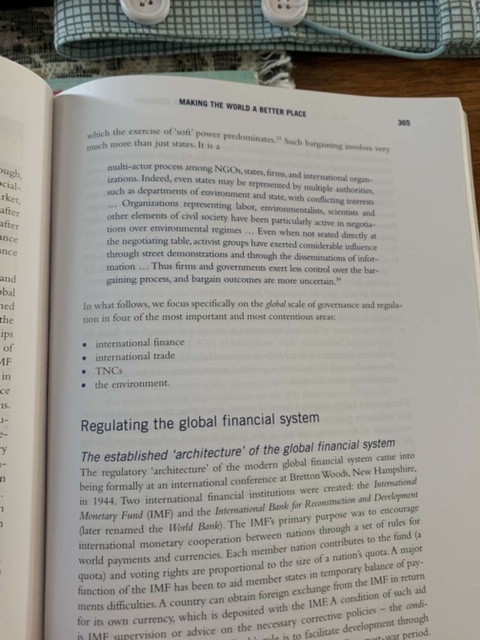
- to recognize, and Uncomfortable reality that both the benefits and the cost of haluation are very unevenly distributed and that there are severend problems that need resolution: The advocatory movements of obal civil society are the cates and judges of obal values and norms. The woch and hone this everyday, local and global wareness of values is by ing public outrage and generating global public indignation over per tacular norm violations. This they do by focusing on individual In fact, the major responsibility for making the world a better place with dominant sets of actors/institutions: TNC and states. The central of this book has been that, among the multiplicity of actors involved in the dotal economy, these two - whether in conflict or collaboration - are responsible for much of the shaping and reshaping of the global economic map. As such, they bear the primary responsibility for improving the lives and livelihoods of people ghout the world. For that reason they form the focus of the next two sections hapter. First, we will look at the role of TNCs in terms of their corporate insibility (CSR). Second, we will focus on states in the context of global issues. TNCS AND CORPORATE SOCIAL RESPONSIBILITY 'The business of business is business' This statement, generally attributed to Milton Friedman, the free market econo mist, implies that the primary purpose of firms is to maximize shareholder value. In other words, the only actors who matter are the shareholders (stockholders: the ultimate owners of the company. Everybody and everything else-employees, cu tomers, suppliers, members of the communities in which the company facilities are located, the environment are not the company's direct concern. This is the ideology of business that dominates the USA and the UK economies in particular the neo-liberal model of free market capitalism. It is demonstrated most dearly in the context of company takeovers, where the views of employees are usually gonored, even though they are much more directly engaged in the company than many of the shareholders (which are predominantly huge financial institutions for whom a firm is simply part of a broader portfolio), and have more at stake their incomes and livelihoods). In fact, such a narrow view of business responsibilities WOWOHLOUISVL 358 PART THREE WINNING AND LOSING IN THE GLOBAL ECONOMY broader concept ers, such as labour gitimate interests in is far from universal. In many European countries, for example, a broader of stakeholder capitalism exists in which other actors ('stakeholders', such consumers, suppliers) are explicitly recognized as having legitimate inte business decisions Issues of corporate responsibility impinge on virtually all aspects of mode and ran the entire spectrum of relationships between firms, states and civil cry, we cannot explore all of these. Instead we will concentrate on those of CSR that have an explicitly international dimension." 3288 Approaches to CSR Rob van Tulder and his colleagues identify four approaches to CSR (Figure 11.1) cach of which reflects different degrees of relationship to the social environment and to external stakeholders: In CSR is essentially that embodied in the business of business is business philosophy: the only responsibility companies (can) have is to generate profits no fundamental ethical questions are raised about what they are doing' (p. 143). Reactive CSR is slightly different: it shares the focus on efficiency but with particular attention to not making any mistakes ... entrepreneurs monitor their environment and manage their primary stakeholders so as to keep mounting issues in check ... Entrepreneurs ... respond specifically to action of external actors that could damage their reputation' (p. 143). Active CSR represents the most ethical entrepreneurial orientation Entrepreneurs ... are explicitly inspired by ethical values ... on the basis of which company objectives are formulated. These objectives are subsequently realised in a socially responsible manner regardless of actual or potential soch pressures by stakeholders' (p. 145). Proactive CSR occurs where an entrepreneur involves 'external stakehold right at the beginning of an issue's life cycle' (p. 145). It implies active ongoing discussion with stakeholders: a 'discourse ethics' approach. International CSR and GPNS As we have seen throughout this book, the production, distribution and a fion of goods and services are primarily organized within GPNs, usually and coordinated by THC, ution and consump- s usually controlled MAKING THE WORLD A BETTER PLACE for corporate codes or borcedes firms patined towards the bande och more on crements with non-makholder The Much will clearly depend upon the relative br o ther ll as the social conscience of There has been E among the hand-line business es com here e albeit often reluctant recognition that companie de v a r responsabilities i Hense, there has been a rush to formulate me t e of this may well be rustic, in other care mere en uticult to avoid the conclusion that a major catalyst for CSR been the n g pressure on INC to recognize their social responsibilities and to con to acceptable ethical standards. For example, there is no doubt that wch ressures led to such leading companies as Apple and Nike to publish a lot of their Sahal suppliers in their CSR reports. This was an unprecedented step for compa nies which had always been highly secretive about their supply networks Types of code of conduct There are four major types of code of conduct: Codes devised by individual TNCs, or groups of TNC, with no involvement of other stakeholders. Example: the Global Social Compliance Programme established by Wal-Mart, Tesco, Carrefour and Metro Codes drawn up by coalitions of interest groups in specific industries, such clothing." Example: the Global Alliance for Workers and Communities involving Nike, and Gap, together with the World Bank and the International Youth Foundation Codes formulated by TNCs in association with some of their stakeholders. Examples: Global Framework Agreements (GFA) between a TNC and a global Labour union federation; the UK Ethical Trading Initiative (ETT), an alliance of companies, NGOs and labour unions. Codes established by international NGOs. Example: the UN Global Compact, which is based upon the ILO Declaration of Fundamental Principles and Rights to Work. Figure 11.3 sets out its 10 principles. All such codes are, of course, the outcome of complex bargaining processes They need to be understood as part of a contradictory process, involv ing collaboration and conflict between commercial and civil society actors, in which inherent tensions play out conduct tend to be to which the various stakeholders participate in a codes formula ends to affect the likelihood of different levels of implementation ance, the nature of the codes themselves and the degree of com- The extent to which tion. This tends to and compliance, the promise involved. . A country of origin compliance, indicati ficity and compliance, i.e. The US companies fall somew active CSR strategy. The companies is particularly rem ger involvement of stak European codes is higher than of origin effect. All Japanese firms scored low on both specificity and ce indicating inactive codes, whereas the only examples of high speci- and compliance, 1.e. active codes, could be found with European firms... is companies fall somewhere in between and generally represent the re- CSR strategy. The difference in approach between US and European nies is particularly remarkable, but could be largely explained by the big mwolvement of stakeholders. The implementation likelihood of almost all un codes is higher than that of their American or Japanese counterparts." of conduct, therefore, are useful mechanisms in the progress to greater CSR. are clearly better than nothing. But they are insufficient, not least because who are partial in terms of both their coverage and their essentially voluntary nature. STATES AND ISSUES OF GLOBAL GOVERNANCE Global-national tensions The world's economy is global; its politics are national. This, in a nut- shell, is the dilemma of global governance." WONOSOBISVI T W INNING AND LOSING IN THE GLOBAL ECONOMY which the While the world has become much more highly integrated economi call the mechanisms for managing the system in a stable, sustainak way have and behind et commy although rush to embrace the make such oth the thin In what tion in Virtually the entire world economy is now a lokal market anale w ww in Chapter 6, there are several variants. The collapse of the state ist wstems at the end of the 19ts and the headlong rush to embrace the together with the more controlled opening up of the Chinese economy 19 t ed a very different global system from the one which emer the Second World War. The massive flows of goods, services and, especially, fin i s increasingly bewildering variety created a world whose rules of govern have not kept pace with such changes In Chapter 3 (see Figure 3.2), we noted the 'thickening web' of public private institutions that make up the institutional macro-structures of the economy. Now we focus on the core institutions, a mixture of bodies establishe in different circumstances, and at different times, in the seven decades since the end of the Second World War. They consist of widely differing membership (Figure 11.4). with widely different methods of reaching agreement. Many of them - especially those set up in the immediate aftermath of the war, like the IME and the World Bank - have power structures and sets of rules that were put place in a very different world. Essentially, they reflect the prevailing dominance of the Western nations, most notably the USA and the bigger European nations Since then, of course, while the world has changed dramatically the global institu tions have seriously lagged behind this new reality. The various 'G groups, espe- cially the G7 and G8, are totally unrepresentative of today's world. Only very recently has the voice of some of the growing developing countries been accom modated through the emergence of the G20. The significance of the G20 lies in its much wider membership, especially the involvement of developing countries These global governance institutions reflect intricate bargaining, based upon asymmetrical power configurations within and between member institutions, in inter inte TN the Regy UN World Bank IMF WTO International standards organisations The The being in 19 Monet (later inter world quot functe ment for i is IN tionc Sub 620 Turkey Saudi Arabia EU Mexico South Korea China Russia Germany Italy UK France Canada Japan Argentina South Africa India Indonesia A Figure 114 The core of global governance institutions tion MAKING THE WORLD A BETTER PLACE the exercise of soft power predominates. Suchbarining i ch more than just states. It is s very ugh cial rker after after actor process among NGOs, states, forms, and international oran- rations. Indeed, even states may be represented by m ile who chas departments of environment and state with comic s Organizations representing labor, environmental scientists and other elements of civil society have been particularly active in tions over environmental regimes. Even when not seated directly at the negotiating table, activist groups have exerted considerable influence through street demonstrations and through the disseminations of infor mation ... Thus firms and governments exert less control over the bar gaining process, and bargain outcomes are more uncertain. ance ance and obal ned the In what follows, we focus specifically on the global scale of governance and regula tion in four of the most important and most contentious areas: of international finance international trade TNCS the environment. SYS. Regulating the global financial system The established 'architecture of the global financial system The regulatory architecture of the modern global financial system came into being formally at an international conference at Bretton Woods, New Hampshire in 1944. Two international financial institutions were created: the International Monetary Fund (IMF) and the International Bank for Reconstruction and Development (later renamed the World Bank). The IMF's primary purpose was to encourage international monetary cooperation between nations through a set of rules for world payments and currencies. Each member nation contributes to the funda quota) and voting rights are proportional to the size of a nation's quota. A major function of the IMF has been to aid member states in temporary balance of pay- ments difficulties. A country can obtain foreign exchange from the its own currency, which is deposited with the IME A condition of such and MF Supervision or advice on the necessary corrective policies - the and mole is to facilitate development through www period
Step by Step Solution
There are 3 Steps involved in it
1 Expert Approved Answer
Step: 1 Unlock

Question Has Been Solved by an Expert!
Get step-by-step solutions from verified subject matter experts
Step: 2 Unlock
Step: 3 Unlock
 Study Help