







Question: 1 Part I Basic Number Theory 1. Compute p(n) for n 2, 5, 6, 8, 12. 2. Compute 24 mod 5 36 mod 7 45
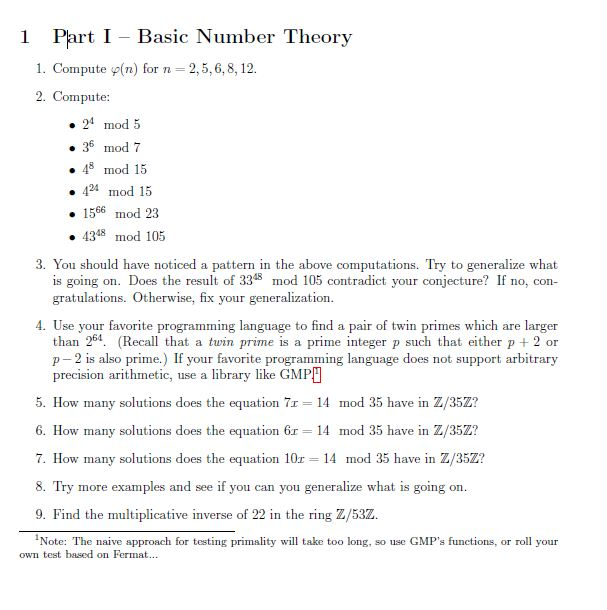
1 Part I Basic Number Theory 1. Compute p(n) for n 2, 5, 6, 8, 12. 2. Compute 24 mod 5 36 mod 7 45 mod 15 424 mod 15 15 mod 23. 4348 mod 105 3. You should have noticed a pattern in the above computations. Try to generalize what is going on. Does the result of 33 mod 105 contradict your conjecture? If no, con- gratulations. Otherwise, fix your generalization. 4. Use your favorite programming language to find a pair of twin primes which are larger than 2 (Recall that a twin prime is a prime integer p such that either p 2 or 64 p-2 is also prime.) If your favorite programming language does not support arbitrary precision arithmetic, use a library like GMP 5. How many solutions does the equation 7r 14 mod 35 have in z/35Z? 6. How many solutions does the equation 6r 14 mod 35 have in Z/35Z? 7. How many solutions does the equation 10a 14 mod 35 have in Z/35Z? 8. Try more examples and see if you can you generalize what is going on 9. Find the multiplicative inverse of 22 in the ring Z/53Z. Note: The naive approach for testing primality will take too long, so use GMP's functions, or roll your own test based on Fermat
Step by Step Solution
There are 3 Steps involved in it

Get step-by-step solutions from verified subject matter experts
 Study Help