







Question: 1. payback period , 2. payback comparisons 3. NPV 1. Payback period. Jordan Enterprises is considering a capital expenditure that requires an initial investment of
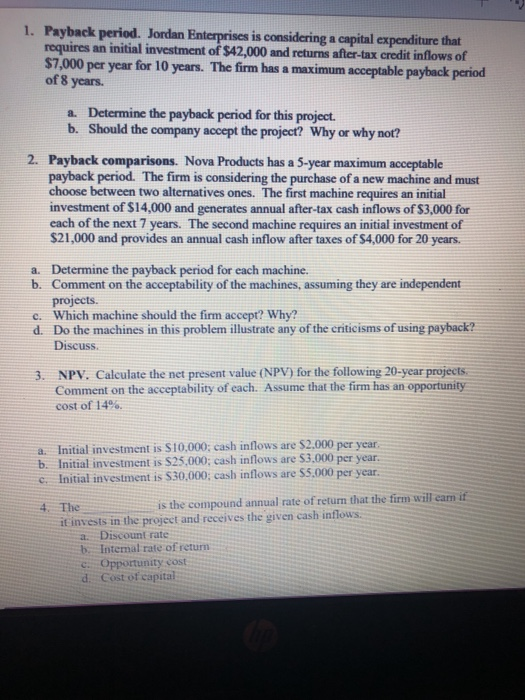
1. Payback period. Jordan Enterprises is considering a capital expenditure that requires an initial investment of $42,000 and returns after-tax credit inflows of $7,000 per year for 10 years. The firm has a maximum acceptable payback period of 8 years. a. Determine the payback period for this project. b. Should the company accept the project? Why or why not? 2. Payback comparisons. Nova Products has a 5-year maximum acceptable payback period. The firm is considering the purchase of a new machine and must choose between two alternatives ones. The first machine requires an initial investment of $14,000 and generates annual after-tax cash inflows of $3,000 for each of the next 7 years. The second machine requires an initial investment of $21,000 and provides an annual cash inflow after taxes of $4,000 for 20 years. a. Determine the payback period for each machine. b. Comment on the acceptability of the machines, assuming they are independent projects. c. Which machine should the firm accept? Why? d. Do the machines in this problem illustrate any of the criticisms of using payback? Discuss 3. NPV. Calculate the net present value (NPV) for the following 20-year projects, Comment on the acceptability of each. Assume that the firm has an opportunity cost of 14%. a. Initial investment is $10,000: cash inflows are $2.000 per year. b. Initial investment is $25.000: cash inflows are $3.000 per year. c. Initial investment is $30,000; cash inflows are $5,000 per year. 4 The is the compound annual rate of return that the firm will eam if it invests in the project and receives the given cash inflows. a. Discount rate b. Intemal rate of return c. Opportunity cost d. Cost of capital
Step by Step Solution
There are 3 Steps involved in it

Get step-by-step solutions from verified subject matter experts
 Study Help