



Question: 1. Perform the following unit conversion (Show the full details of your work): a. 132 in. to L. b. 878.17 ft.lbf to KJ c.
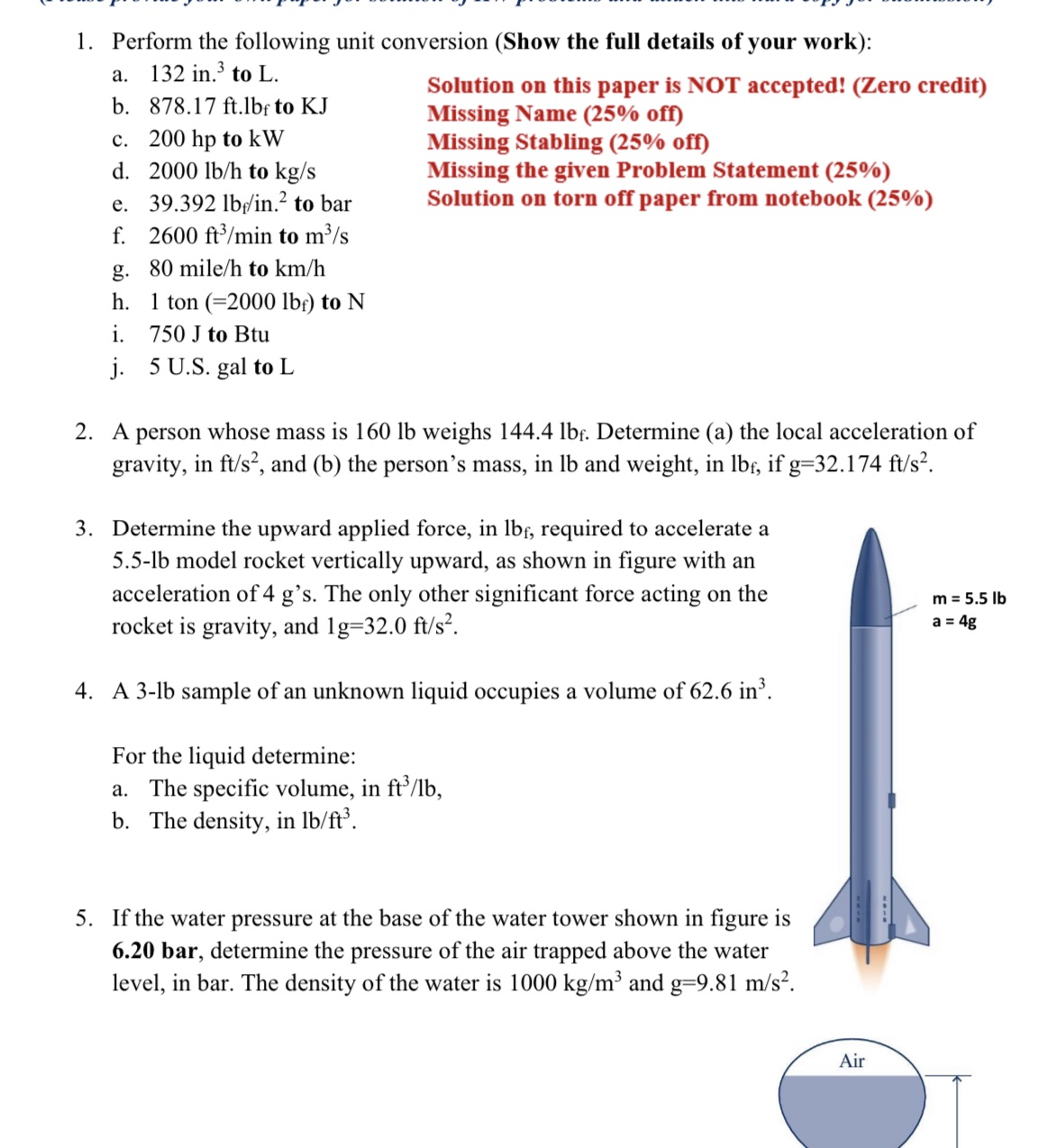
1. Perform the following unit conversion (Show the full details of your work): a. 132 in. to L. b. 878.17 ft.lbf to KJ c. 200 hp to kW d. 2000 lb/h to kg/s e. 39.392 lb/in. to bar f. 2600 ft/min to m/s Solution on this paper is NOT accepted! (Zero credit) Missing Name (25% off) Missing Stabling (25% off) Missing the given Problem Statement (25%) Solution on torn off paper from notebook (25%) g. 80 mile/h to km/h 1 ton (=2000 lbf) to N 750 J to Btu h. i. j. 5 U.S. gal to L 2. A person whose mass is 160 lb weighs 144.4 lbf. Determine (a) the local acceleration of gravity, in ft/s, and (b) the person's mass, in lb and weight, in lbf, if g=32.174 ft/s. 3. Determine the upward applied force, in lbf, required to accelerate a 5.5-lb model rocket vertically upward, as shown in figure with an acceleration of 4 g's. The only other significant force acting on the rocket is gravity, and 1g=32.0 ft/s. 4. A 3-lb sample of an unknown liquid occupies a volume of 62.6 in. For the liquid determine: a. The specific volume, in ft/lb, b. The density, in lb/ft. m = 5.5 lb a = 4g 5. If the water pressure at the base of the water tower shown in figure is 6.20 bar, determine the pressure of the air trapped above the water level, in bar. The density of the water is 1000 kg/m and g=9.81 m/s. Air
Step by Step Solution
There are 3 Steps involved in it

Get step-by-step solutions from verified subject matter experts