



Question: 1. Please answer all the questions on the picture below. I know it's a lot of work but I am really stumped here and my
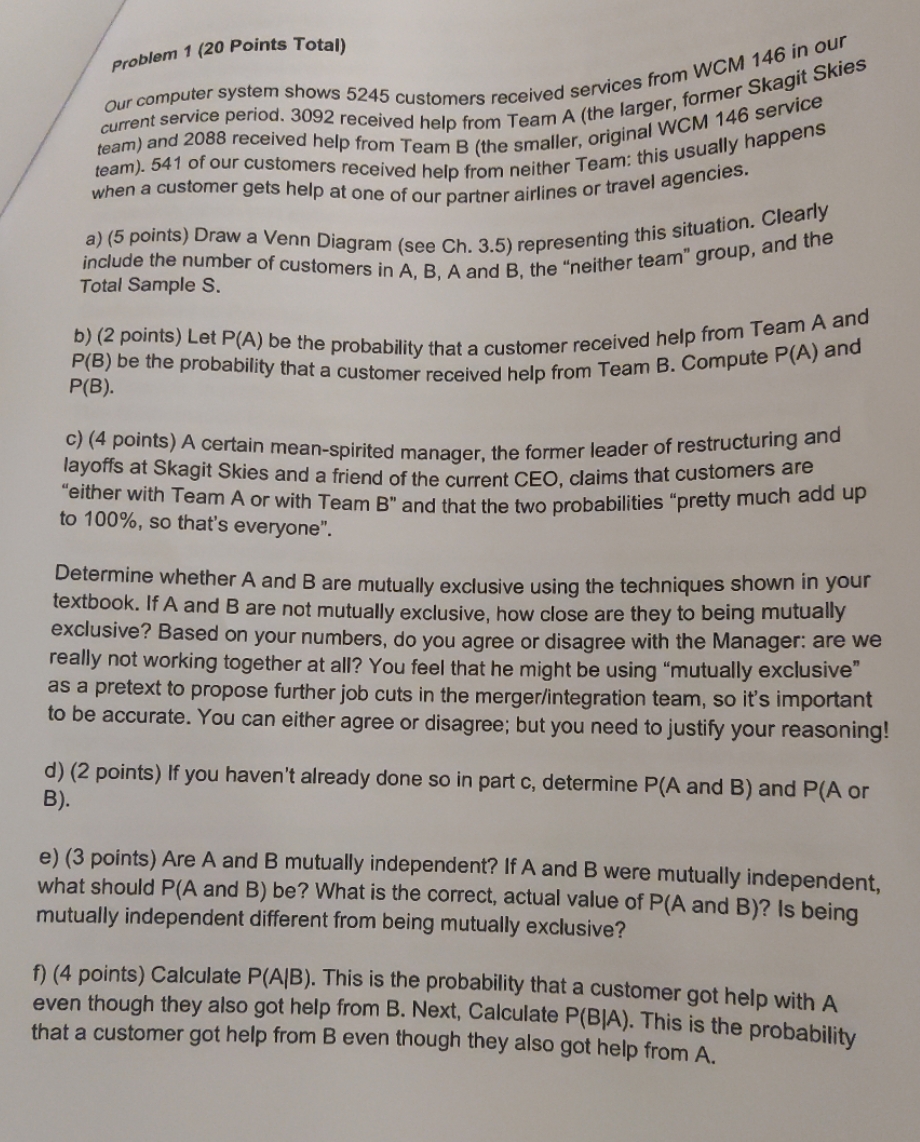
1. Please answer all the questions on the picture below. I know it's a lot of work but I am really stumped here and my teacher isn't much help. I will be leaving the background information in the chat and I will be rating highly. Thank You!!!
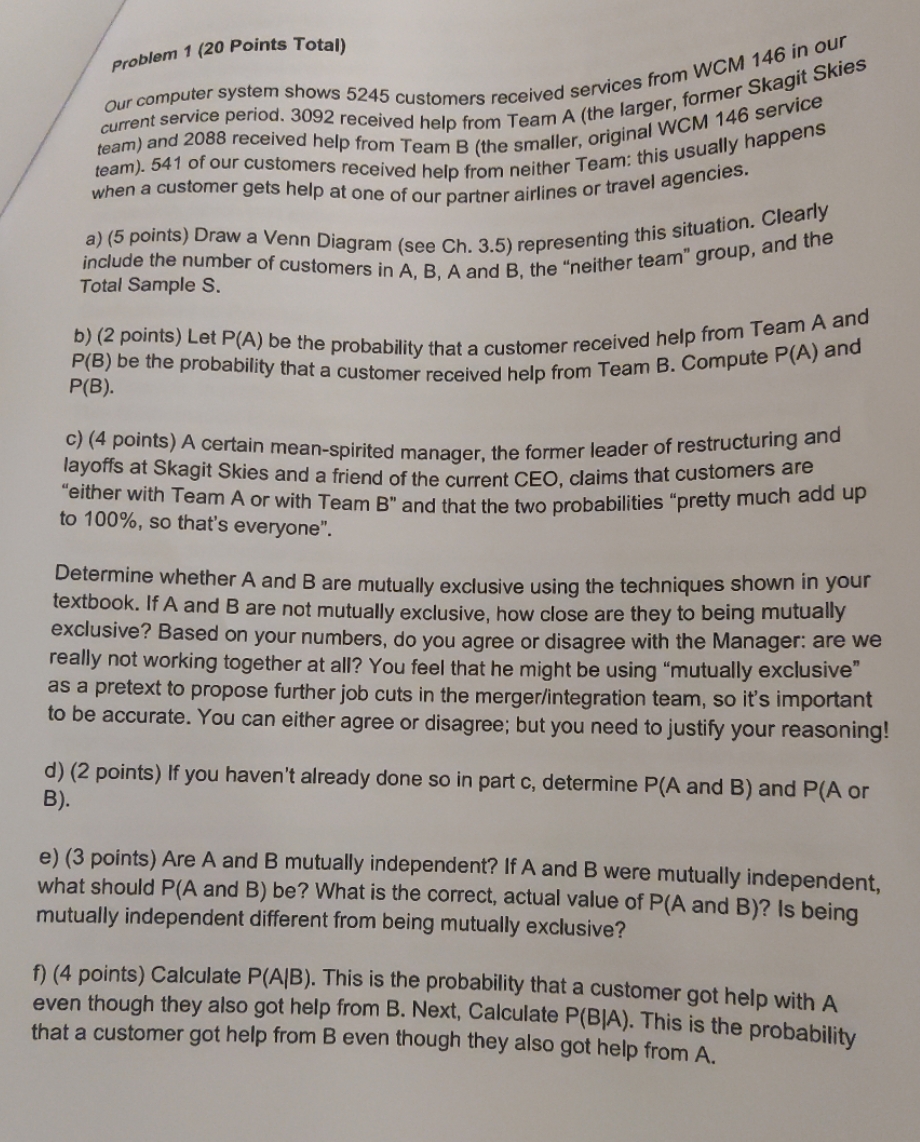
Problem 1 (20 Points Total) our computer system shows 5245 customers received services from WCM 146 in our current service period. 3092 received help from Team A (the larger, former Skagit Skies (6am) and 2088 received help from Team B (the smaller, original WCM 146 service team). 541 of our customers received help from neither Team: this usually happens when a customer gets help at one of our partner airlines or travel agencies. a) (5 points) Draw a Venn Diagram (see Ch. 3.5) representing this situation. Clearly include the number of customers in A, B, A and B, the "neither team" group, and the Total Sample S. b) (2 points) Let P(A) be the probability that a customer received help from Team A and P(B) be the probability that a customer received help from Team B. Compute P(A) and P (B). c) (4 points) A certain mean-spirited manager, the former leader of restructuring and layoffs at Skagit Skies and a friend of the current CEO, claims that customers are "either with Team A or with Team B" and that the two probabilities "pretty much add up to 100%, so that's everyone". Determine whether A and B are mutually exclusive using the techniques shown in your textbook. If A and B are not mutually exclusive, how close are they to being mutually exclusive? Based on your numbers, do you agree or disagree with the Manager: are we really not working together at all? You feel that he might be using "mutually exclusive" as a pretext to propose further job cuts in the merger/integration team, so it's important to be accurate. You can either agree or disagree; but you need to justify your reasoning! d) (2 points) If you haven't already done so in part c, determine P(A and B) and P(A or B). e) (3 points) Are A and B mutually independent? If A and B were mutually independent, what should P(A and B) be? What is the correct, actual value of P(A and B)? Is being mutually independent different from being mutually exclusive? f) (4 points) Calculate P(A|B). This is the probability that a customer got help with A even though they also got help from B. Next, Calculate P(BIA). This is the probability that a customer got help from B even though they also got help from A
Step by Step Solution
There are 3 Steps involved in it

Get step-by-step solutions from verified subject matter experts