







Question: (1 point) Consider a 2-year $5000 par value bond that pays semi-annual coupons at a rate of c(2) = 4%. Suppose that the bond was
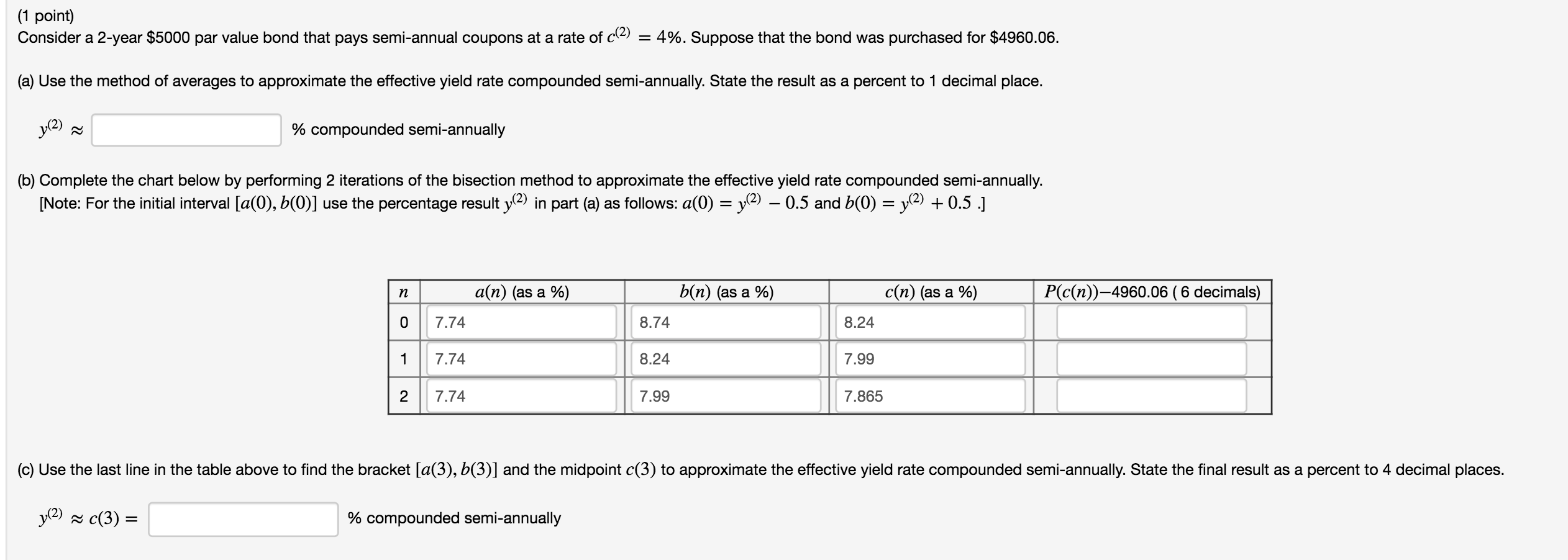
(1 point) Consider a 2-year $5000 par value bond that pays semi-annual coupons at a rate of c(2) = 4%. Suppose that the bond was purchased for $4960.06. (a) Use the method of averages to approximate the effective yield rate compounded semi-annually. State the result as a percent to 1 decimal place. y(2) % compounded semi-annually (b) Complete the chart below by performing 2 iterations of the bisection method to approximate the effective yield rate compounded semi-annually. [Note: For the initial interval [a(0), 6(0)] use the percentage result yl2) in part (a) as follows: a(0) = y(2) 0.5 and b(0) = y(2) + 0.5 .) n a(n) (as a %) b(n) (as a %) c(n) (as a %) P(c(n))4960.06 (6 decimals) 0 7.74 8.74 8.24 1 7.74 8.24 7.99 2 7.74 7.99 7.865 (c) Use the last line in the table above to find the bracket [a(3), b(3)] and the midpoint c(3) to approximate the effective yield rate compounded semi-annually. State the final result as a percent to 4 decimal places. y(2) = c(3) = % compounded semi-annually (1 point) Consider a 2-year $5000 par value bond that pays semi-annual coupons at a rate of c(2) = 4%. Suppose that the bond was purchased for $4960.06. (a) Use the method of averages to approximate the effective yield rate compounded semi-annually. State the result as a percent to 1 decimal place. y(2) % compounded semi-annually (b) Complete the chart below by performing 2 iterations of the bisection method to approximate the effective yield rate compounded semi-annually. [Note: For the initial interval [a(0), 6(0)] use the percentage result yl2) in part (a) as follows: a(0) = y(2) 0.5 and b(0) = y(2) + 0.5 .) n a(n) (as a %) b(n) (as a %) c(n) (as a %) P(c(n))4960.06 (6 decimals) 0 7.74 8.74 8.24 1 7.74 8.24 7.99 2 7.74 7.99 7.865 (c) Use the last line in the table above to find the bracket [a(3), b(3)] and the midpoint c(3) to approximate the effective yield rate compounded semi-annually. State the final result as a percent to 4 decimal places. y(2) = c(3) = % compounded semi-annually
Step by Step Solution
There are 3 Steps involved in it

Get step-by-step solutions from verified subject matter experts
 Study Help