







Question: (1 point) Consider the function / (2) = 7+e (a) f(x) . (0) f is increasing for I E (c) f is decreasing for I
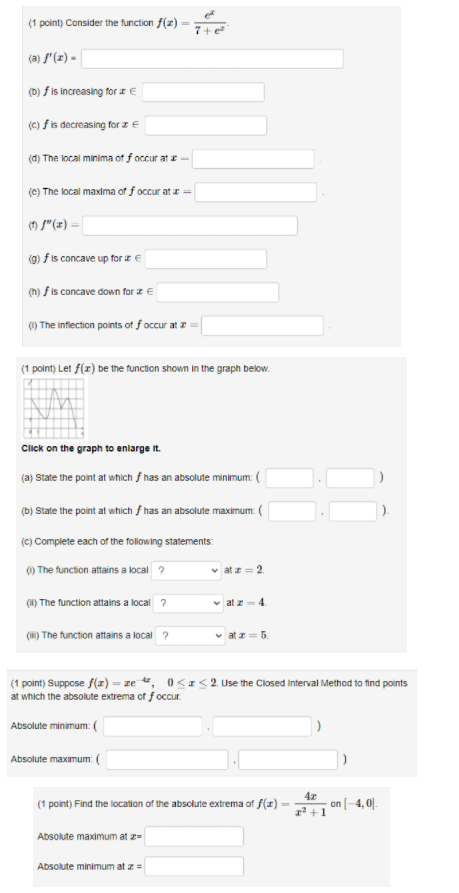
(1 point) Consider the function / (2) = 7+e (a) f(x) . (0) f is increasing for I E (c) f is decreasing for I E (d) The local minima of f occur at c - (e) The local maxima of f occur at = = ( f(=) = (9) f is concave up for I E (h) f is concave down for = e (1) The inflection points of f occur at = (1 point) Let f(r) be the function shown in the graph below. Click on the graph to enlarge it. (a) State the point at which / has an absolute minimum: ( (b) State the point at which / has an absolute maximum: ( (c) Complete each of the following statements: () The function attains a local ? at = = 2 (il) The function attains a local 7 va- 4 (ii) The function attains a local ? v ac = 5. (1 point) Suppose /(z) = ze , 0
Step by Step Solution
There are 3 Steps involved in it

Get step-by-step solutions from verified subject matter experts
 Study Help