





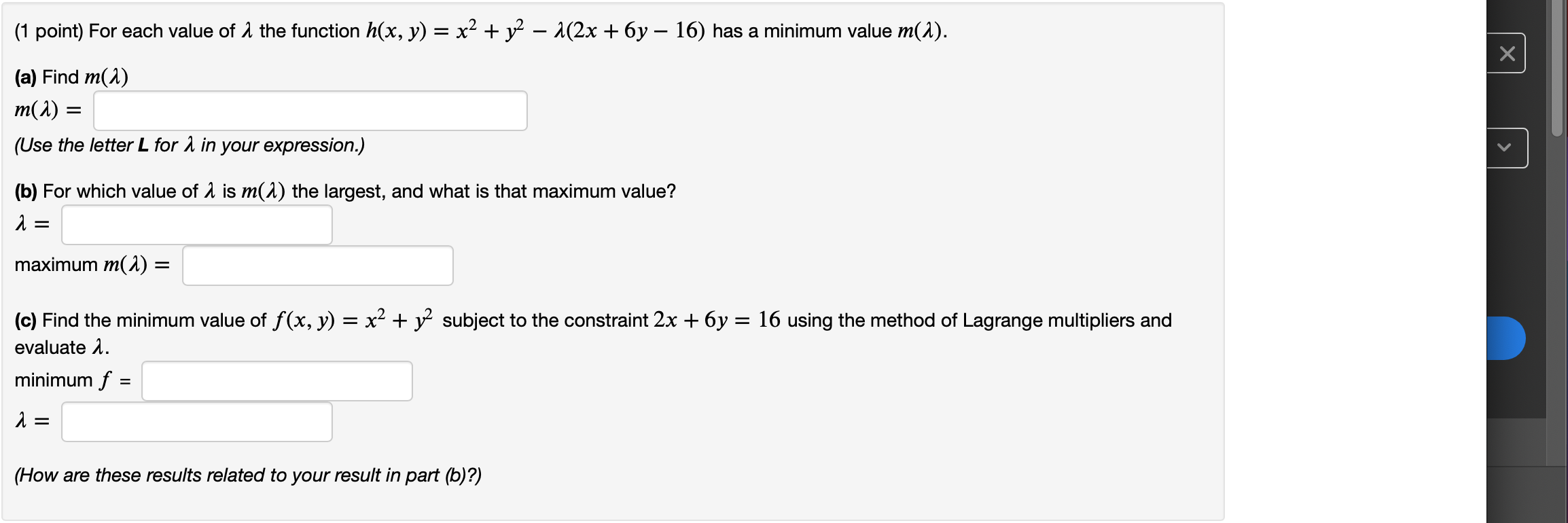
Question: (1 point) For each value of A the function h(x, y) = x2 + y2 1(2x + 6y 16) has a minimum value mu). (3)

(1 point) For each value of A the function h(x,(1 point) For each value of A the function h(x,(1 point) For each value of A the function h(x,
(1 point) For each value of A the function h(x, y) = x2 + y2 1(2x + 6y 16) has a minimum value mu). (3) Find moi) m0.) = (Use the letter L for A in your expression.) (b) For which value of A is m().) the largest, and what is that maximum value? A = maximum mu) = (c) Find the minimum value of f (x, y) = x2 + y2 subject to the constraint 2x + 6y = 16 using the method of Lagrange multipliers and evaluate A. minimum f = A: (How are these results related to your result in part (b) ?) (1 point) The plane x + y + 21 = 8 intersects the paraboloid z = x2 + y2 in an ellipse. Find the points on this ellipse that are nearest to and farthest from the origin. Point farthest away occurs at ( . . )- Point nearest occurs at l . , ). (1 point) Use Lagrange multipliers to find the maximum and minimum values of f(x, y, z) = x + 4y + 32, subject to the constraint x2 + y2 + z2 = . if such values exist. maximum = minimum = (For either value, enter DNE if there is no such value.)

Step by Step Solution

There are 3 Steps involved in it

1 Expert Approved Answer
Step: 1 Unlock blur-text-image
Question Has Been Solved by an Expert!

Get step-by-step solutions from verified subject matter experts

Step: 2 Unlock
Step: 3 Unlock

Students Have Also Explored These Related Mathematics Questions!