







Question: ( 1 point ) In compilers, the lexical analyzer scans the input source code character by character. When it encounters whitespace characters, it discards them
point In compilers, the lexical analyzer scans the input source code character by character.
When it encounters whitespace characters, it discards them without creating tokens. Whitespace
characters do not contribute to the code's meaning and are often used for formatting and readability
purposes only. After removing whitespace, the lexical analyzer continues to tokenize the remaining
nonwhitespace characters in the source code, identifying keywords, identifiers, literals, operators,
and other language constructs.
The lexical analyzer generates the sequence of tokens without spaces as an output. Consider the
following pair of correct and incorrect programming language statements represented as a sequence
of tokens, and devise a dynamic programming algorithm to identify the minimum number of edits
required to transform an incorrect sequence to the correct sequence.
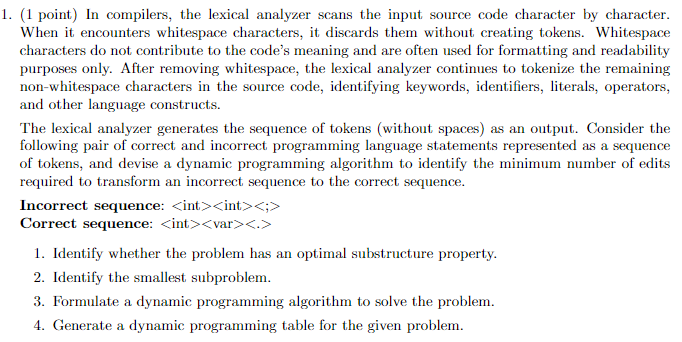
Incorrect sequence: int : int ;:
Correct sequence: int var :
Identify whether the problem has an optimal substructure property.
Identify the smallest subproblem.
Formulate a dynamic programming algorithm to solve the problem.
Generate a dynamic programming table for the given problem.
Step by Step Solution
There are 3 Steps involved in it
1 Expert Approved Answer
Step: 1 Unlock

Question Has Been Solved by an Expert!
Get step-by-step solutions from verified subject matter experts
Step: 2 Unlock
Step: 3 Unlock
 Study Help