







Question: (1 point) In this problem, use the general expressions for left and right sums, left-hand sum = SCOAT + f(y)Ar + ... + f(n-1)At and
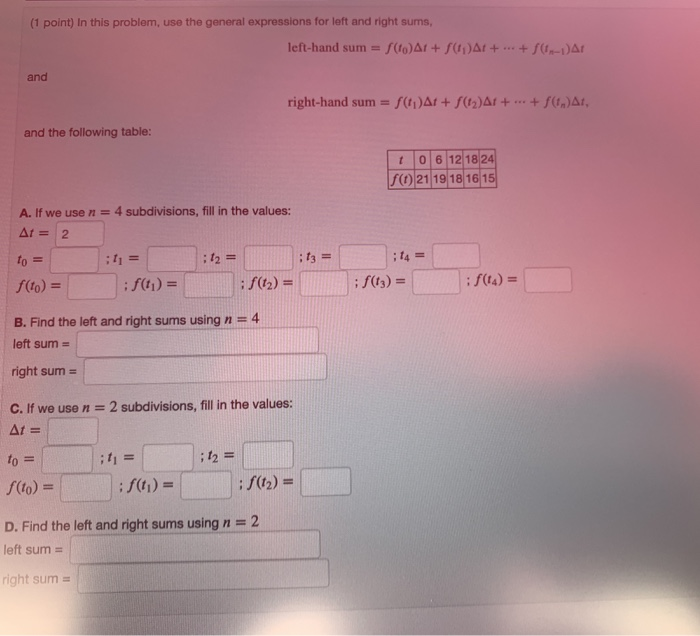
(1 point) In this problem, use the general expressions for left and right sums, left-hand sum = SCOAT + f(y)Ar + ... + f(n-1)At and right-hand sum = $(Af + f(12)Af + ... + f.)At, and the following table: + 0 6 12 18 24 SO 21 19 18 16 15 A. If we use n = 4 subdivisions, fill in the values: Af = 2 to = :11 = :12 = f(t0) = if(t) = : f(t) = :13 = ;14 = if(t) = if(14) = B. Find the left and right sums using n = 4 left sum = right sum = C. If we use n = 2 subdivisions, fill in the values: At = ;12 = to = f(to) = it1 = :f(1) = : f (t2) = D. Find the left and right sums using n = 2 left sum = right sum = (1 point) In this problem, use the general expressions for left and right sums, left-hand sum = SCOAT + f(y)Ar + ... + f(n-1)At and right-hand sum = $(Af + f(12)Af + ... + f.)At, and the following table: + 0 6 12 18 24 SO 21 19 18 16 15 A. If we use n = 4 subdivisions, fill in the values: Af = 2 to = :11 = :12 = f(t0) = if(t) = : f(t) = :13 = ;14 = if(t) = if(14) = B. Find the left and right sums using n = 4 left sum = right sum = C. If we use n = 2 subdivisions, fill in the values: At = ;12 = to = f(to) = it1 = :f(1) = : f (t2) = D. Find the left and right sums using n = 2 left sum = right sum =
Step by Step Solution
There are 3 Steps involved in it

Get step-by-step solutions from verified subject matter experts
 Study Help