







Question: (1 point) Load Factor and Probing (SLO) In an open addressing hash table using linear probing, the average number of probes for successful, S,
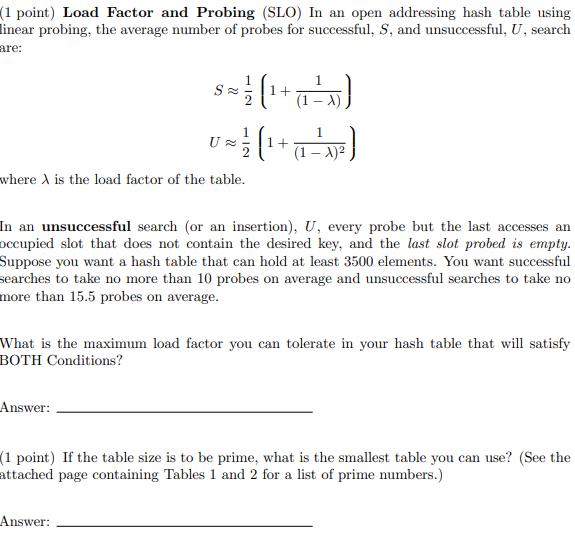
(1 point) Load Factor and Probing (SLO) In an open addressing hash table using linear probing, the average number of probes for successful, S, and unsuccessful, U, search are: S (1 U 1+ (1-A) where A is the load factor of the table. In an unsuccessful search (or an insertion), U, every probe but the last accesses an occupied slot that does not contain the desired key, and the last slot probed is empty. Suppose you want a hash table that can hold at least 3500 elements. You want successful searches to take no more than 10 probes on average and unsuccessful searches to take no more than 15.5 probes on average. What is the maximum load factor you can tolerate in your hash table that will satisfy BOTH Conditions? Answer: (1 point) If the table size is to be prime, what is the smallest table you can use? (See the attached page containing Tables 1 and 2 for a list of prime numbers.) Answer:
Step by Step Solution
There are 3 Steps involved in it

Get step-by-step solutions from verified subject matter experts
 Study Help