







Question: 1 Polynomial Approximation The objects we are interested in this exercise are the continuous functions over the [0, 1 domain. In the language we developed
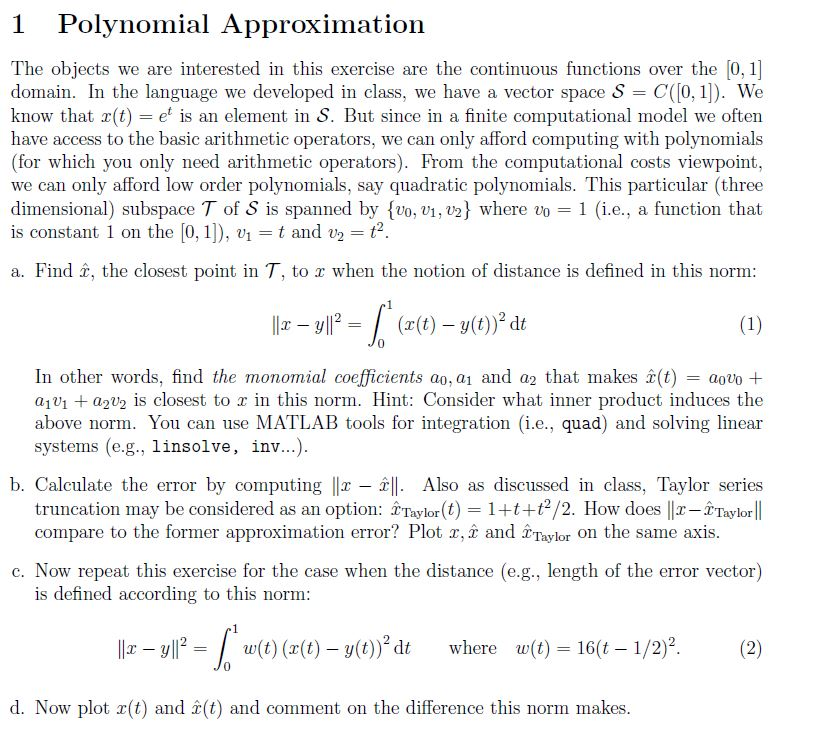
1 Polynomial Approximation The objects we are interested in this exercise are the continuous functions over the [0, 1 domain. In the language we developed in class, we have a vector space SC(0, We know that r(t)e is an element in S. But since in a finite computational model we often have access to the basic arithmetic operators, we can only afford computing with polynomials for which you only need arithmetic operators). From the computational costs viewpoint, we can only afford low order polynomials, say quadratic polynomials. This particular (three dimensional) subspace T of S is spanned by [vo, v1, v2 where vo 1 (i.e., a function that is constant 1 on the 10, 1), v,-t and v2 = t2. a. Find , the closest point in T, to r when the notion of distance is defined in this nornm l-2(x(t) y(t)2 dt 0 In other words, find the monomial coefficients ao, a1 and a2 that makes (t) -aovo + a1v1 a202 is closest to r in this norm. Hint: Consider what inner product induces the above norm. You can use MATLAB tools for integration (i.e., quad) and solving linear systems (e.g., linsolve, inv b. Calculate the error by computing Also as discussed in class, Taylor series truncation may be considered as an option: Taylor(t) 1t/2. How does |z-Taylor compare to the former approximation error? Plot r, and Taylor on the same axis c. Now repeat this exercise for the case when the distance (e.g., length of the error vector) is defined according to this norm w(t) (r(t) - y)2 dt where (t) 16(t 1/2)2. d. Now plot x(t) and x(t) and comment on the difference this norm makes
Step by Step Solution
There are 3 Steps involved in it

Get step-by-step solutions from verified subject matter experts
 Study Help