







Question: 1. Practice with PDPM CMGs (Level 3-Applying) Determine the CMG for the PDPM component discussed in each case presented below. Use tables included in chapter
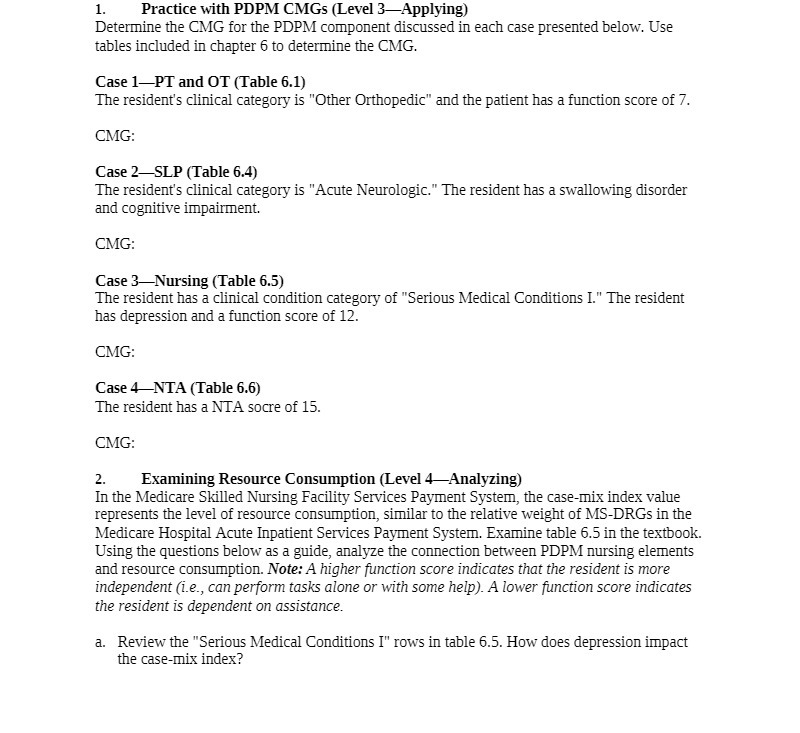
1. Practice with PDPM CMGs (Level 3-Applying) Determine the CMG for the PDPM component discussed in each case presented below. Use tables included in chapter 6 to determine the CMG. Case 1-PT and OT (Table 6.1) The resident's clinical category is "Other Orthopedic" and the patient has a function score of 7. CMG: Case 2-SLP (Table 6.4) The resident's clinical category is "Acute Neurologic." The resident has a swallowing disorder and cognitive impairment. CMG: Case 3-Nursing (Table 6.5) The resident has a clinical condition category of "Serious Medical Conditions I." The resident has depression and a function score of 12. CMG: Case 4-NTA (Table 6.6) The resident has a NTA socre of 15. CMG: 2. Examining Resource Consumption (Level 4-Analyzing) In the Medicare Skilled Nursing Facility Services Payment System, the case-mix index value represents the level of resource consumption, similar to the relative weight of MS-DRGs in the Medicare Hospital Acute Inpatient Services Payment System. Examine table 6.5 in the textbook. Using the questions below as a guide, analyze the connection between PDPM nursing elements and resource consumption. Note: A higher function score indicates that the resident is more independent (i.e., can perform tasks alone or with some help). A lower function score indicates the resident is dependent on assistance. a. Review the "Serious Medical Conditions I" rows in table 6.5. How does depression impact the case-mix index
Step by Step Solution
There are 3 Steps involved in it

Get step-by-step solutions from verified subject matter experts
 Study Help