







Question: 1) Probability density function of a message signal x(t) is given as a) Please generate 10000 samples of this message signal using inverse transformation
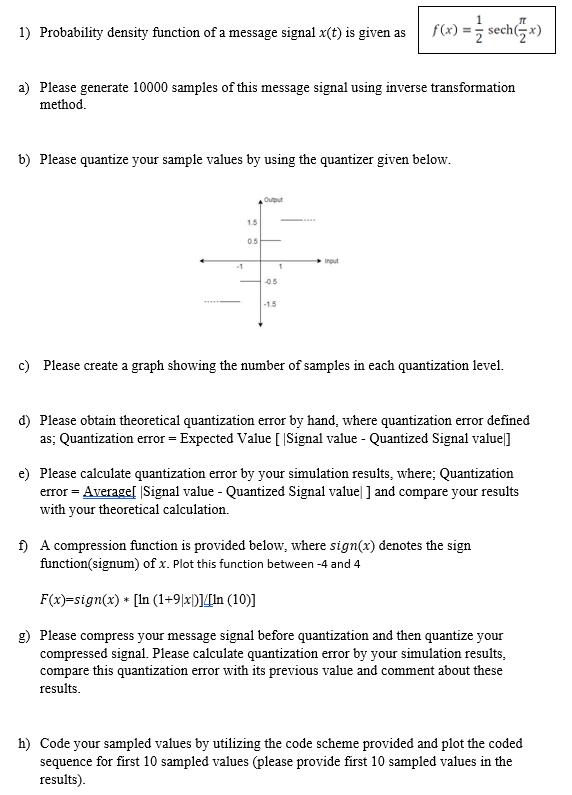
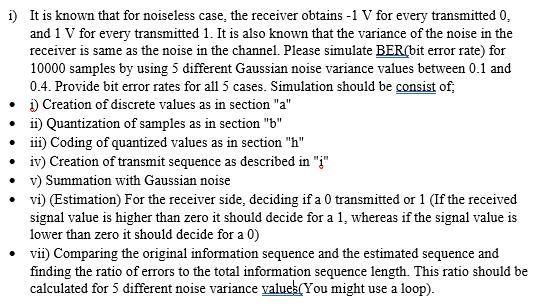
1) Probability density function of a message signal x(t) is given as a) Please generate 10000 samples of this message signal using inverse transformation method. b) Please quantize your sample values by using the quantizer given below. -1 1.5 0.5 Output T -0.5 -1.5 1 f(x) = = sech(x) Input c) Please create a graph showing the number of samples in each quantization level. d) Please obtain theoretical quantization error by hand, where quantization error defined as; Quantization error = Expected Value [Signal value - Quantized Signal value] e) Please calculate quantization error by your simulation results, where; Quantization error = Averagel |Signal value - Quantized Signal value] and compare your results with your theoretical calculation. f) A compression function is provided below, where sign(x) denotes the sign function(signum) of x. Plot this function between -4 and 4 F(x)=sign(x) + [ln (1+9|x)][in (10)] g) Please compress your message signal before quantization and then quantize your compressed signal. Please calculate quantization error by your simulation results, compare this quantization error with its previous value and comment about these results. h) Code your sampled values by utilizing the code scheme provided and plot the coded sequence for first 10 sampled values (please provide first 10 sampled values in the results). i) It is known that for noiseless case, the receiver obtains -1 V for every transmitted 0, and 1 V for every transmitted 1. It is also known that the variance of the noise in the receiver is same as the noise in the channel. Please simulate BER(bit error rate) for 10000 samples by using 5 different Gaussian noise variance values between 0.1 and 0.4. Provide bit error rates for all 5 cases. Simulation should be consist of; i) Creation of discrete values as in section "a" ii) Quantization of samples as in section "b" iii) Coding of quantized values as in section "h" iv) Creation of transmit sequence as described in "" v) Summation with Gaussian noise vi) (Estimation) For the receiver side, deciding if a 0 transmitted or 1 (If the received signal value is higher than zero it should decide for a 1, whereas if the signal value is lower than zero it should decide for a 0) vii) Comparing the original information sequence and the estimated sequence and finding the ratio of errors to the total information sequence length. This ratio should be calculated for 5 different noise variance values(You might use a loop).
Step by Step Solution
3.47 Rating (157 Votes )
There are 3 Steps involved in it
In this article I provide insights on generating samples from a custom proba... View full answer

Get step-by-step solutions from verified subject matter experts
 Study Help