







Question: 1 Problem 1 ( 2 0 points ) Suppose that the smoking status, ( X ) , has ( operatorname {
Problem points
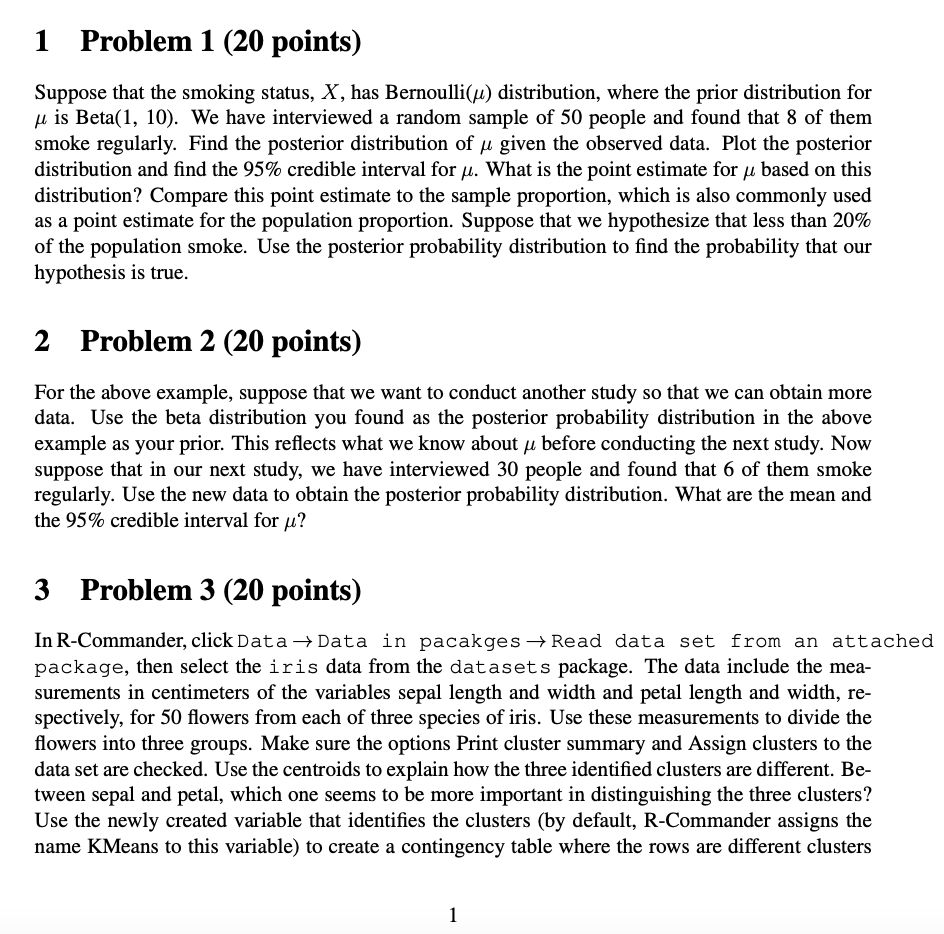
Suppose that the smoking status, X has operatornameBernoullimu distribution, where the prior distribution for mu is operatornameBeta We have interviewed a random sample of people and found that of them smoke regularly. Find the posterior distribution of mu given the observed data. Plot the posterior distribution and find the credible interval for mu What is the point estimate for mu based on this distribution? Compare this point estimate to the sample proportion, which is also commonly used as a point estimate for the population proportion. Suppose that we hypothesize that less than of the population smoke. Use the posterior probability distribution to find the probability that our hypothesis is true.
Problem points
For the above example, suppose that we want to conduct another study so that we can obtain more data. Use the beta distribution you found as the posterior probability distribution in the above example as your prior. This reflects what we know about mu before conducting the next study. Now suppose that in our next study, we have interviewed people and found that of them smoke regularly. Use the new data to obtain the posterior probability distribution. What are the mean and the credible interval for mu
Problem points
In RCommander, clickData rightarrow Data in pacakges rightarrow Read data set from an attached package, then select the iris data from the datasets package. The data include the measurements in centimeters of the variables sepal length and width and petal length and width, respectively, for flowers from each of three species of iris. Use these measurements to divide the flowers into three groups. Make sure the options Print cluster summary and Assign clusters to the data set are checked. Use the centroids to explain how the three identified clusters are different. Between sepal and petal, which one seems to be more important in distinguishing the three clusters? Use the newly created variable that identifies the clusters by default, RCommander assigns the name KMeans to this variable to create a contingency table where the rows are different clusters and the columns are different species. What is the connection between clusters and the type of flowers?
Problem points
We want to examine the relationship between body temperature Y and heart rate X Further, we would like to use heart rate to predict the body temperature.
a Use the "BodyTemperature.txt data set to build a simple linear regression model for body temperature using heart rate as the predictor.
b Interpret the estimate of regression coefficient and examine its statistical significance.
c Find the confidence interval for the regression coefficient.
d Find the value of R and show that it is equal to sample correlation coefficient.
e Create simple diagnostic plots for your model and identify possible outliers.
f If someone's heart rate is what would be your estimate of this person's body temperature?
Problem points
We believe that gender might also be related to body temperature and could help us to predict its unknown values.
a Use the "BodyTemperature.txt data set to build a multiple linear regression model for body temperature using heart rate and gender as predictors.
b How much R did increase compared the above simple linear regression model?
c Explain the estimates of regression coefficients in plain language.
d Find the confidence intervals for regression coefficients.
e If a woman's heart rate is what would be your estimate of her body temperature? What would be your estimate of body temperature for a man whose heart rate is "temperature","gender","rate"
Step by Step Solution
There are 3 Steps involved in it
1 Expert Approved Answer
Step: 1 Unlock

Question Has Been Solved by an Expert!
Get step-by-step solutions from verified subject matter experts
Step: 2 Unlock
Step: 3 Unlock
 Study Help