







Question: 1. Problem 1: Constrained optimization Assume that the yield Y, in kg, of corn as a function of the amounts of nitrogen N and phosphorus
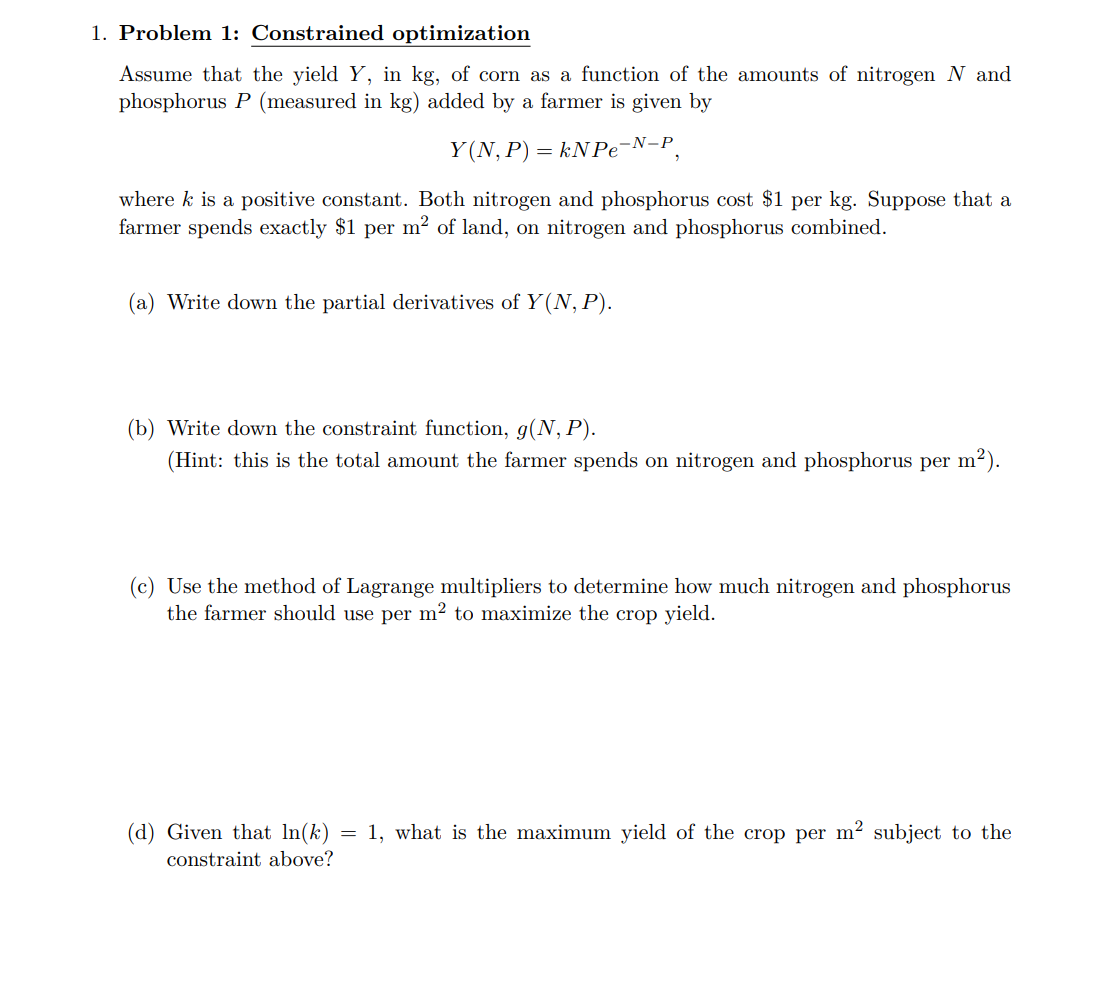
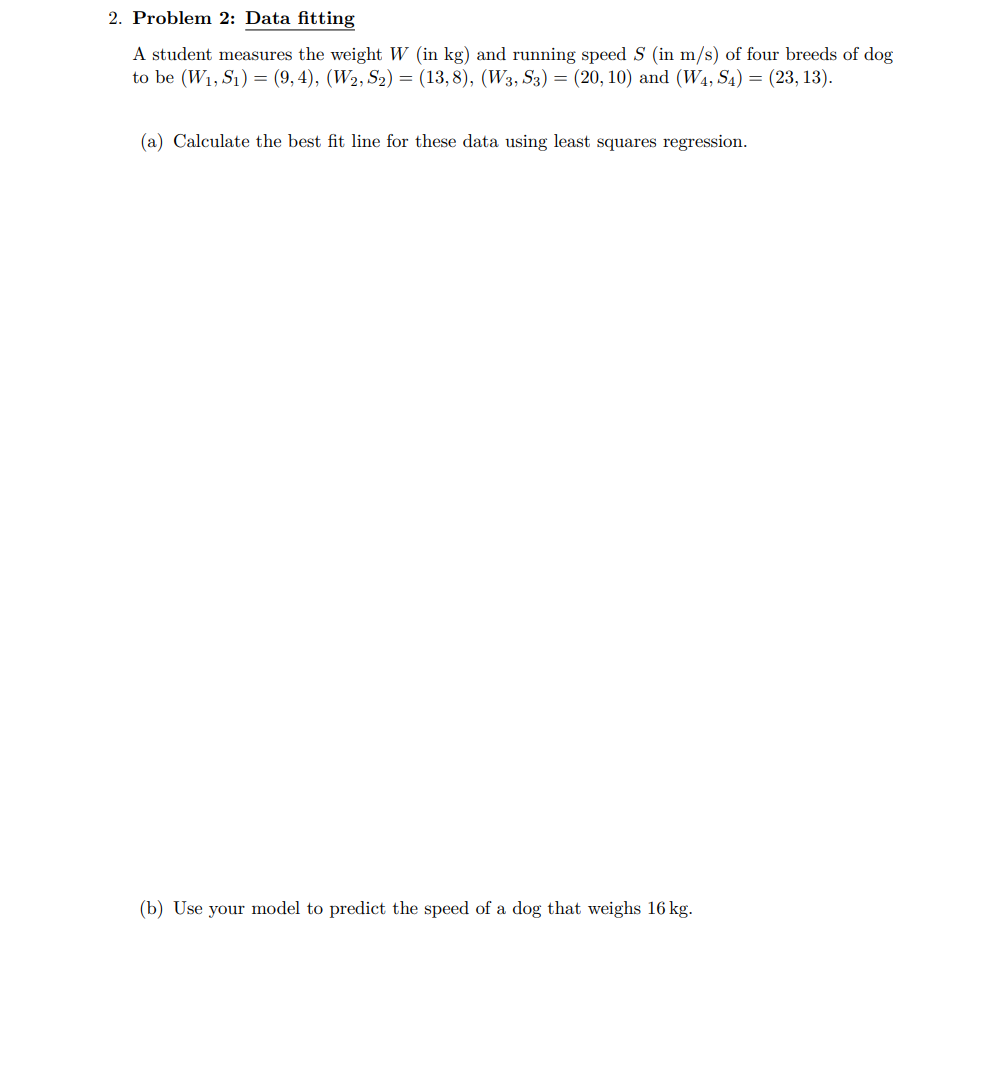
1. Problem 1: Constrained optimization Assume that the yield Y, in kg, of corn as a function of the amounts of nitrogen N and phosphorus P (measured in kg) added by a farmer is given by Y(J.\\,T] P) = ki\\lTPe_-"\\'rP? where k is a positive constant. Both nitrogen and phosphorus cost $1 per kg. Suppose that a farmer spends exactly $1 per m? of land, on nitrogen and phosphorus combined. (a) Write down the partial derivatives of Y (N, P). (b) Write down the constraint function, g(N, P). (Hint: this is the total amount the farmer spends on nitrogen and phosphorus per m?). (c) Use the method of Lagrange multipliers to determine how much nitrogen and phosphorus the farmer should use per m? to maximize the crop yield. (d) Given that In(k) = 1, what is the maximum yield of the crop per m? subject to the constraint above? 2. Problem 2: Data fitting A student measures the weight W (in kg) and running speed S (in m/s) of four breeds of dog to be (W1, 51) = (9, 4), (W2, 52) = (13, 8), (W3, $3) = (20, 10) and (W4, S4) = (23, 13). (a) Calculate the best fit line for these data using least squares regression. (b) Use your model to predict the speed of a dog that weighs 16 kg
Step by Step Solution
There are 3 Steps involved in it

Get step-by-step solutions from verified subject matter experts
 Study Help