



Question: 1 Problem 1: Network Revenue Management Background: You are a revenue management analyst for an international airline. The airline has a network of flights
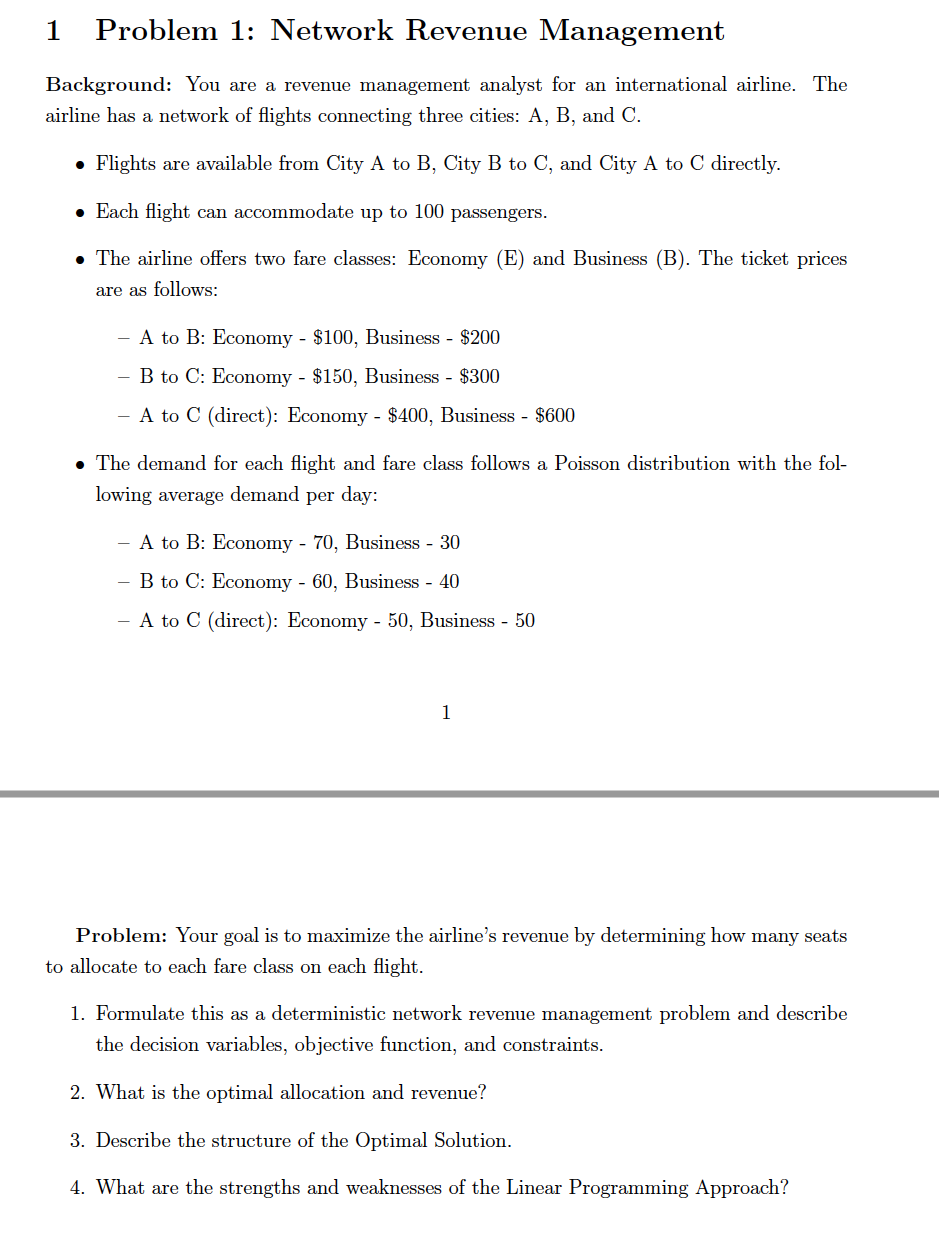
1 Problem 1: Network Revenue Management Background: You are a revenue management analyst for an international airline. The airline has a network of flights connecting three cities: A, B, and C. Flights are available from City A to B, City B to C, and City A to C directly. Each flight can accommodate up to 100 passengers. The airline offers two fare classes: Economy (E) and Business (B). The ticket prices are as follows: - - A to B: Economy - $100, Business - $200 B to C: Economy - $150, Business - $300 A to C (direct): Economy - $400, Business - $600 The demand for each flight and fare class follows a Poisson distribution with the fol- lowing average demand per day: - A to B: Economy - 70, Business - 301 -B to C: Economy - 60, Business - 40 -A to C (direct): Economy - 50, Business - 50 1 Problem: Your goal is to maximize the airline's revenue by determining how many seats to allocate to each fare class on each flight. 1. Formulate this as a deterministic network revenue management problem and describe the decision variables, objective function, and constraints. 2. What is the optimal allocation and revenue? 3. Describe the structure of the Optimal Solution. 4. What are the strengths and weaknesses of the Linear Programming Approach?
Step by Step Solution
There are 3 Steps involved in it

Get step-by-step solutions from verified subject matter experts