







Question: 1. Prove Theorem 4.4.6: For a binary symmetric channel using minimum distance decoding, the probability of a decoding error for a maximal (n,M,d)-code satisfies
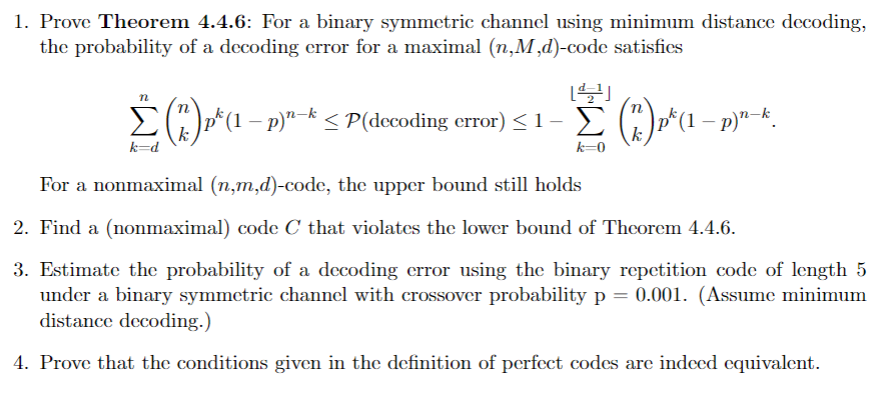
1. Prove Theorem 4.4.6: For a binary symmetric channel using minimum distance decoding, the probability of a decoding error for a maximal (n,M,d)-code satisfies k=d (^) p (1 - p)"-* P(decoding error) 1 [21] For a nonmaximal (n,m,d)-code, the upper bound still holds k=0 k 2. Find a (nonmaximal) code C that violates the lower bound of Theorem 4.4.6. 3. Estimate the probability of a decoding error using the binary repetition code of length 5 under a binary symmetric channel with crossover probability p = 0.001. (Assume minimum distance decoding.) 4. Prove that the conditions given in the definition of perfect codes are indeed equivalent.
Step by Step Solution
There are 3 Steps involved in it

Get step-by-step solutions from verified subject matter experts
 Study Help