







Question: 1. Provide a high-level decomposition. This should do no more than break the problem into the main subproblems. It is a description of what the
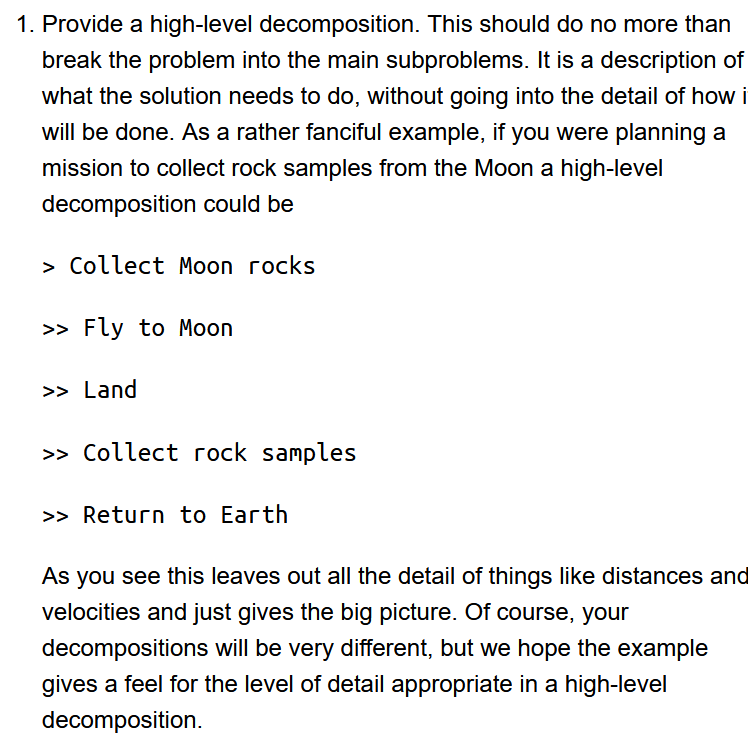
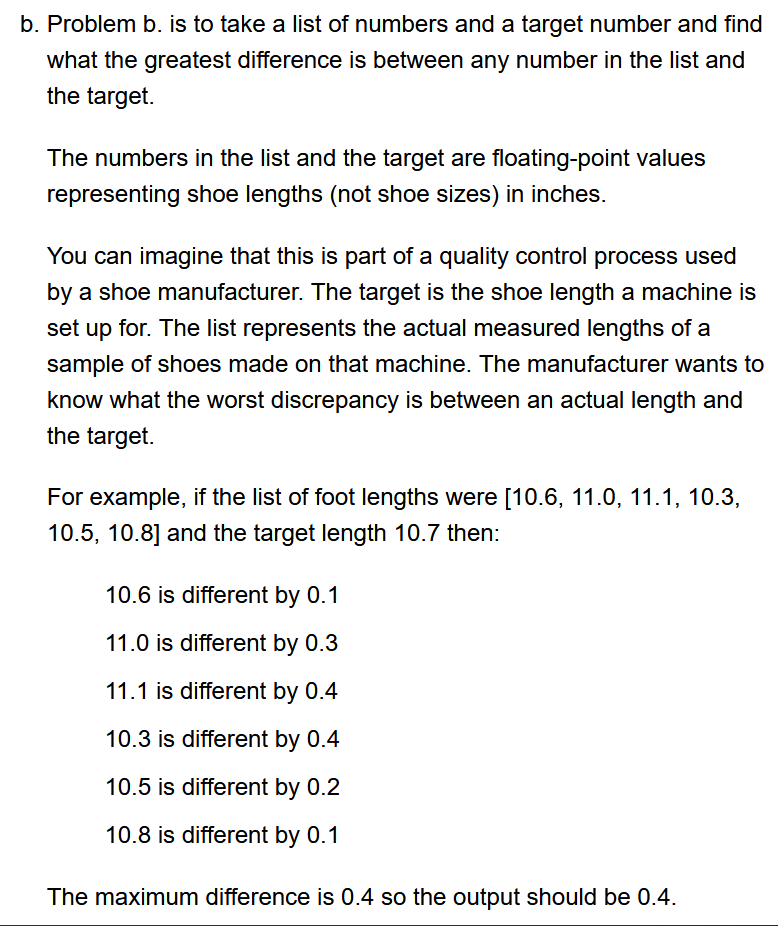
1. Provide a high-level decomposition. This should do no more than break the problem into the main subproblems. It is a description of what the solution needs to do, without going into the detail of how i will be done. As a rather fanciful example, if you were planning a mission to collect rock samples from the Moon a high-level decomposition could be s Collect Moon rocks s: Fly to Moon s: Land s: Collect rock samples :> Return to Earth As you see this leaves out all the detail of things like distances and velocities and just gives the big picture. Of course, your decompositions will be very different, but we hope the example gives a feel for the level of detail appropriate in a high-level decomposition. b. Problem b. is to take a list of numbers and a target number and nd what the greatest difference is between any number in the list and the target. The numbers in the list and the target are oating-point values representing shoe lengths (not shoe sizes) in inches. You can imagine that this is part of a quality control process used by a shoe manufacturer. The target is the shoe length a machine is set up for. The list represents the actual measured lengths of a sample of shoes made on that machine. The manufacturer wants to know what the worst discrepancy is between an actual length and the target. For example, if the list of foot lengths were [10.6, 11.0, 11.1, 10.3, 10.5, 10.8] and the target length 10.? then: 10.6 is different by 0.1 11.0 is different by 0.3 11.1 is different by 0.4 10.3 is different by 0.4 10.5 is different by 0.2 10.8 is different by 0.1 The maximum difference is 0.4 so the output should be 0.4
Step by Step Solution
There are 3 Steps involved in it

Get step-by-step solutions from verified subject matter experts
 Study Help