







Question: (1) Provide suitable background about the problem. (2) Describe the assumptions you make about the probability distributions involved in the problem. (3) State the
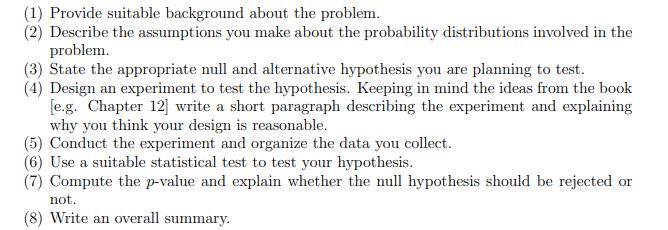

(1) Provide suitable background about the problem. (2) Describe the assumptions you make about the probability distributions involved in the problem. (3) State the appropriate null and alternative hypothesis you are planning to test. (4) Design an experiment to test the hypothesis. Keeping in mind the ideas from the book [e.g. Chapter 12] write a short paragraph describing the experiment and explaining why you think your design is reasonable. (5) Conduct the experiment and organize the data you collect. (6) Use a suitable statistical test to test your hypothesis. (7) Compute the p-value and explain whether the null hypothesis should be rejected or not. (8) Write an overall summary. (2) Pick your favorite irrational number, such as 2, 7, e, o, or y. Do the digits in the decimal expansion of this number appear in random order? In other words, as you get more and more digits in the expansion, is every of the ten digits 0, 1,...,9 equally likely to appear? What about a particular sequence of length 2, or 3, or 4, etc.? For example, is 1324 more likely than 8888?
Step by Step Solution
3.44 Rating (144 Votes )
There are 3 Steps involved in it
Problem A group of scientists are interested in studying the impact of a new type of drug on the rat... View full answer

Get step-by-step solutions from verified subject matter experts
 Study Help