







Question: 1. Pure rik is differest from speculative rikk because: a. peculative risk implies that nwoting happens or something bad hippens, whoreas pure rivk has a
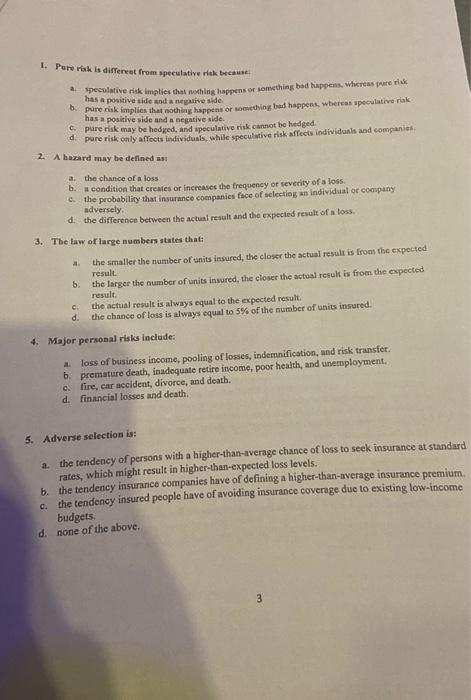
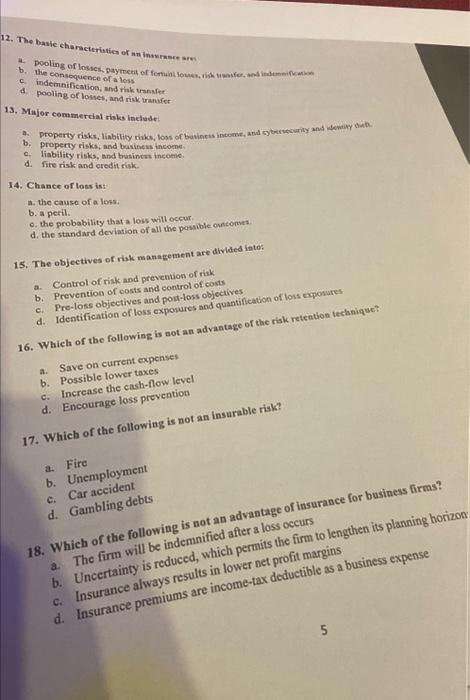
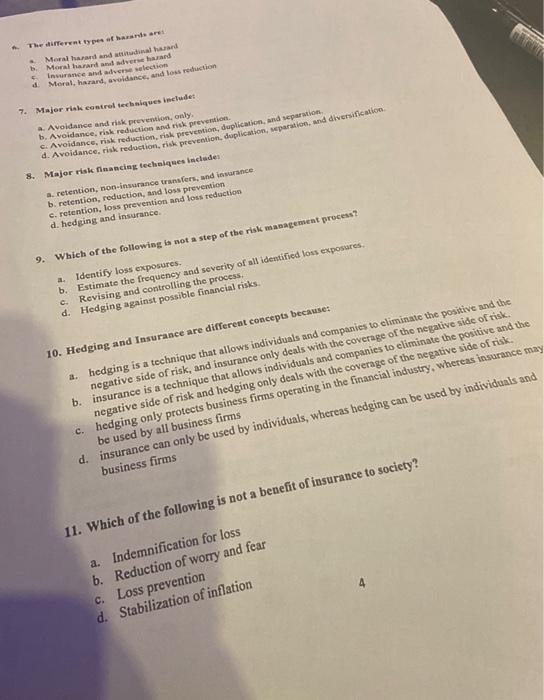
1. Pure rik is differest from speculative rikk because: a. peculative risk implies that nwoting happens or something bad hippens, whoreas pure rivk has a positive side and a neealive alde. b. pure risk implies that nothlag happens or womething bad happens, wbereas speculative risk: has a positive side and a negative side. c. pure risk may be hedged, and apeculative risk cannot be hedged. d. pure risk only affocts individuals, while speculative risk affects individanls and companies. 2. A hazard may be defined ast a. the chance of a loss b. a condition that creates or increases the frequency or severity of a loss. c. the probability that insurance companies face of selectiog an individual or company adversely, d. the difference between the actual result and the expected revult of a loss. 3. The law of large numbers states that: a. the smaller the number of tnits insured, the closer the actual result is from the expocted result. b. the larger the number of units insured, the eloser the actail result is from the expected result, c. the actual result is always equal to the expected result. d. the chance of loss is always equal to 5% of the rumber of units insured. 4. Major personal risks include: a. loss of business income, pooling of losses, indemnification, and risk transfer. b. premature death, inadequate retire income, poor health, and unecoployment. c. Fire, car accident, divorce, and death. d. finuncial losses and death. 5. Adverse selection is: a. the tendency of persons with a higher-than-average chance of loss to seek insurance at standard. rates, which might result in higher-than-expected loss levels. b. the tendency insurance companies have of defining a higher-than-average insurance premium. c. the tendency insured people have of avoiding insurance covernge due to existing low-income budgets. d. none of the above. 12. The basic chantecteristics of nn inswrmere wret a. pooling of losics, payment of b. the consequence of a loss c. indemnification, and risk tranker- 4. pooling of loises, and rick iranter 13. Minjor commercial riaks inelude. a. Property risks, liabtitity rikas, loss of teo b. property risks, and baviness incoone? c. liability risks, and businces 14. Chance of loss is: a. the cause of a lons. b. a peril. c. the probability that a loss will occur. d. the standard deviation of all the possible ornteonses. 15. The objectives of risk managentent are divided intos a. Control of risk asd prevention of risk b. Prevention of costs and control of costs c. Pro-loss objectives and port-loss objectives c. Identification of loss exposures and quantifieation of loss exponures 16. Which of the following is not an advantage of the risk retestion technigue? a. Save on current expenses b. Possible lower taxes c. Increase the cash-flow level d. Encourage loss provention 17. Which of the following is not an insurable risk? a. Fire b. Unemployment c. Car accident d. Gambling debts 18. Which of the following is not an advantage of insurance for business firms? a. The firm will be indemnified after a loss occurs b. Uncertainty is reduced, which permits the firm to lengthen its planning horizon c. Insurance always results in lower net profit margins d. Insurance premiums are income-tax deductible as a business expense 5 a. Meral Twarant and atividiwal hasard b. Mowal harant ambl adverse hayar3 4. Invirance aivi advetse selection a. Avoidance and risk prevention, oibly. b. Avoidance, risk reduction and thck prevertions. ci Avoidance, risk reduction, risk pecvection, duplication, and weparation. 7. Miajor tisk financing teclsniques inclede a. retention, non-insurance transfers, and ievurance b. retention, reduetion, and loss pievertien c. retention, loss prevertion and hoss teduction d. hedging and insurance: 9. Which of the following is not a step of the risli mapagement process? a. Identify loss exposures. b. Estimate the frequency and severity of all identified loss exposures. c. Revising and controlling the process: 10. Hedging and Insurance are different concepts because: 3. hedging is a technique that allows individuals and companies to eliminate the posituive and the negative side of risk, and insurance only deals with the coverage of the negalive side of tisk. b. insurance is a technique that allows individuals and companies to elininate the positive and the negative side of risk and hedging only deals with the coverage of the negative side of tisk. c. hedging only protects business firms operating in the financial industry, whereas insurance maxy business firms
Step by Step Solution
There are 3 Steps involved in it

Get step-by-step solutions from verified subject matter experts
 Study Help