







Question: 1 @ Question 1 ~ N W R W b5 4 3 2 - =5 Clear All Draw: Line 1 2 3 4 5 Dot
1
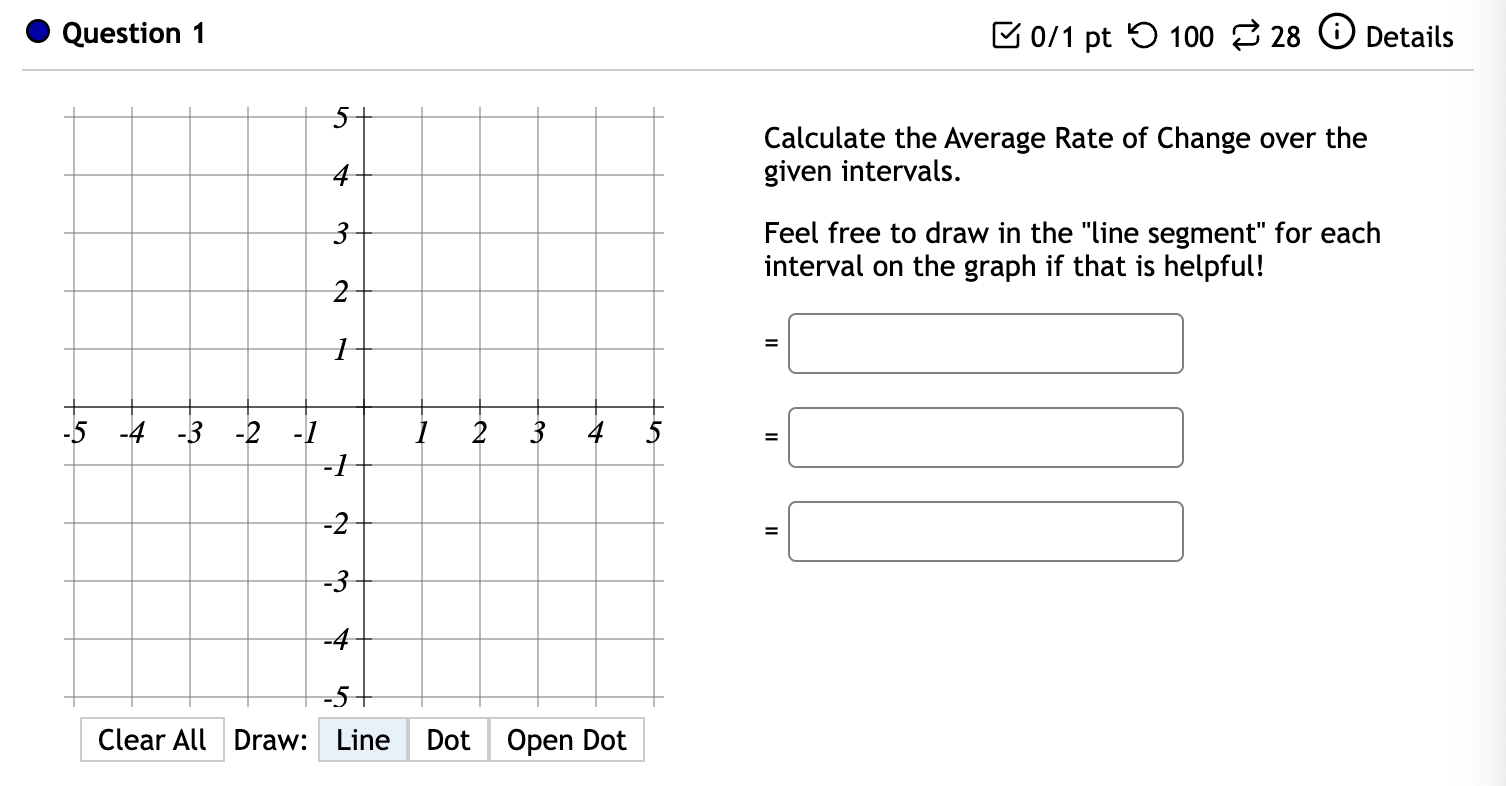
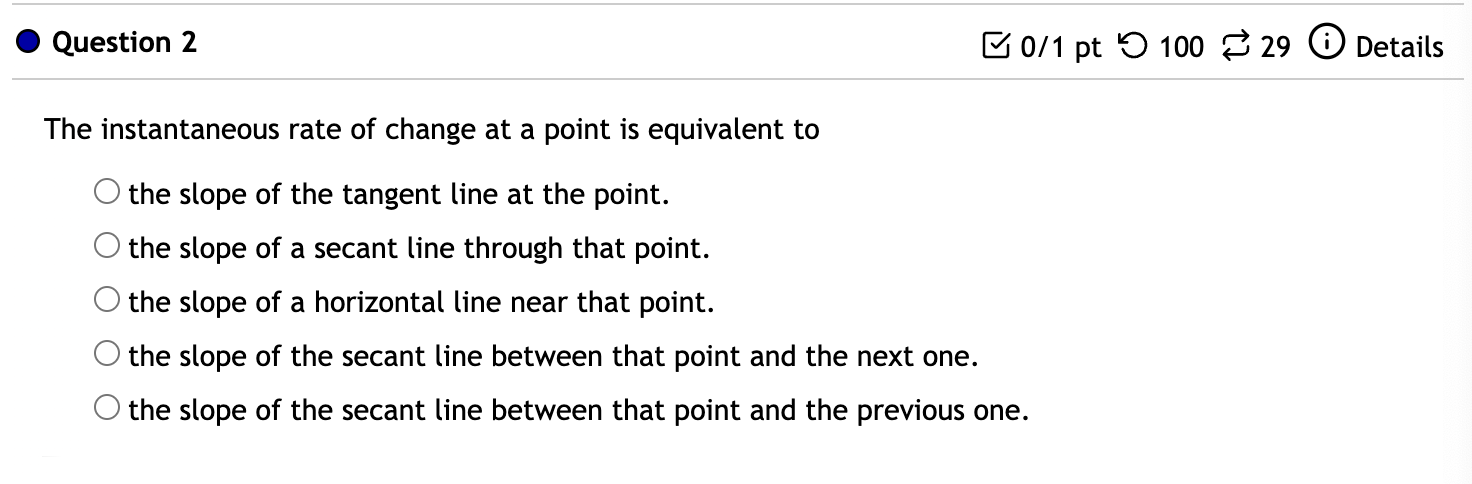
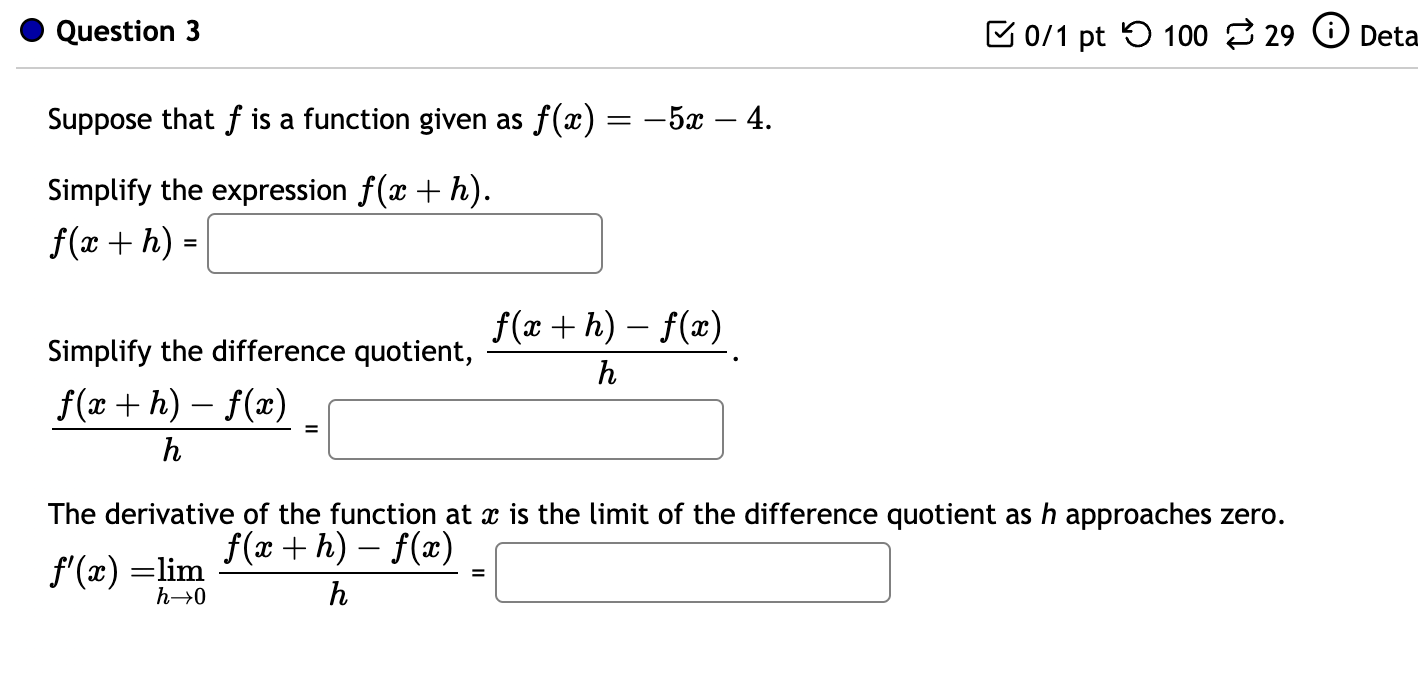
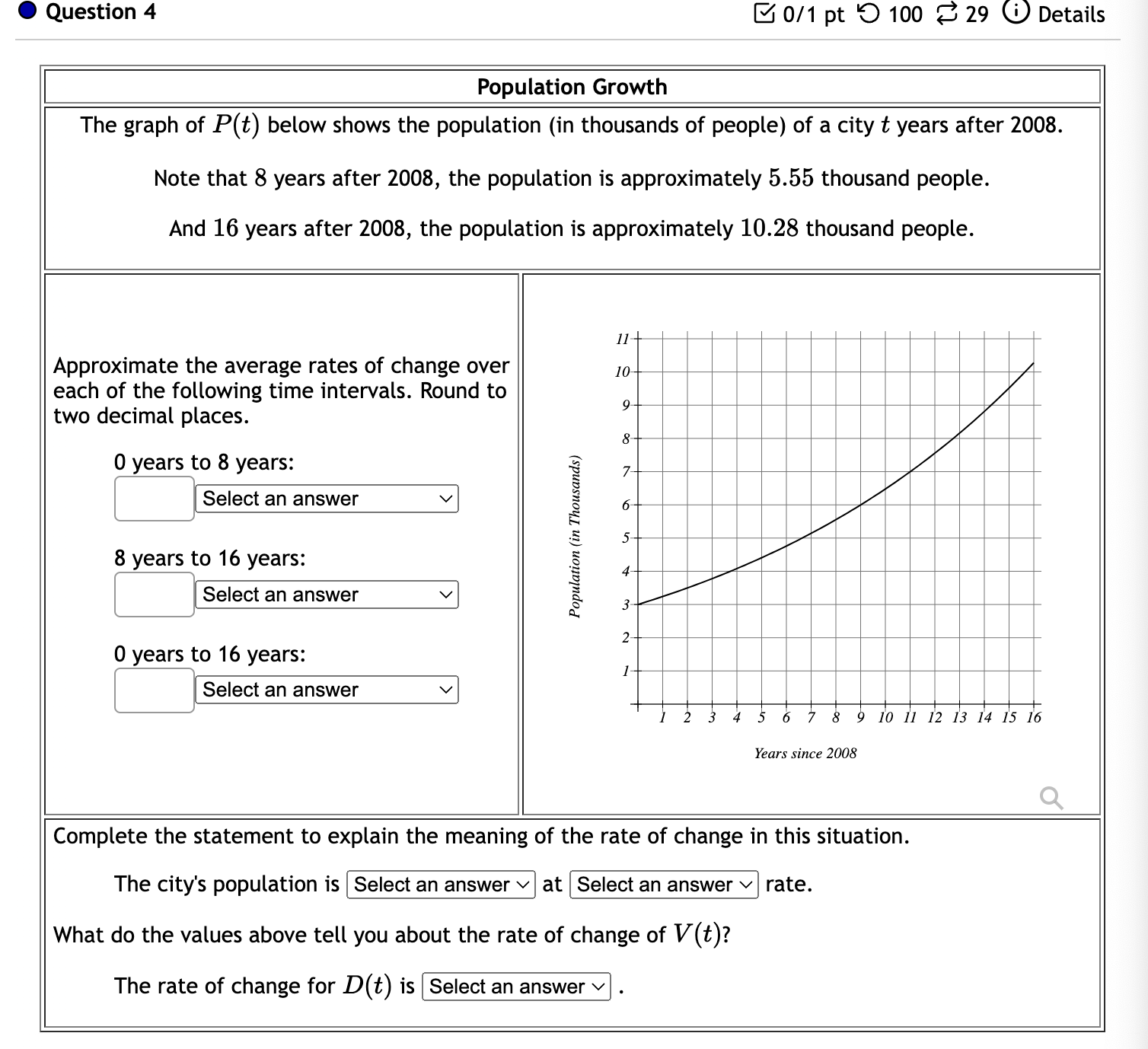
@ Question 1 ~ N W R W b5 4 3 2 - =5 Clear All Draw: Line 1 2 3 4 5 Dot Open Dot & 0/1pt O 100 2 28 @O Details Calculate the Average Rate of Change over the given intervals. Feel free to draw in the "line segment\" for each interval on the graph if that is helpful! @ Question 2 & 0/1pt O 100 229 O Details The instantaneous rate of change at a point is equivalent to O the slope of the tangent line at the point. O the slope of a secant line through that point. O the slope of a horizontal line near that point. O the slope of the secant line between that point and the next one. O the slope of the secant line between that point and the previous one. @ Question 3 & 0/1pt O 100 229 O Deta Suppose that f is a function given as f(z) = 5z 4. Simplify the expression f(z + h). f(x+h) = +h Simplify the difference quotient, ( ) fl= ) flehte) [ The derivative of the functlon at z is the limit of the difference quotient as h approaches zero. O e @ Question 4 & 0/1 pt O 100 2 29 () Details Population Growth The graph of P(t) below shows the population (in thousands of people) of a city years after 2008. Note that 8 years after 2008, the population is approximately 5.55 thousand people. And 16 years after 2008, the population is approximately 10.28 thousand people. Approximate the average rates of change over each of the following time intervals. Round to two decimal places. 0 years to 8 years: Select an answer v 8 years to 16 years: Select an answer v = = g 3 8 3 = = = -2 = = g
Step by Step Solution
There are 3 Steps involved in it

Get step-by-step solutions from verified subject matter experts
 Study Help