







Question: 1. Question. Consider the following C code fragment: 1 v o i d 2 f o o b a r ( ch a r a
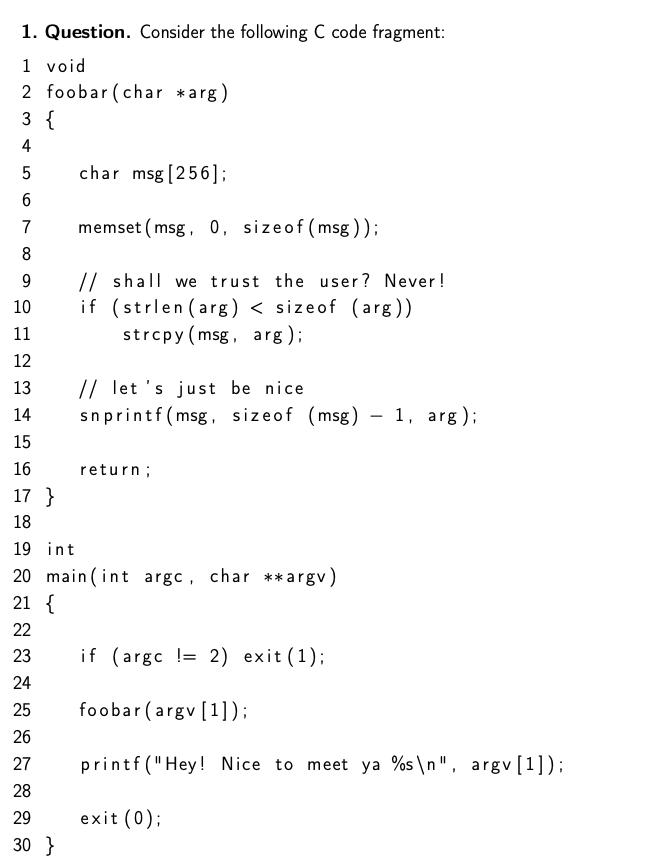
1. Question. Consider the following C code fragment: 1 v o i d 2 f o o b a r ( ch a r a rg ) 3 { 4 5 ch a r msg [ 2 5 6 ] ; 6 7 memset (msg , 0 , s i z e o f ( msg ) ) ; 8 9 // s h a l l we t r u s t th e u s e r ? Neve r ! 10 i f ( s t r l e n ( a rg )
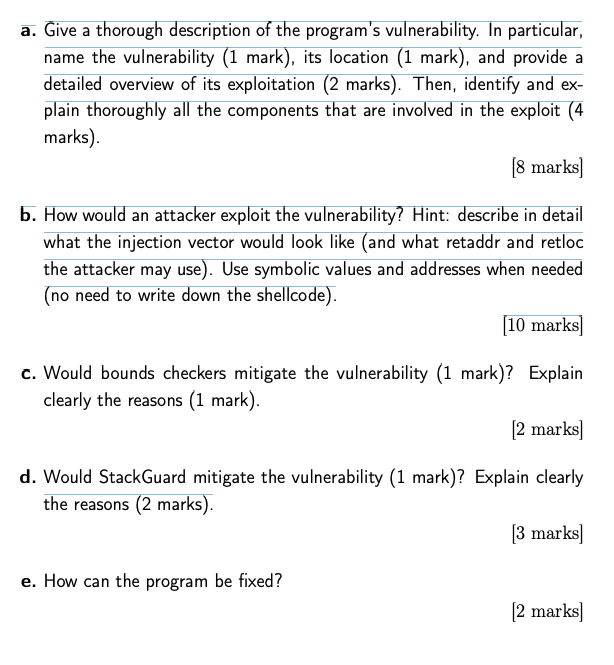
a. Give a thorough description of the programs vulnerability. In particular, name the vulnerability (1 mark), its location (1 mark), and provide a detailed overview of its exploitation (2 marks). Then, identify and explain thoroughly all the components that are involved in the exploit (4 marks). [8 marks]
b. How would an attacker exploit the vulnerability? Hint: describe in detail what the injection vector would look like (and what retaddr and retloc the attacker may use). Use symbolic values and addresses when needed (no need to write down the shellcode). [10 marks]
c. Would bounds checkers mitigate the vulnerability (1 mark)? Explain clearly the reasons (1 mark). [2 marks]
d. Would StackGuard mitigate the vulnerability (1 mark)? Explain clearly the reasons (2 marks).
a. Give a thorough description of the program's vulnerability. In particular, name the vulnerability (1 mark), its location (1 mark), and provide a detailed overview of its exploitation (2 marks). Then, identify and ex- plain thoroughly all the components that are involved in the exploit (4 marks) (8 marks b. How would an attacker exploit the vulnerability? Hint: describe in detail what the injection vector would look like (and what retaddr and retloc the attacker may use). Use symbolic values and addresses when needed (no need to write down the shellcode). [10 marks) c. Would bounds checkers mitigate the vulnerability (1 mark)? Explain clearly the reasons (1 mark). [2 marks d. Would StackGuard mitigate the vulnerability (1 mark)? Explain clearly the reasons (2 marks). [3 marks] e. How can the program be fixed? [2 marks] 10 ES 1. Question. Consider the following C code fragment: 1 void 2 foobar (char *arg) 3 { 4 5 char msg [256): 6 7 memset (msg, 0, sizeof(msg)); 8 9 // shall we trust the user? Never! if (strlen(arg)
Step by Step Solution
There are 3 Steps involved in it

Get step-by-step solutions from verified subject matter experts
 Study Help