







Question: 1) Question. Construct the representative household's utility maximisation decentralised problem such that a4 = 24-1e#+Et, whereby & N 0, 02); find the optimal rules attendant
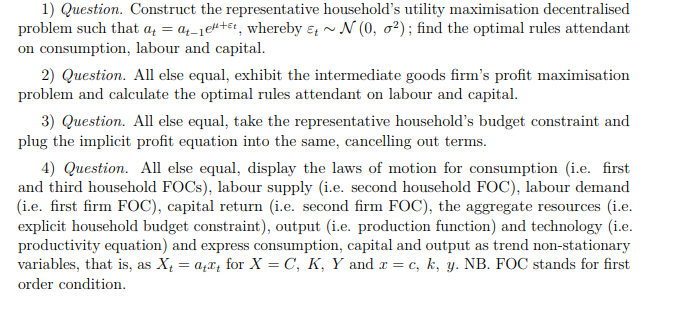
1) Question. Construct the representative household's utility maximisation decentralised problem such that a4 = 24-1e#+Et, whereby & N 0, 02); find the optimal rules attendant on consumption, labour and capital. 2) Question. All else equal, exhibit the intermediate goods firm's profit maximisation problem and calculate the optimal rules attendant on labour and capital. 3) Question. All else equal, take the representative household's budget constraint and plug the implicit profit equation into the same, cancelling out terms. 4) Question. All else equal, display the laws of motion for consumption (i.e. first and third household FOCs), labour supply (i.e. second household FOC), labour demand (i.e. first firm FOC), capital return (i.e. second firm FOC), the aggregate resources (i.e. explicit household budget constraint), output (i.e. production function) and technology (i.e. productivity equation) and express consumption, capital and output as trend non-stationary variables, that is, as X= 24.14 for X = C, K, Y and r=c, k, y. NB. FOC stands for first order condition. 1) Question. Construct the representative household's utility maximisation decentralised problem such that a4 = 24-1e#+Et, whereby & N 0, 02); find the optimal rules attendant on consumption, labour and capital. 2) Question. All else equal, exhibit the intermediate goods firm's profit maximisation problem and calculate the optimal rules attendant on labour and capital. 3) Question. All else equal, take the representative household's budget constraint and plug the implicit profit equation into the same, cancelling out terms. 4) Question. All else equal, display the laws of motion for consumption (i.e. first and third household FOCs), labour supply (i.e. second household FOC), labour demand (i.e. first firm FOC), capital return (i.e. second firm FOC), the aggregate resources (i.e. explicit household budget constraint), output (i.e. production function) and technology (i.e. productivity equation) and express consumption, capital and output as trend non-stationary variables, that is, as X= 24.14 for X = C, K, Y and r=c, k, y. NB. FOC stands for first order condition
Step by Step Solution
There are 3 Steps involved in it

Get step-by-step solutions from verified subject matter experts
 Study Help