







Question: 1. Read proposition 6.9 and answer the exercise after it. 2. Prove proposition 6.10(just prove the concave up). Proposition 6.10. Let f : (a, b)
1. Read proposition 6.9 and answer the exercise after it.
2. Prove proposition 6.10(just prove the concave up).
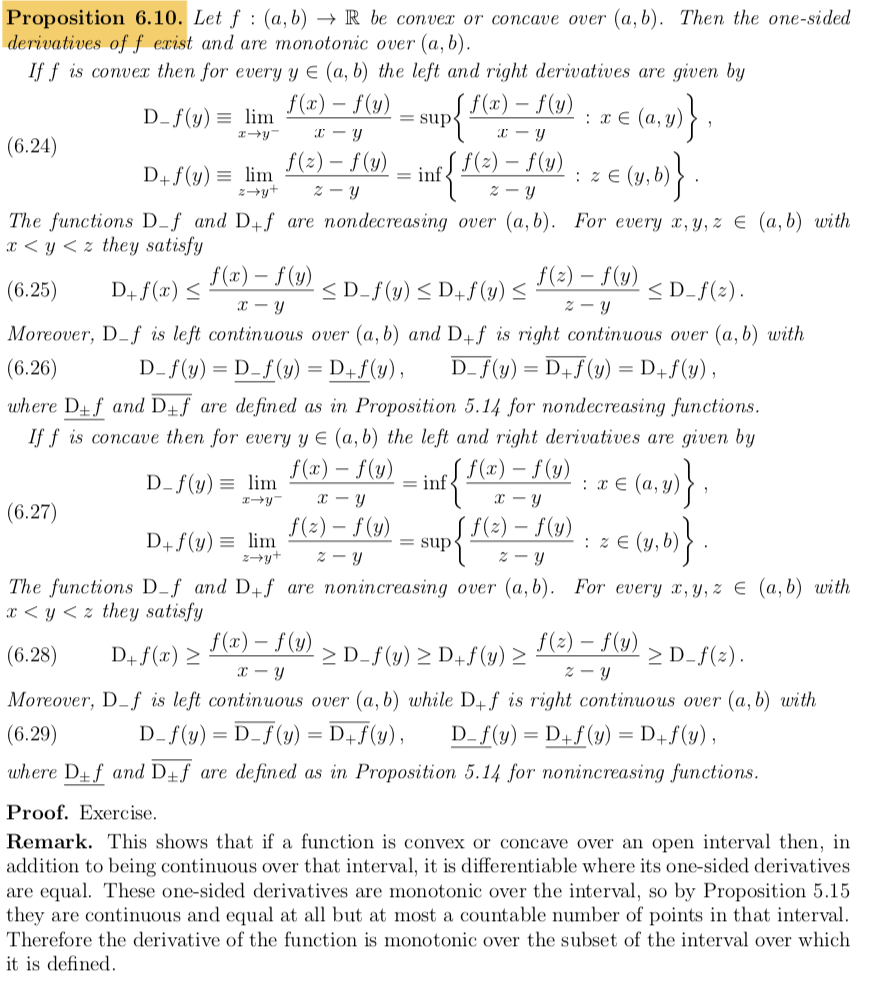
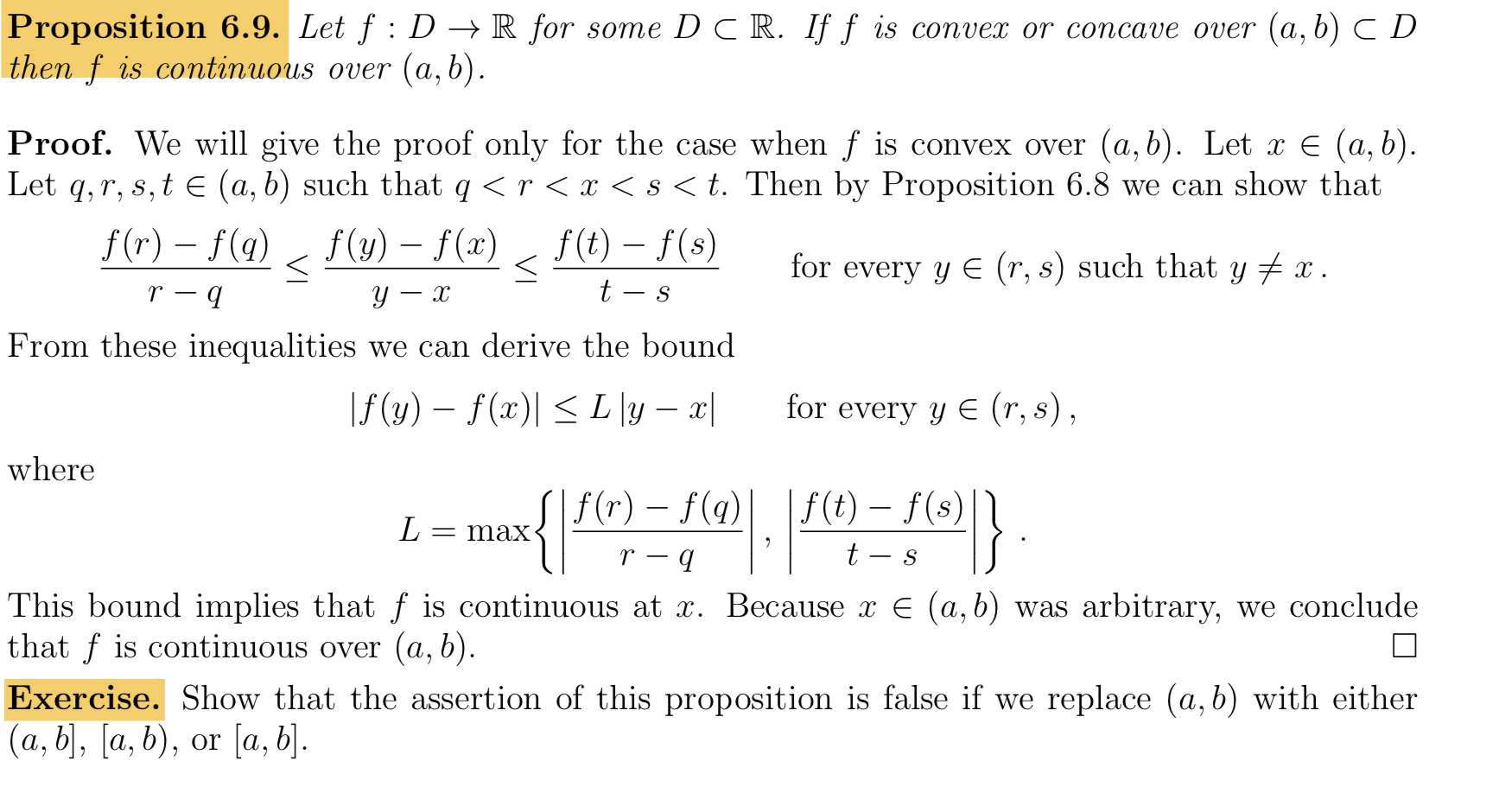
Proposition 6.10. Let f : (a, b) - R be conver or concave over (a, b). Then the one-sided derivatives of f exist and are monotonic over (a, b). If f is conver then for every y E (a, b) the left and right derivatives are given by D_f(y) = lim f(x) - f(y) = sup a - y J f (x) - f() : TE (a, y) , (6.24) a - y D+ f(y) = lim f(2) - f(y) zay+ 2 - y = inf f(2) - f(3) : = E (y,b) . 2 - y The functions D_f and Def are nondecreasing over (a, b). For every x, y, z E (a, b) with x !(x) - 9) > D_f (U) > Def (U) > 1(8) - 19) > D_f (2). x - y 2 - y Moreover, D_f is left continuous over (a, b) while D. f is right continuous over (a, b) with (6.29) D_ f(y) = D_f(y) = D+f(y), D_f(y) = D+f(y) = D+f(y) , where Def and Def are defined as in Proposition 5.14 for nonincreasing functions. Proof. Exercise. Remark. This shows that if a function is convex or concave over an open interval then, in addition to being continuous over that interval, it is differentiable where its one-sided derivatives are equal. These one-sided derivatives are monotonic over the interval, so by Proposition 5.15 they are continuous and equal at all but at most a countable number of points in that interval. Therefore the derivative of the function is monotonic over the subset of the interval over which it is defined.Proposition 6.9. Let f : D - R for some D C R. If f is convex or concave over (a, b) C D then f is continuous over (a, b). Proof. We will give the proof only for the case when f is convex over (a, b). Let x E (a, b). Let q, r, s, t E (a, b) such that q
Step by Step Solution
There are 3 Steps involved in it

Get step-by-step solutions from verified subject matter experts
 Study Help