







Question: 1) Recommend and justify a solution Be sure to address how this proposed solution will fix the problem(s) Don't just punt by delaying a decision
1) Recommend and justify a solution Be sure to address how this proposed solution will fix the problem(s) Don't just punt by delaying a decision and recommending further analysis. Make a decision and recommend a course of action 2) Suggest an implementation strategy where appropriate What one thing are you going to focus on to help correct the problem within the next two weeks? 3 months? 6 months? 1 year? What barriers might you run into during implementation and how would you propose that these barriers be overcome
***paragraph that was cut off from bellow page 3***
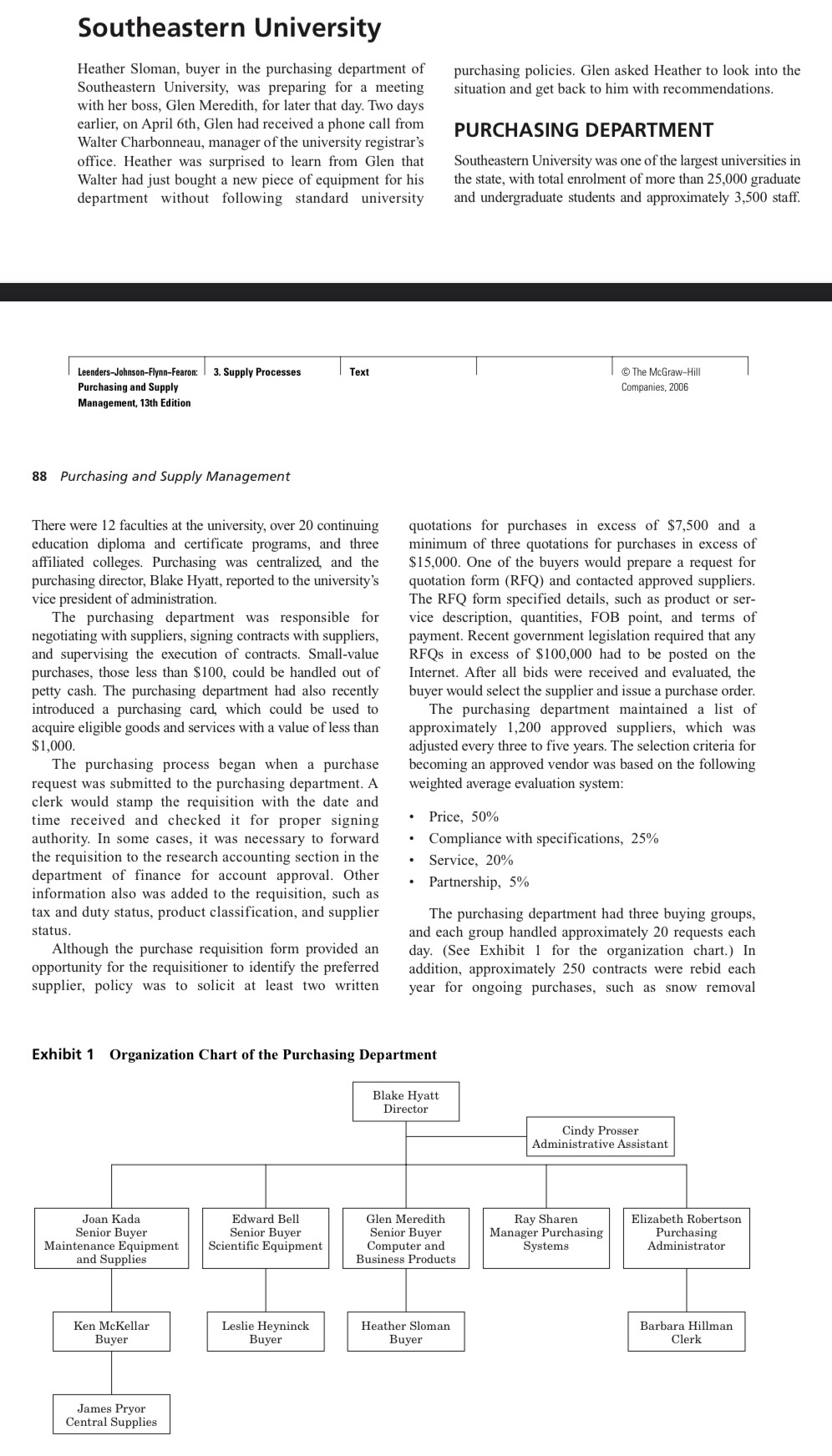
services and photocopier supplies. The total dollar volume of purchases amounted to $75 million of goods and services each year. According to Heather Sloman, the main objective of the purchasing department was to achieve the greatest cost savings. She commented on the role of purchasing at the university: "Our training in purchasing allows us to negotiate the best deals for the university and help avoid wasting university money." Although it was university policy that approval from the purchasing department was required before commitments could be made to suppliers, it was not unusual that university personnel contacted suppliers directly. Every year there were about 275 cases where contracts were signed with suppliers without prior approval of purchasing. Heather described what happened in these situations: "Most of the time, the only thing we can do is to call them and ask them to provide the details of the purchase. Usually the purchase has already been made, and there isn't much else that can be done." THE FOLDING MACHINE ISSUE The office of registrar handled about 160,000 pieces of mail a year. There were four major peaks of mailings each year: fees, admissions, records, and scholarships. As many as 50 to 60 people could be occupied manually stuffing envelops two days a month. A combination of full-time employees and temporary staff were used to perform this activity. Walter Charbonneau had seen an advertisement in a flyer for an automatic folding machine, which could be used to eliminate some of the manual work in dealing with mass mailings. He later contacted a representative of the company and placed an order for the machine, at a cost of $14,000. Glen was notified shortly after the machine had arrived because Walter needed to make arrangements for payment. As far as Heather knew, the machine had arrived only in the last few days and had not been installed. Heather found that the supplier of the folding machine was not on her approved supplier list. She then contacted three of her suppliers and received quotes of $10,000, $11,000, and $15,000 for similar equipment. The third quotation included one year of free service. HEATHER'S OPTIONS Heather recognized that some employees were going to ignore university policy from time to time and she had to be prepared to deal with such situations. However, if university staff failed to appreciate the benefits of sound purchasing practices, the university's centralized purchasing system would be undermined. When she spoke to Glen Meredith about the situation two days earlier, he said: "Let me know what we should do about this machine in the registrar's office. But also think about what else we can be doing to prevent these kinds of situations from happening again. These bad deals cost the university too much money each year. Besides, as a public institution, we must be extra careful to follow our procedures." There were a number of alternatives Heather was considering regarding the equipment. One option was to simply keep the machine and pay the supplier. However, she felt the equipment could be returned, and if nec- essary she could negotiate a cancellation penalty with the supplier. Alternatively, Heather could go back to the supplier and use the quotations to negotiate a lower price. Heather had about four hours before her meeting with Glen. As she sat down to prepare for the meeting, Heather thought about what she might say to Glen regarding avoiding future problems of this
Step by Step Solution
There are 3 Steps involved in it

Get step-by-step solutions from verified subject matter experts
 Study Help