







Question: 1. Reset the simulation and run different trials until you get a speed you feel comfortable with (it should be a value where you can
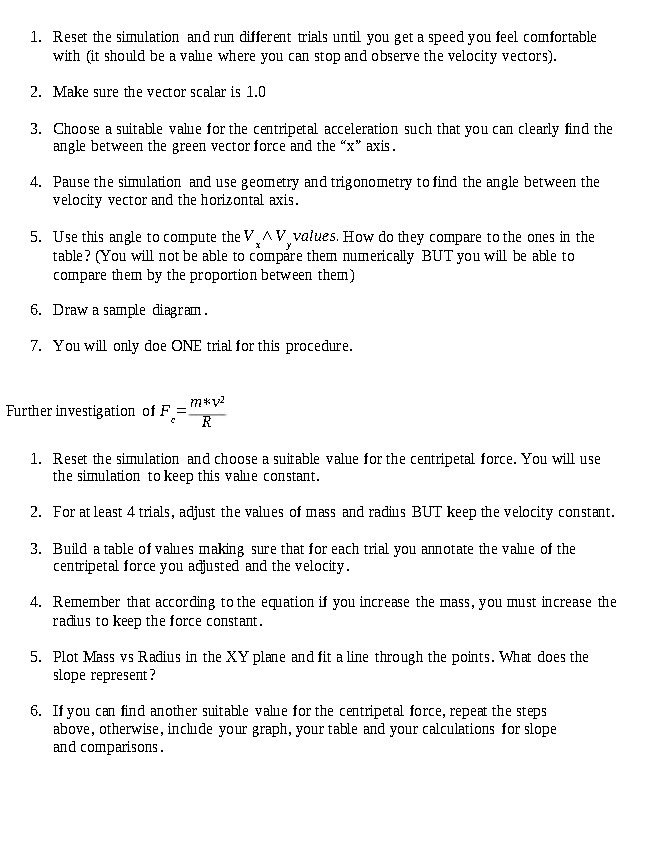
1. Reset the simulation and run different trials until you get a speed you feel comfortable with (it should be a value where you can stop and observe the velocity vectors). 2. Make sure the vector scalar is 1.0 3. Choose a suitable value for the centripetal acceleration such that you can clearly find the angle between the green vector force and the "x" axis. 4. Pause the simulation and use geometry and trigonometry to find the angle between the velocity vector and the horizontal axis. 5. Use this angle to compute the V A V values. How do they compare to the ones in the table? (You will not be able to compare them numerically BUT you will be able to compare them by the proportion between them) 6. Draw a sample diagram. 7. You will only doe ONE trial for this procedure. Further investigation of F - (7*v R 1. Reset the simulation and choose a suitable value for the centripetal force. You will use the simulation to keep this value constant. 2. For at least 4 trials, adjust the values of mass and radius BUT keep the velocity constant. 3. Build a table of values making sure that for each trial you annotate the value of the centripetal force you adjusted and the velocity. 4. Remember that according to the equation if you increase the mass, you must increase the radius to keep the force constant. 5. Plot Mass vs Radius in the XY plane and fit a line through the points. What does the slope represent ? 6. If you can find another suitable value for the centripetal force, repeat the steps above, otherwise, include your graph, your table and your calculations for slope and comparisons
Step by Step Solution
There are 3 Steps involved in it

Get step-by-step solutions from verified subject matter experts
 Study Help