







Question: 1. Review attachment Chapter 13 - Whole Organization and Multiple Organization Interventions (Part 2): Consolidated Construction Materials Supply - 1: A Case Study in Dialogic
1. Review attachment Chapter 13 - Whole Organization and Multiple Organization Interventions (Part 2): Consolidated Construction Materials Supply - 1: A Case Study in Dialogic OD and answer the following questions:
a. How are the consultant's actions similar to and different from conventional diagnostic OD?
b. What are the competing wants that managers at CCMS are trying to accomplish at the same time? Can you identify any internal contradictions, polarities, or paradoxes that may be part of why they haven't been able to get things under control?
c. What might be a generative image that could power this change activity?a phrase or question that captures all they want to do and would be compelling to employees?
d. If you were managers at CCMS and were about to invite employees to propose changes and act on those changes, what guidelines would you give them?
e. Who should be part of the steering committee for this change process?
Please include references. Thank you!
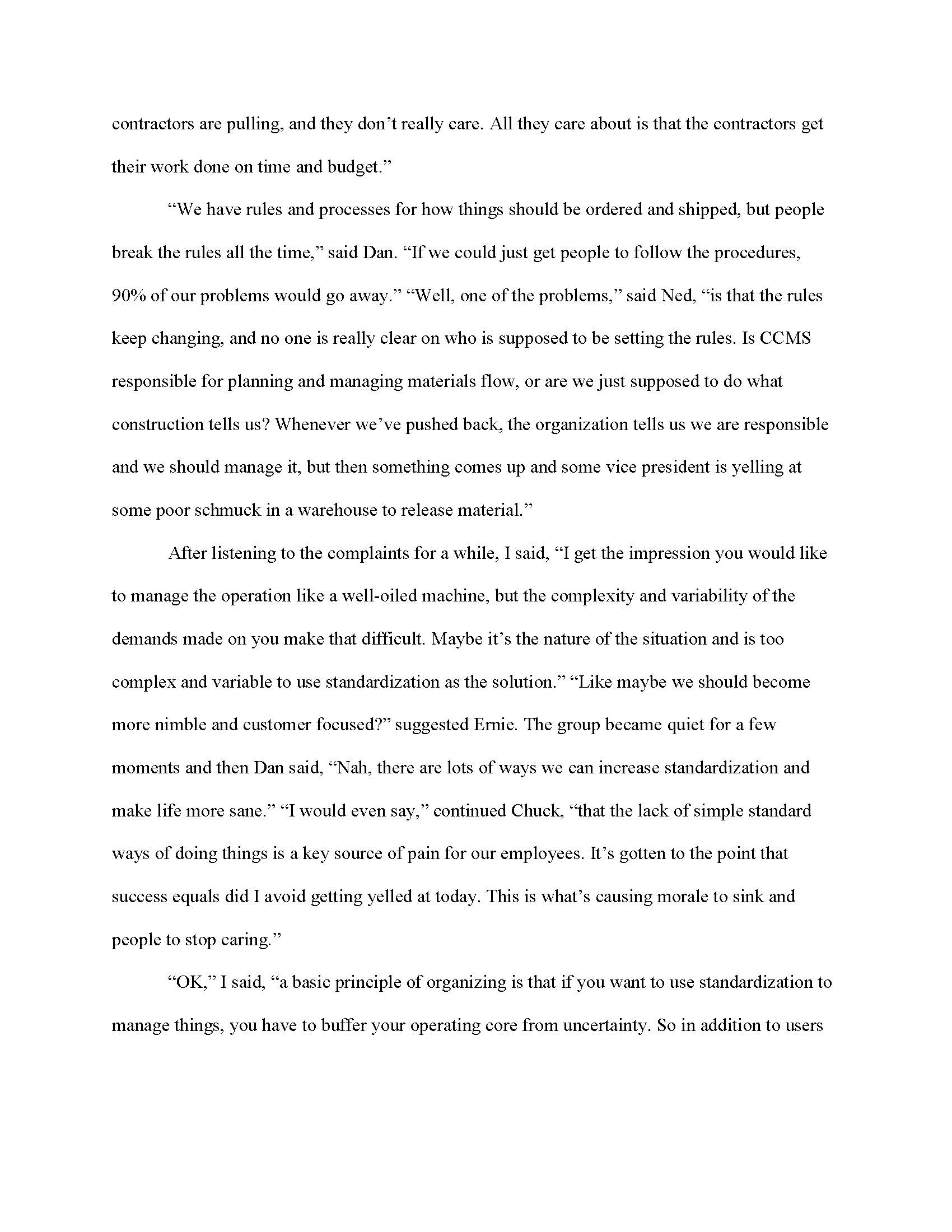
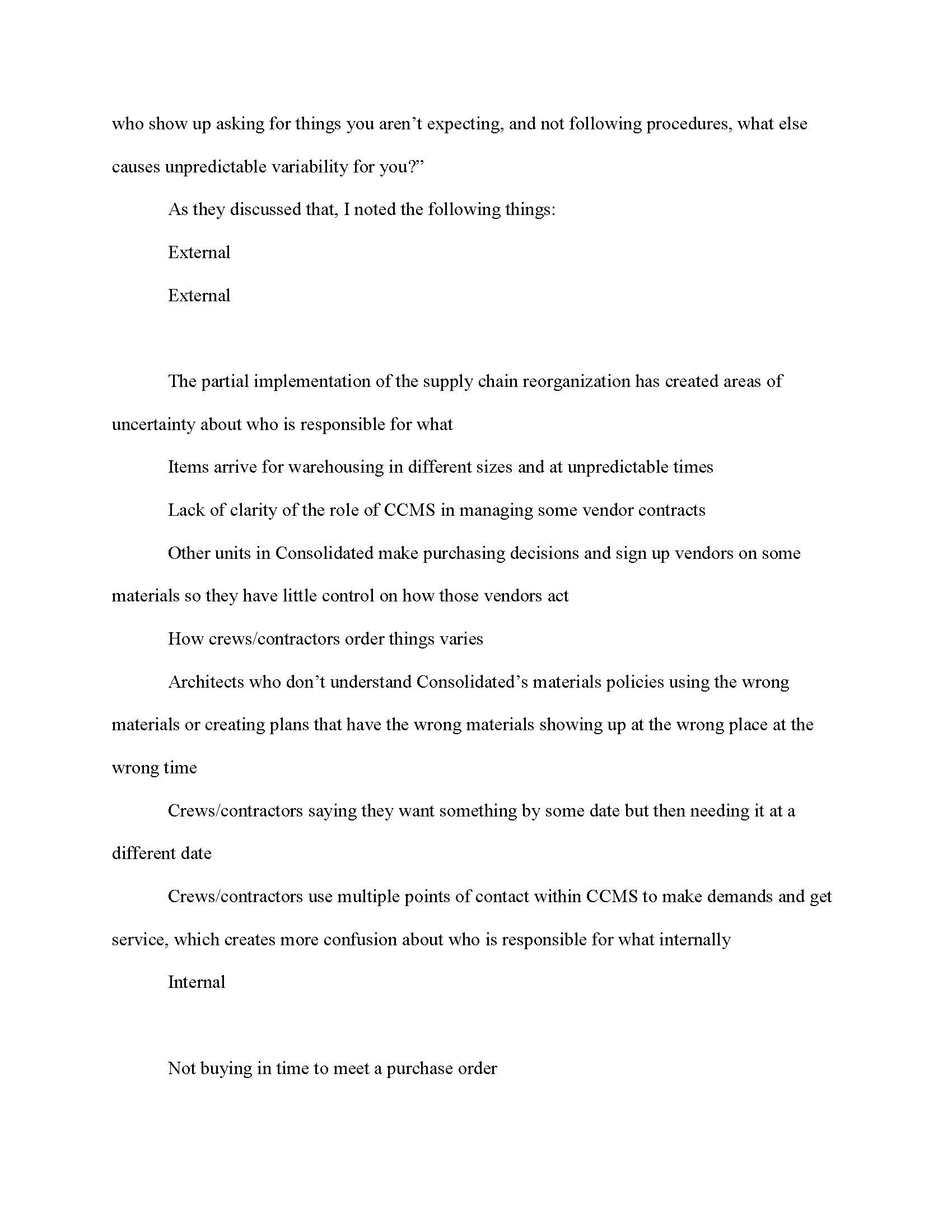
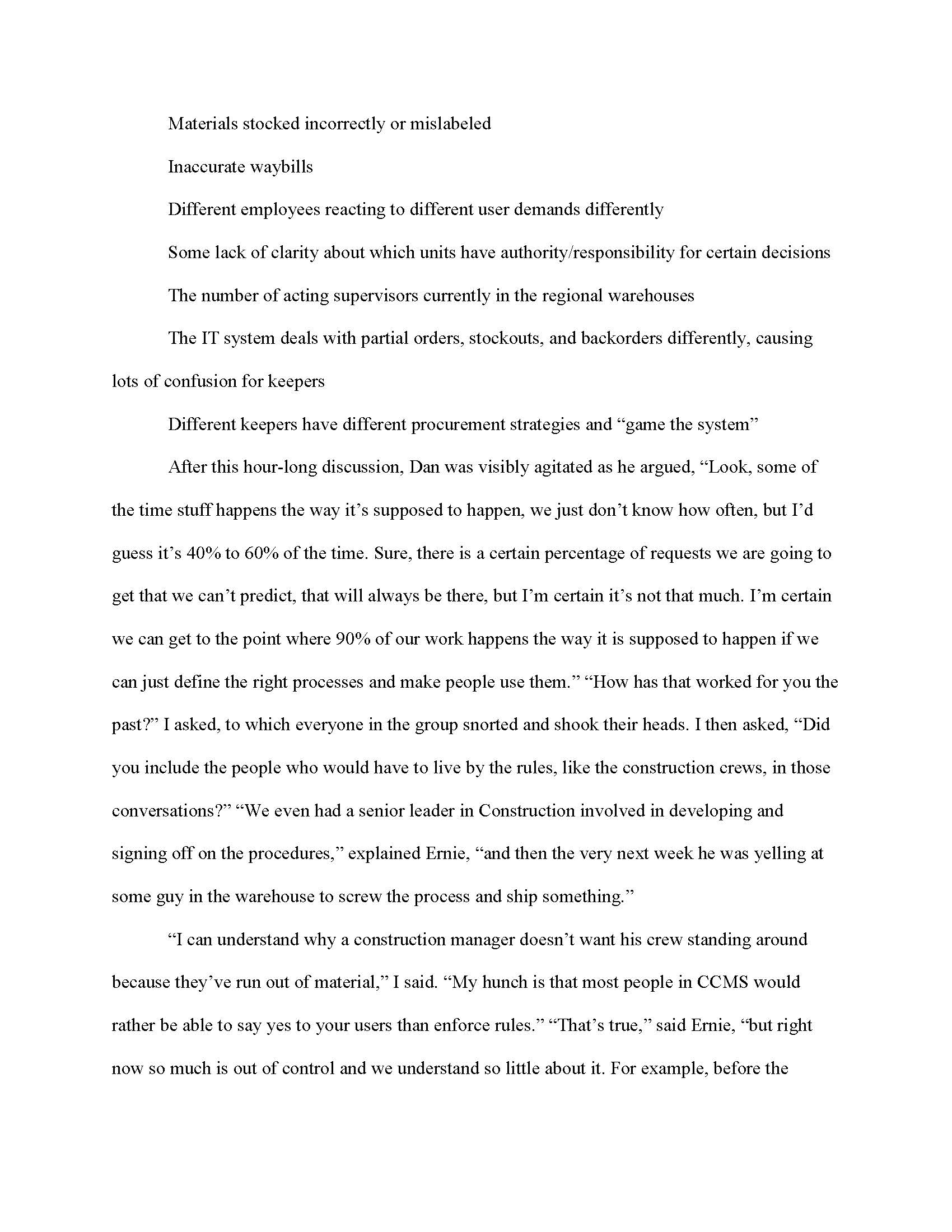
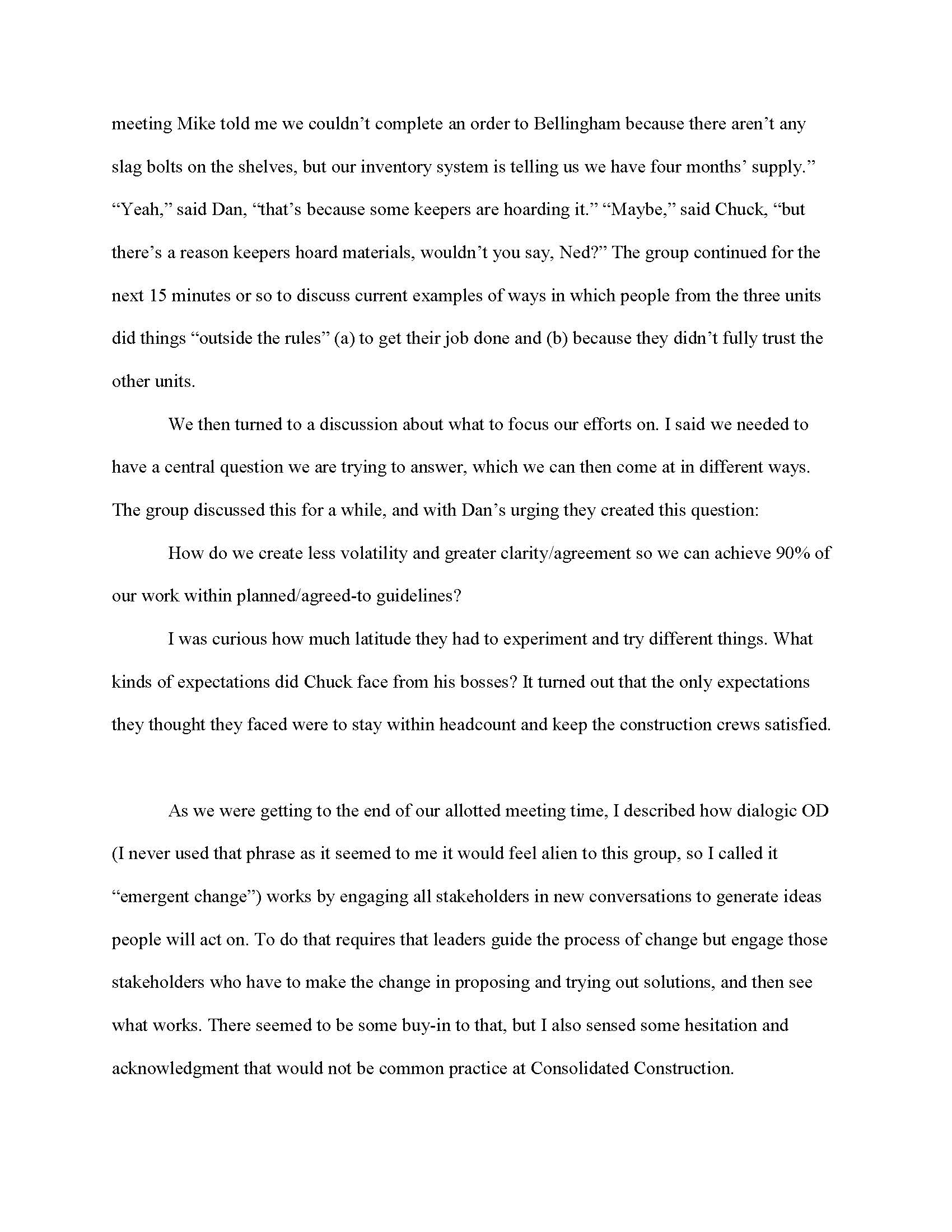
Three years ago I joined the company as manager of regional warehousing. Three months ago I was promoted to director of material supply. We have a lot of problems that are causing significant daily turmoil, and I think we really need to increase the amount of cooperation between the different units in the organization. I was at a talk you gave a few years ago on collaboration in organizations and what you said really made sense to me. I thought maybe you could help us out. This was part of the initial phone call from Chuck Hemsworth, director of material supply for Consolidated Construction, a large residential and commercial builder in the Pacific Northwest that had been operating for over 50 years. He had contacted me to see if I could help him make some changes to the Material Supply (CCMS) organization. Later that week, we met at his office near the central warehouse and he described an organization with so many issues that part of the problem was figuring out where to start. About 3 years earlier, Consolidated had hired one of the very large global consulting companies to develop a strategy and organizational structure for its entire supply chain, of which Material Supply was a part. Chuck's perception was that the consulting firm had copied the strategy and design of one of the better run large construction firms and presented that as a blueprint for Consolidated without really tailoring it to the unique characteristics of the company. In the past 3 years only about 40% of the recommendations had been implemented, and the consequence was that there were a lot internal processes that didn't work together well, an antiquated IT system, areas of supply where it wasn't clear who was in charge, issues with how construction crews ordered and received materials, and general low morale throughout.Chuck described the structure of Material Supply, with nearly 200 employees, as three functional units which were interdependent but tended to operate in isolation from each other (see Figure 13.1). He attributed that to the previous director's more hierarchical leadership style that did not create an environment of integration and teamwork across the managers of the various operations. The three units included Order and Scheduling (0&8), which was responsible for estimating what materials Consolidated would need in the next 6 to 12 months and making sure they didn't run out while keeping costs of goods on hand as low as possible. The Central Warehouse (CW) was where most of the materials Consolidated bought, from nails to lumber to furnaces, tools, and electrical, were initially shipped to, inspected, stored, and from where the regional warehouses made weekly orders that CW had to pack and ship as accurately and economically as possible. Regional Warehousing (RW) was a group of smaller materials distribution points scattered throughout the many small communities in the four states Consolidated operated in, and from which the construction crews got most of their materials. Chuck described Consolidated Construction as very hierarchical and used to a top-down management style. Many of the senior managers were engineers, and the company's approach to change was to have experts design the change and then try to implement it. The workforce, however, was mainly unionized longtime employees, which made it difficult to force changes that weren't accepted at the front lines. The experience with the reorganization of the supply chain was pretty typical. Change management programs came and went, often making life at the front lines worse rather than better, and there was a certain amount of cynicism throughout the organization. Chuck thought that nothing would get better without an increase in collaboration between the three units. He had begun holding monthly Management Team (MT) meetings with the managers of those units and felt that trust was being built, people were starting to communicate freely, and that they were interested in trying to make things better. Supervisors and employees below them, and people in the rest of the organization, were pretty guarded and cautious. He asked me what I thought he should do to increase collaboration and engagement. I explained my dialogic OD philosophy and approach, calling it \"emergent change.\" I said I didn't think he could increase collaboration by talking about itinstead, he had to create real opportunities for motivated people to collaborate. To do that, he had to identify one or more issues that people really cared about and bring them into well-designed conversations with each other. The fundamental principle was that the people who would have to make any change work had to be a part of the conversation. Those conversations would be organized to encourage people to propose changes that they would want to act on. Some of these would probably not work out and that was OK; the important thing was to encourage bottom-up action and learn as you go. I said I usually work through some kind of a steering committee that is a microcosm of the various parts and levels of the organization to identify the issues to work on and how to work on them emergently. Chuck thought emergent change would be very countercultural in Consolidated, but it fit his style and with what he was learning in the MBA program he was just completing. He thought we should begin by working through his MT meeting, so that is what we did. THE FIRST MT MEETING After Chuck introduced me to the group, I asked, \"Why are we here?\" and then sat back and listened for the better part of an hour as the group discussed its issues. Dan started off by describing their inability to get the construction crews to follow the rules for ordering materials and how that caused headaches for different people in different ways. \"A crew will come to a warehouse and ask for some material they see right in front of them. But they didn't order it like they should have, so if the keeper (a unionized employee who works at a regional warehouse) gives it to them, someone else who did order it is going to be out of luck. In some cases the keeper will say no, so the crew lead will call their boss who will call someone else, and the next thing you know the keeper is being yelled at by someone way up the food chain, so he ends up giving the crew what they wanted. So a lot of our keepers just give them what they want and then have to scramble to cover it.\" \"Yeah,\" said Ernie, \"or a keeper will call Central Warehouse needing a rush shipment of something and the person they get on the phone will tell them they have to follow the procedures, so the keeper will call someone else, and keep calling around until they nd someone who will rush them the material.\" \"The worst are the contractors,\" said Ned. \"They'll show up to pick up something they ordered, but then load as much other stuff as they can onto their trucks 'so they don't have to come back later.\"' In addition to in-house crews, Consolidated outsourced some of the work to a group of contractors. Part of Consolidated's business model was to buy materials at high discounted volumes and force its contractors to use Consolidated's materials, which ensured lower material prices and that contractors weren't marking up material costs. However, different contractors were better or worse at managing their own supply chains, and this caused a lot of unpredictability for CCMS. Ned continued: \"I've been to some of their yards where they have 6 months' worth of hardware sitting on shelves!\" Contractors were hired and managed by another division of Consolidated, Contractor Management, so any problems with contractors had to be taken to the other division to sort out. \"Contractor Management doesn't do anything to enforce material supply procedures,\" explained Chuck. \"They don't really understand the crap the contractors are pulling, and they don't really care. All they care about is that the contractors get their work done on time and budget.\" \"We have rules and processes for how things should be ordered and shipped, but people break the rules all the time,\" said Dan. \"If we could just get people to follow the procedures, 90% of our problems would go away.\" \"Well, one of the problems,\" said Ned, \"is that the rules keep changing, and no one is really clear on who is supposed to be setting the rules. Is CCMS responsible for planning and managing materials ow, or are we just supposed to do what construction tells us? Whenever we've pushed back, the organization tells us we are responsible and we should manage it, but then something comes up and some vice president is yelling at some poor schmuck in a warehouse to release material.\" After listening to the complaints for a while, I said, \"I get the impression you would like to manage the operation like a well-oiled machine, but the complexity and variability of the demands made on you make that diicult. Maybe it's the nature of the situation and is too complex and variable to use standardization as the solution.\" \"Like maybe we should become more nimble and customer focused?\" suggested Ernie. The group became quiet for a few moments and then Dan said, \"Nah, there are lots of ways we can increase standardization and make life more sane.\" \"I would even say,\" continued Chuck, \"that the lack of simple standard ways of doing things is a key source of pain for our employees. It's gotten to the point that success equals did I avoid getting yelled at today. This is what's causing morale to sink and people to stop caring.\" \"OK,\" I said, \"a basic principle of organizing is that if you want to use standardization to manage things, you have to buffer your operating core from uncertainty. So in addition to users who show up asking for things you aren't expecting, and not following procedures, what else causes unpredictable variability for you?\" As they discussed that, I noted the following things: External External The partial implementation of the supply chain reorganization has created areas of uncertainty about who is responsible for what Items arrive for warehousing in different sizes and at unpredictable times Lack of clarity of the role of CCMS in managing some vendor contracts Other units in Consolidated make purchasing decisions and Sign up vendors on some materials so they have little control on how those vendors act How crews/contractors order things varies Architects who don't understand Consolidated's materials policies using the wrong materials or creating plans that have the wrong materials showing up at the wrong place at the wrong time Crews/contractors saying they want something by some date but then needing it at a different date Crews/ contractors use multiple points of contact within CCMS to make demands and get service, which creates more confusion about who is responsible for what internally Internal Not buying in time to meet a purchase order Materials stocked incorrectly or mislabeled Inaccurate waybills Different employees reacting to different user demands differently Some lack of clarity about which units have authority/responsibility for certain decisions The number of acting supervisors currently in the regional warehouses The IT system deals with partial orders, stockouts, and backorders differently, causing lots of confusion for keepers Different keepers have different procurement strategies and \"game the system\" After this hour-long discussion, Dan was visibly agitated as he argued, \"Look, some of the time stuff happens the way it's supposed to happen, we just don't know how often, but I'd guess it's 40% to 60% of the time. Sure, there is a certain percentage of requests we are going to get that we can't predict, that will always be there, but I'm certain it's not that much. I'm certain we can get to the point where 90% of our work happens the way it is supposed to happen if we can just define the right processes and make people use them.\" \"How has that worked for you the past?\" I asked, to which everyone in the group snorted and shook their heads. Ithen asked, \"Did you include the people who would have to live by the rules, like the construction crews, in those conversations?\" \"We even had a senior leader in Construction involved in developing and signing off on the procedures,\" explained Ernie, \"and then the very next week he was yelling at some guy in the warehouse to screw the process and ship something.\" \"I can understand why a construction manager doesn't want his crew standing around because they've run out of material,\" I said. \"My hunch is that most people in CCMS would rather be able to say yes to your users than enforce rules.\" \"That's true,\" said Ernie, \"but right now so much is out of control and we understand so little about it. For example, before the meeting Mike told me we couldn't complete an order to Bellingham because there aren't any slag bolts on the shelves, but our inventory system is telling us we have four months' supply.\" \"Yeah,\" said Dan, \"that's because some keepers are hoarding it.\" \"Maybe,\" said Chuck, \"but there's a reason keepers hoard materials, wouldn't you say, Ned?\" The group continued for the next 15 minutes or so to discuss current examples of ways in which people from the three units did things \"outside the rules\" (a) to get their job done and (b) because they didn't fully trust the other units. We then turned to a discussion about what to focus our efforts on. I said we needed to have a central question we are trying to answer, which we can then come at in different ways. The group discussed this for a while, and with Dan's urging they created this question: How do we create less volatility and greater clarity/agreement so we can achieve 90% of our work within planned/agreed-to guidelines? I was curious how much latitude they had to experiment and try different things. What kinds of expectations did Chuck face from his bosses? It turned out that the only expectations they thought they faced were to stay within headcount and keep the construction crews satised. As we were getting to the end of our allotted meeting time, I described how dialogic OD (I never used that phrase as it seemed to me it would feel alien to this group, so I called it \"emergent change\") works by engaging all stakeholders in new conversations to generate ideas people will act on. To do that requires that leaders guide the process of change but engage those stakeholders who have to make the change in proposing and trying out solutions, and then see what works. There seemed to be some buy-in to that, but I also sensed some hesitation and acknowledgment that would not be common practice at Consolidated Construction
Step by Step Solution
There are 3 Steps involved in it

Get step-by-step solutions from verified subject matter experts
 Study Help