







Question: 1. select the correct words in Bold Quantitative easing is an example of ( traditional / Non-traditional ) monetary policy, which is generally used when
1. select the correct words in Bold
Quantitative easing is an example of (traditional / Non-traditional) monetary policy, which is generally used when interest rates are (well above / near zero) zero.
During the 2008 credit crisis, the Federal Reserve created a term asset-backed security loan facility (TALF) that (purchased / sold) (high quality / low quality) bonds backed by consumer loans, credit card loans, and automobile loans. Because investors were concerned about consumers defaulting on these loans, the (primary / secondary) market became inactive. Consequently, financial institutions stopped making consumer loans. The TALF provided loans to institutional investors that (purchased / sold) these types of loans. In this way, the Federal Reserve engaged in (quantitive easing / traditional monetary policies) to (decrease / increase) liquidity in the market for these securities.
2.
3. Select correct bold word:
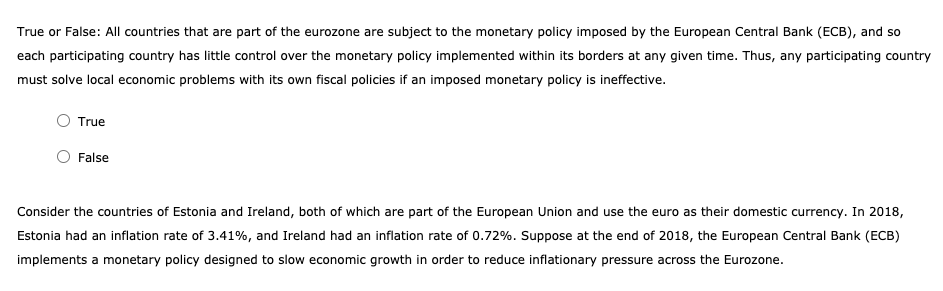
Given the inflation rates of Estonia and Ireland in 2018, Estonia would benefit (more / less) from this monetary policy than Ireland. As a result, (Estonia / Ireland) should consider using fiscal policy to solve its local economic problems.
True or False: All countries that are part of the eurozone are subject to the monetary policy imposed by the European Central Bank (ECB), and so each participating country has little control over the monetary policy implemented within its borders at any given time. Thus, any participating country must solve local economic problems with its own fiscal policies if an imposed monetary policy is ineffective. True False Consider the countries of Estonia and Ireland, both of which are part of the European Union and use the euro as their domestic currency. In 2018, Estonia had an inflation rate of 3.41%, and Ireland had an inflation rate of 0.72%. Suppose at the end of 2018, the European Central Bank (ECB) implements a monetary policy designed to slow economic growth in order to reduce inflationary pressure across the Eurozone
Step by Step Solution
There are 3 Steps involved in it

Get step-by-step solutions from verified subject matter experts
 Study Help