



Question: (1) Shareholder Value & Market Efficiency (Chapter 5) a. Suppose that you purchase a newly issued 10-year U.S. Treasury bond for $10,000. The bond has
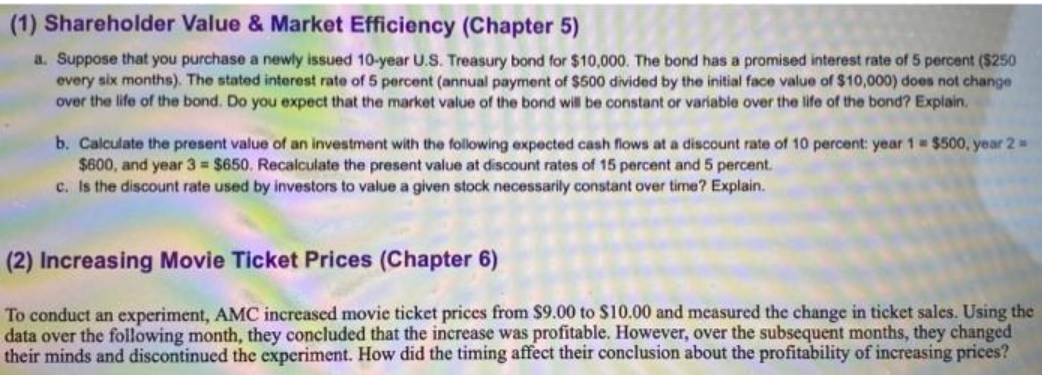
(1) Shareholder Value & Market Efficiency (Chapter 5) a. Suppose that you purchase a newly issued 10-year U.S. Treasury bond for $10,000. The bond has a promised interest rate of 5 percent ($250 every six months). The stated interest rate of 5 percent (annual payment of $500 divided by the initial face value of $10,000) does not change over the life of the bond. Do you expect that the market value of the bond will be constant or variable over the life of the bond? Explain. b. Calculate the present value of an investment with the following expected cash flows at a discount rate of 10 percent: year 1 = $500, year 2 $600, and year 3 = $650. Recalculate the present value at discount rates of 15 percent and 5 percent. C. Is the discount rate used by investors to value a given stock necessarily constant over time? Explain. (2) Increasing Movie Ticket Prices (Chapter 6) To conduct an experiment, AMC increased movie ticket prices from $9.00 to $10.00 and measured the change in ticket sales. Using the data over the following month, they concluded that the increase was profitable. However, over the subsequent months, they changed their minds and discontinued the experiment. How did the timing affect their conclusion about the profitability of increasing prices
Step by Step Solution
There are 3 Steps involved in it

Get step-by-step solutions from verified subject matter experts