







Question: 1. Simplify the following. Write the final answer in the form r + iy. (@) 1- 6i (b) = - 47 (c) (5+ {)-1 (d)
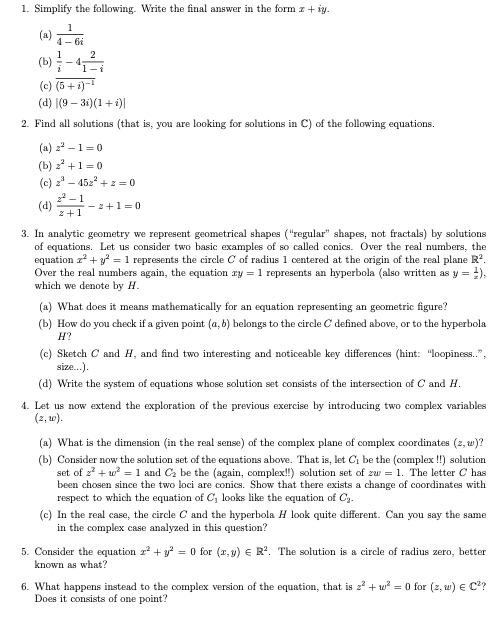
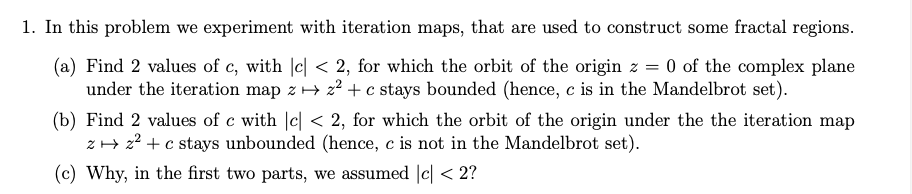
1. Simplify the following. Write the final answer in the form r + iy. (@) 1- 6i (b) = - 47 (c) (5+ {)-1 (d) |(9 - 30) (1 + ()| 2. Find all solutions (that is, you are looking for solutions in C) of the following equations. (a) 23-1=0 (b) 2 +1=0 (c) 2- 452' + 2 = 0 2 -1 (d) = 2+1 -2+1=0 3. In analytic geometry we represent geometrical shapes ( "regular" shapes, not fractals) by solutions of equations. Let us consider two basic examples of so called conics. Over the real numbers, the equation ' + y' = 1 represents the circle C of radius 1 centered at the origin of the real plane R". Over the real numbers again, the equation ry = 1 represents an hyperbola (also written as y = =), which we denote by H. (a) What does it means mathematically for an equation representing an geometric figure? (b) How do you check if a given point (a, b) belongs to the circle C defined above, or to the hyperbola H? (c) Sketch C and #, and find two interesting and noticeable key differences (hint: "loopiness.."; size...). (d) Write the system of equations whose solution set consists of the intersection of C and H. 4. Let us now extend the exploration of the previous exercise by introducing two complex variables ( z, W). (a) What is the dimension (in the real sense) of the complex plane of complex coordinates (z, w)? (b) Consider now the solution set of the equations above. That is, let Ci be the (complex !!) solution set of 2 + w = 1 and C be the (again, complex!!) solution set of zur = 1. The letter C has been chosen since the two loci are conics. Show that there exists a change of coordinates with respect to which the equation of Of looks like the equation of Of- (c) In the real case, the circle C and the hyperbola # look quite different. Can you say the same in the complex case analyzed in this question? 5. Consider the equation s' +y' = 0 for (x,y) 6 R'. The solution is a circle of radius zero, better known as what? 6. What happens instead to the complex version of the equation, that is 2 + w= 0 for (2, w) e C*? Does it consists of one point?1. In this problem we experiment with iteration maps, that are used to construct some fractal regions. (a) Find 2 values of c, with |c|
Step by Step Solution
There are 3 Steps involved in it

Get step-by-step solutions from verified subject matter experts
 Study Help