







Question: 1 Single photon wavepacket One considers the most general, normalzedono photon state: 11)wp-c41). The indes represents a plane wave propagating in the Os direction with
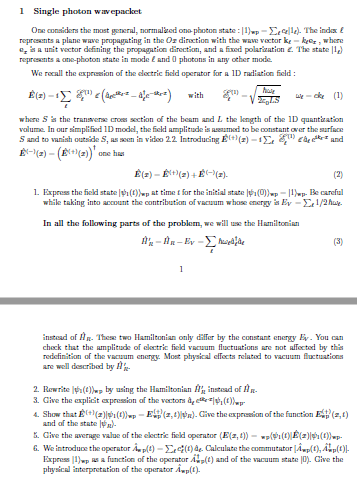
1 Single photon wavepacket One considers the most general, normalzedono photon state: 11)wp-c41). The indes represents a plane wave propagating in the Os direction with the wave vector ke-kee, where esa unit vector defining the propagation direction, and a fixed polarization 2. The state (12) represents a one-photon state in model and photos in any other mode We recall the expression of the electric field operator for a 1D radiation field: (E) - (druhe e-*) with Lycke (1) where the tranese crom section of the beam and L the length of the 1D quantization volume. In our simplified ID mode, the field amplitude is named to be constant over the surface S and to vanish outside S, as seen in video 22 Introducing C+ (2) - 12 dels and Ex-1(2) - (x+(z)' one has (E)- S+)(z) +-). (2) 1. Express the field statel:(0))wp at time for the initial state, 0))-p-11)wp. Be careful while taking into account the contribution of vacuum whose energy & Ev - 1/2 hug. In all the following parts of the problem, we will be the Hamiltonian H - HR - - (3) - 1 instead of Mr. These two Hamiltonian only differ by the constant energy Ey. You can check that the amplitude of clectric field vauum fluctuations are not affected by this redefinition of the Regum energy. Most physical effects related to vacuum fluctuations are well described by 2. Rewrite()), by using the Hamiltonian instead of r. 3. Give the explicit expression of the vectors de la 4. Show that 6+)(2) 9 (0) - EL(2, tylyn). Give the expression of the function (2,1) and of the state le 6. Give the average value of the electric field operator (E(2,4)) - ply(t) )()wp- 6. We introduce the operator Aapk) - (0) 4. Calculate the commutator Apt), Ap(t)- Express (1) pas a function of the operator Att) and of the vacuum state: 10). Give the physical interpretation of the operator Axplt). 1 Single photon wavepacket One considers the most general, normalzedono photon state: 11)wp-c41). The indes represents a plane wave propagating in the Os direction with the wave vector ke-kee, where esa unit vector defining the propagation direction, and a fixed polarization 2. The state (12) represents a one-photon state in model and photos in any other mode We recall the expression of the electric field operator for a 1D radiation field: (E) - (druhe e-*) with Lycke (1) where the tranese crom section of the beam and L the length of the 1D quantization volume. In our simplified ID mode, the field amplitude is named to be constant over the surface S and to vanish outside S, as seen in video 22 Introducing C+ (2) - 12 dels and Ex-1(2) - (x+(z)' one has (E)- S+)(z) +-). (2) 1. Express the field statel:(0))wp at time for the initial state, 0))-p-11)wp. Be careful while taking into account the contribution of vacuum whose energy & Ev - 1/2 hug. In all the following parts of the problem, we will be the Hamiltonian H - HR - - (3) - 1 instead of Mr. These two Hamiltonian only differ by the constant energy Ey. You can check that the amplitude of clectric field vauum fluctuations are not affected by this redefinition of the Regum energy. Most physical effects related to vacuum fluctuations are well described by 2. Rewrite()), by using the Hamiltonian instead of r. 3. Give the explicit expression of the vectors de la 4. Show that 6+)(2) 9 (0) - EL(2, tylyn). Give the expression of the function (2,1) and of the state le 6. Give the average value of the electric field operator (E(2,4)) - ply(t) )()wp- 6. We introduce the operator Aapk) - (0) 4. Calculate the commutator Apt), Ap(t)- Express (1) pas a function of the operator Att) and of the vacuum state: 10). Give the physical interpretation of the operator Axplt)
Step by Step Solution
There are 3 Steps involved in it

Get step-by-step solutions from verified subject matter experts
 Study Help