







Question: 1. So WHY AREN'T more doing self management for their organizations? 2. Would this work where you work? ( in a gym with children coaching
1. So WHY AREN'T more doing self management for their organizations?
2. Would this work where you work? ( in a gym with children coaching gymnastics)
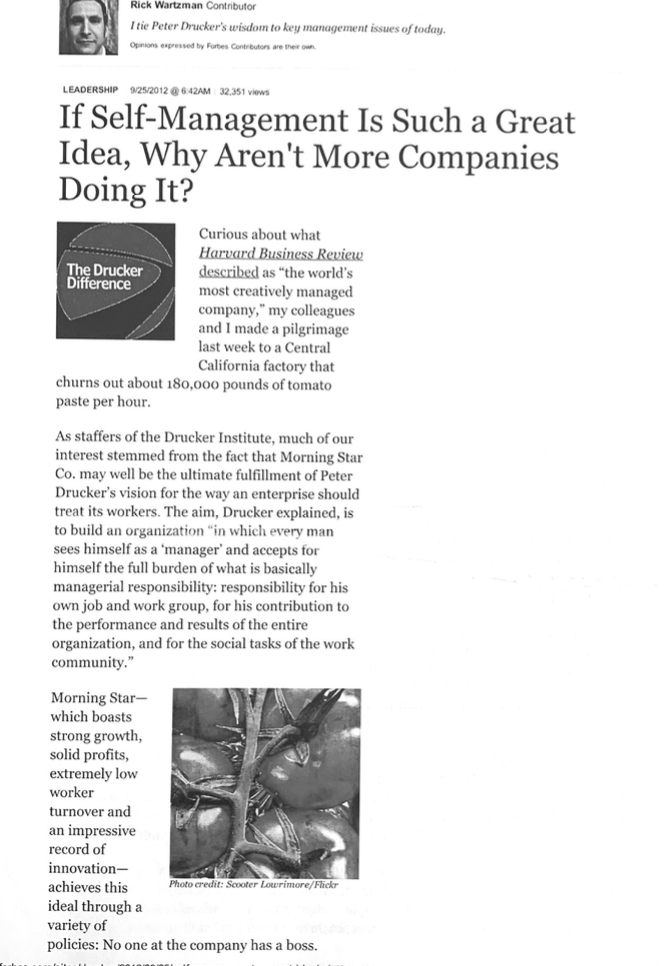
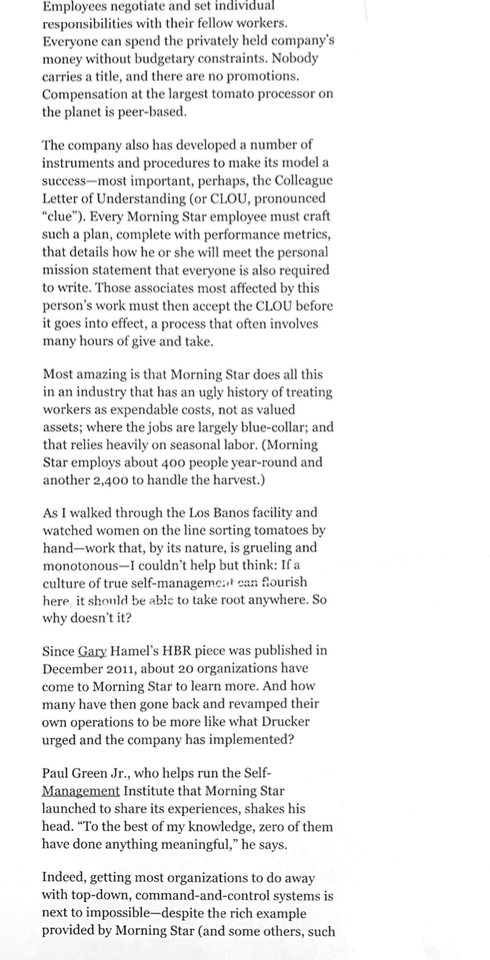
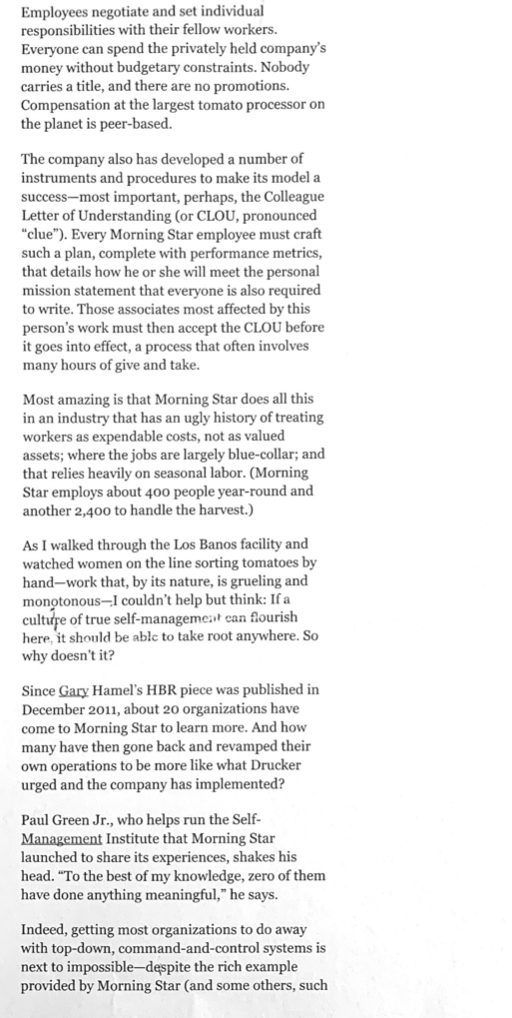
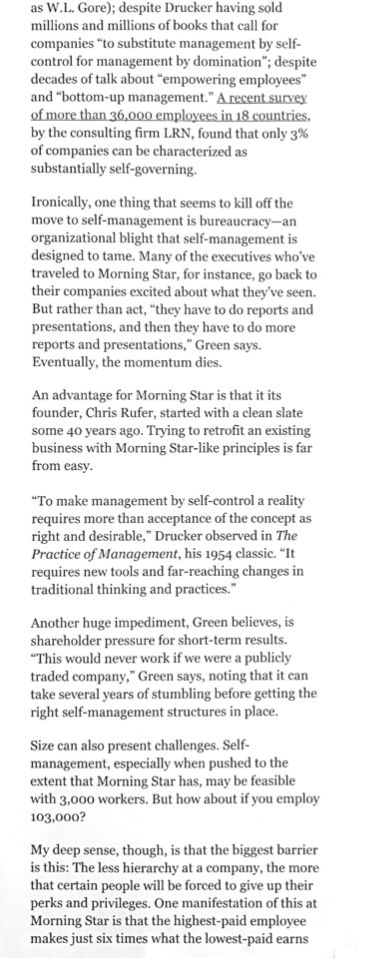
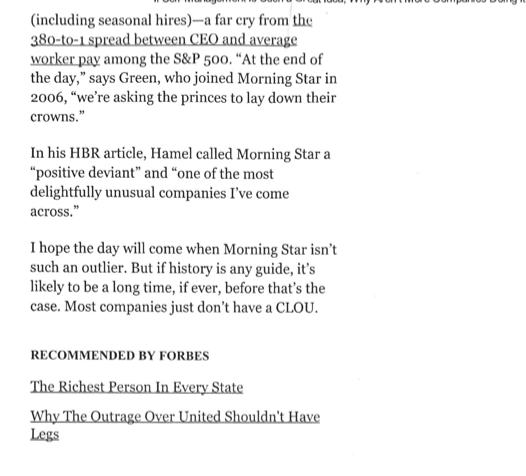
Rick Wartzman Contributor I tie Peter Drucker's wisdom to key management issues of today. Oprions eapressed by Fortes Contributors are ther oun. LEADERSHIP 9/25/2012 (4) 6.42AM 32,351 views If Self-Management Is Such a Great Idea, Why Aren't More Companies Doing It? Curious about what Harvard Business Review described as "the world's most creatively managed company," my colleagues and I made a pilgrimage last week to a Central California factory that churns out about 180,000 pounds of tomato paste per hour. As staffers of the Drucker Institute, much of our interest stemmed from the fact that Morning Star Co. may well be the ultimate fulfillment of Peter Drucker's vision for the way an enterprise should treat its workers. The aim, Drucker explained, is to build an organization "in which every man sees himself as a 'manager' and accepts for himself the full burden of what is basically managerial responsibility: responsibility for his own job and work group, for his contribution to the performance and results of the entire organization, and for the social tasks of the work community." Employees negotiate and set individual responsibilities with their fellow workers. Everyone can spend the privately held company's money without budgetary constraints. Nobody carries a title, and there are no promotions. Compensation at the largest tomato processor on the planet is peer-based. The company also has developed a number of instruments and procedures to make its model a success-most important, perhaps, the Colleague Letter of Understanding (or CLOU, pronounced "clue"). Every Morning Star employee must craft such a plan, complete with performance metrics, that details how he or she will meet the personal mission statement that everyone is also required to write. Those associates most affected by this person's work must then accept the CLOU before it goes into effect, a process that often involves many hours of give and take. Most amazing is that Morning Star does all this in an industry that has an ugly history of treating workers as expendable costs, not as valued assets; where the jobs are largely blue-collar; and that relies heavily on seasonal labor. (Morning Star employs about 400 people year-round and another 2,400 to handle the harvest.) As I walked through the Los Banos facility and watched women on the line sorting tomatoes by hand-work that, by its nature, is grueling and monotonous-I couldn't help but think: If a culture of true self-manageme:, can fourish here it should be able to take root anywhere. So why doesn't it? Since Gary Hamel's HBR piece was published in December 2011, about 20 organizations have come to Morning Star to learn more. And how many have then gone back and revamped their own operations to be more like what Drucker urged and the company has implemented? Paul Green Jr., who helps run the SelfManagement Institute that Morning Star launched to share its experiences, shakes his head. "To the best of my knowledge, zero of them have done anything meaningful," he says. Indeed, getting most organizations to do away with top-down, command-and-control systems is next to impossible-despite the rich example provided by Morning Star (and some others, such Employees negotiate and set individual responsibilities with their fellow workers. Everyone can spend the privately held company's money without budgetary constraints. Nobody carries a title, and there are no promotions. Compensation at the largest tomato processor on the planet is peer-based. The company also has developed a number of instruments and procedures to make its model a success-most important, perhaps, the Colleague Letter of Understanding (or CLOU, pronounced "clue"). Every Morning Star employee must craft such a plan, complete with performance metrics, that details how he or she will meet the personal mission statement that everyone is also required to write. Those associates most affected by this person's work must then accept the CLOU before it goes into effect, a process that often involves many hours of give and take. Most amazing is that Morning Star does all this in an industry that has an ugly history of treating workers as expendable costs, not as valued assets; where the jobs are largely blue-collar; and that relies heavily on seasonal labor. (Morning Star employs about 400 people year-round and another 2,400 to handle the harvest.) As I walked through the Los Banos facility and watched women on the line sorting tomatoes by hand-work that, by its nature, is grueling and monotonous-I couldn't help but think: If a culture of true self-managemeit ean flourish here, it should be able to take root anywhere. So why doesn't it? Since Gary Hamel's HBR piece was published in December 2011, about 20 organizations have come to Morning Star to learn more. And how many have then gone back and revamped their own operations to be more like what Drucker urged and the company has implemented? Paul Green Jr., who helps run the SelfManagement Institute that Morning Star launched to share its experiences, shakes his head. "To the best of my knowledge, zero of them have done anything meaningful," he says. Indeed, getting most organizations to do away with top-down, command-and-control systems is next to impossible-despite the rich example provided by Morning Star (and some others, such millions and millions of books that call for companies "to substitute management by selfcontrol for management by domination"; despite decades of talk about "empowering employees" and "bottom-up management." A recent survey of more than 36,000 employees in 18 countries, by the consulting firm LRN, found that only 3% of companies can be characterized as substantially self-governing. Ironically, one thing that seems to kill off the move to self-management is bureaucracy-an organizational blight that self-management is designed to tame. Many of the executives who've traveled to Morning Star, for instance, go back to their companies excited about what they've seen. But rather than act, "they have to do reports and presentations, and then they have to do more reports and presentations," Green says. Eventually, the momentum dies. An advantage for Morning Star is that it its founder, Chris Rufer, started with a clean slate some 40 years ago. Trying to retrofit an existing business with Morning Star-like principles is far from easy. "To make management by self-control a reality requires more than acceptance of the concept as right and desirable," Drucker observed in The Practice of Management, his 1954 classic. "It requires new tools and far-reaching changes in traditional thinking and practices." Another huge impediment, Green believes, is shareholder pressure for short-term results. "This would never work if we were a publicly traded company," Green says, noting that it can take several years of stumbling before getting the right self-management structures in place. Size can also present challenges. Selfmanagement, especially when pushed to the extent that Morning Star has, may be feasible with 3,000 workers. But how about if you employ 103,000 ? My deep sense, though, is that the biggest barrier is this: The less hierarchy at a company, the more that certain people will be forced to give up their perks and privileges. One manifestation of this at Morning Star is that the highest-paid employee makes just six times what the lowest-paid earns (including seasonal hires) - a far cry from the 380-to-1 spread between CEO and average worker pay among the S\&P 500. "At the end of the day," says Green, who joined Morning Star in 2006, "we're asking the princes to lay down their crowns." In his HBR article, Hamel called Morning Star a "positive deviant" and "one of the most delightfully unusual companies I've come across." I hope the day will come when Morning Star isn't such an outlier. But if history is any guide, it's likely to be a long time, if ever, before that's the case. Most companies just don't have a CLOU. RECOMMENDED BY FORBES The Richest Person In Every State Why The Outrage Over United Shouldn't Have LegsStep by Step Solution
There are 3 Steps involved in it
1 Expert Approved Answer
Step: 1 Unlock

Question Has Been Solved by an Expert!
Get step-by-step solutions from verified subject matter experts
Step: 2 Unlock
Step: 3 Unlock
 Study Help