







Question: 1. Solve this problem using calculus. Consider a variant of the dynamic GE model with production. In this problem you will extend the model to
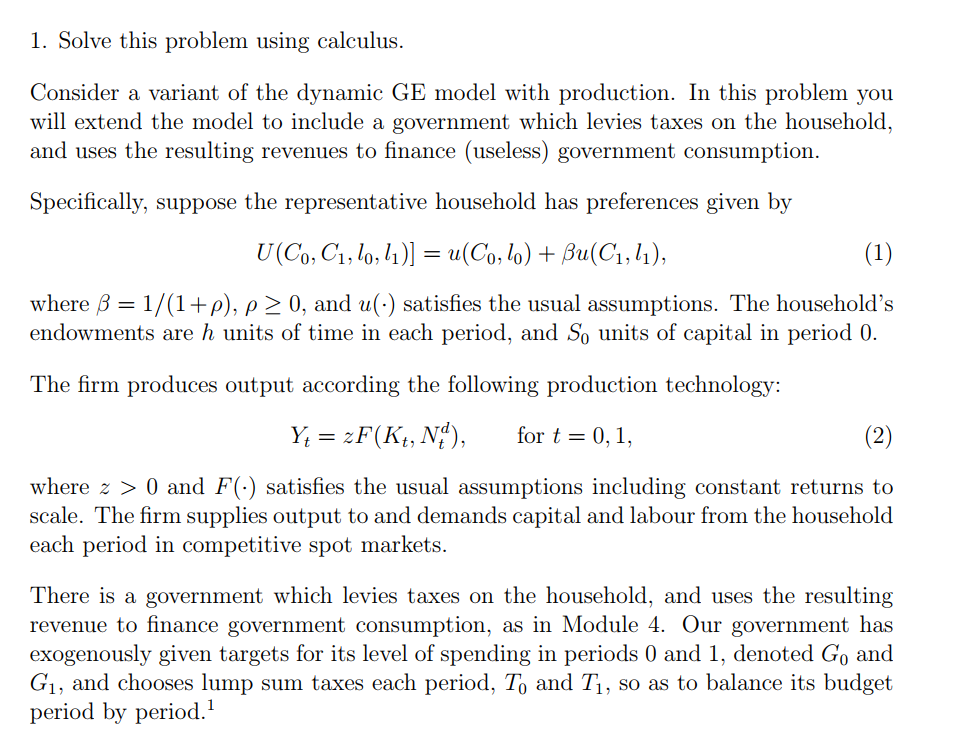
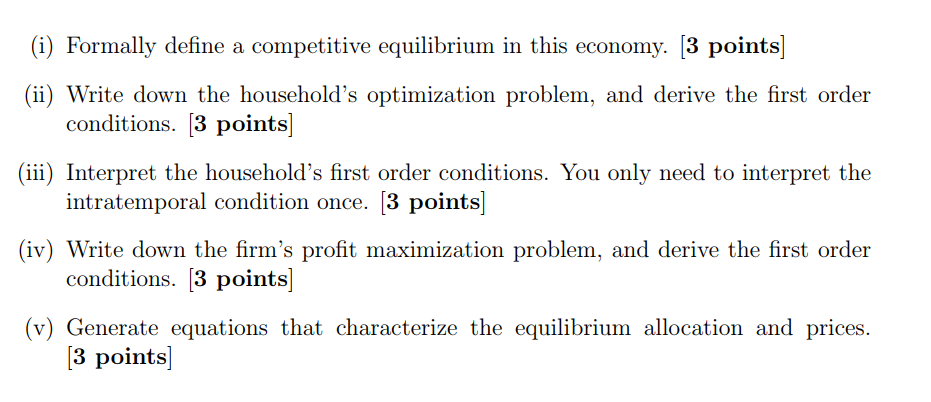
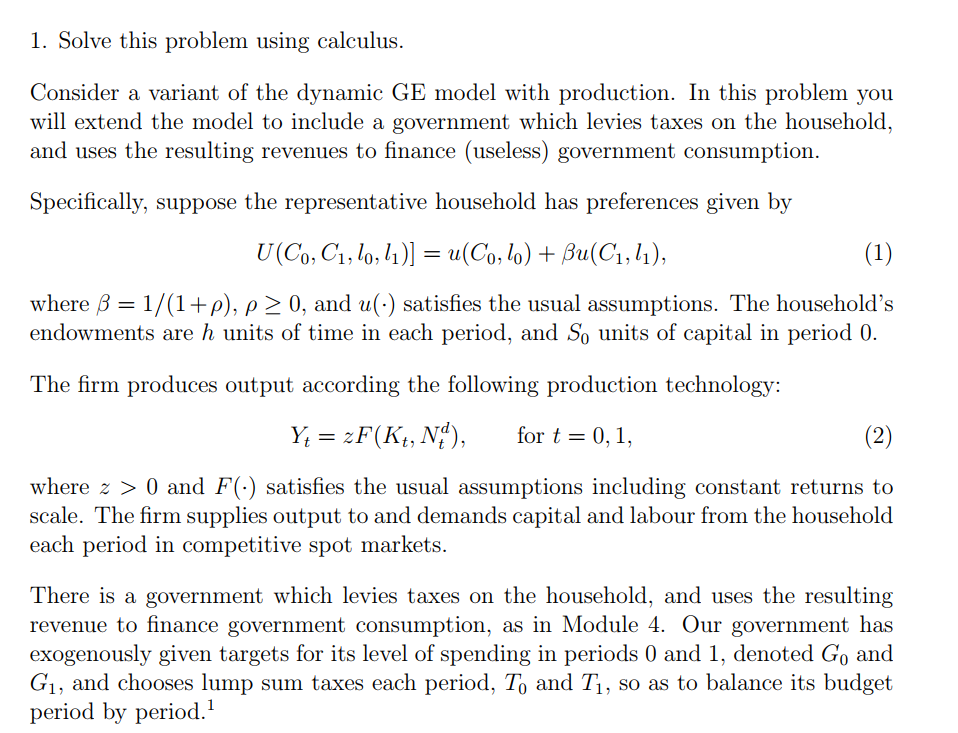
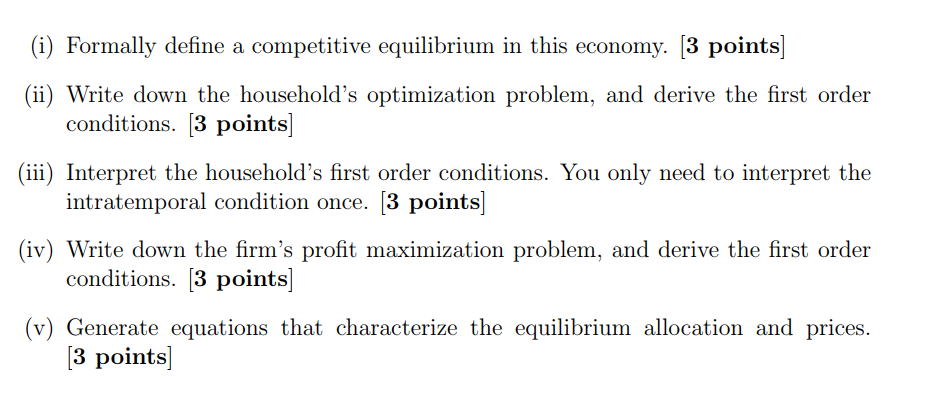
1. Solve this problem using calculus. Consider a variant of the dynamic GE model with production. In this problem you will extend the model to include a government which levies taxes on the household, and uses the resulting revenues to nance (useless) government consumption. Specically, suppose the representative household has preferences given by W00; 01:50:51)] = \"(00: 50) + W01, 11), (1) where {3' = 1/(1 + p), p 2 0, and u(-) satises the usual assumptions. The household's endowments are h units of time in each period, and 30 units of capital in period 0. The rm produces output according the following production technology: 1/; = zF(K,,Nf), for t = 0,1, (2) where z > 0 and F(-) satises the usual assumptions including constant returns to scale. The rm supplies output to and demands capital and labour from the household each period in competitive spot markets. There is a government which levies taxes on the household, and uses the resulting revenue to nance government consumption, as in Module 4. Our government has exogenously given targets for its level of spending in periods 0 and 1, denoted G0 and G1, and chooses lump sum taxes each period, To and T1, so as to balance its budget period by period.1 (i) Formally define a competitive equilibrium in this economy. [3 points] (ii) Write down the household's optimization problem, and derive the first order conditions. [3 points] (iii) Interpret the household's first order conditions. You only need to interpret the intratemporal condition once. 3 points] (iv) Write down the firm's profit maximization problem, and derive the first order conditions. [3 points] (v) Generate equations that characterize the equilibrium allocation and prices. [3 points]
Step by Step Solution
There are 3 Steps involved in it

Get step-by-step solutions from verified subject matter experts
 Study Help