







Question: 1 ST Comprehensive Problem Page 91-94 Sun Microsystems Case #1 Sun Microsystems Questions (pp. 92-95) Sun Microsystems (trends, ratios stock performance) (LO3) Sun Microsystems is
1ST Comprehensive Problem Page 91-94 Sun Microsystems
Case #1 Sun Microsystems Questions (pp. 92-95)
Sun Microsystems (trends, ratios stock performance) (LO3) Sun Microsystems is a leading supplier of computer-related products, including servers, workstations, storage devices, and network switches.*
In the letter to stockholders as part of the 2001 annual report, President and CEO Scott G. McNealy offered the following remarks:
Fiscal 2001 was clearly a mixed bag for Sun, the industry, and the economy as a whole. Still, we finished with revenue growth of 16 percentand thats significant. We believe its a good indication that Sun continued to pull away from the pack and gain market share. For that, we owe a debt of gratitude to our employees worldwide, who aggressively brought costs down even as they continued to bring exciting new products to market.
The statement would not appear to be telling you enough. For example, McNealy says the year was a mixed bag with revenue growth of 16 percent. But what about earnings? You can delve further by examining the income statement in Exhibit 4. Also, for additional analysis of other factors, consolidated balance sheet(s) are presented in Exhibit 5 on page 94.
- Referring to Exhibit 4, compute the annual percentage change in net income per common share-diluted (second numerical line from the bottom) for 19981999, 19992000, and 20002001.
- Also in Exhibit 4, compute net incomeet revenue (sales) for each of the four years. Begin with 1998.
- What is the major reason for the change in the answer for Question 2 between 2000 and 2001? To answer this question for each of the two years, take the ratio of the major income statement accounts to net revenues (sales).
Cost of sales
Research and development
Selling, general and administrative expense
Provision for income tax
- Compute return on stockholders equity for 2000 and 2001 using data from Exhibits 1 and 2.
Comprehensive Problem 2 (Continued)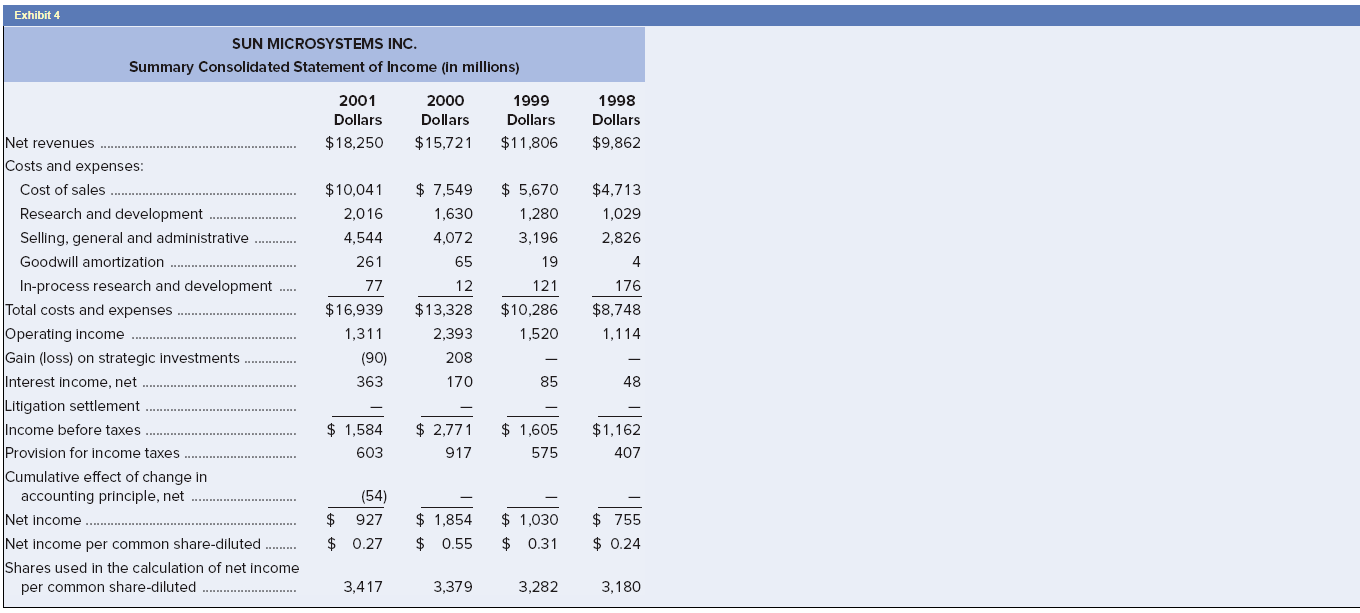
- Analyze your results to Question 4 more completely by computing ratios 1, 2a, 2b, and 3b (all from this chapter) for 2000 and 2001. Actually, the answer to ratio 1 can be found as part of the answer to question 2, but it is helpful to look at it again.
What do you think was the main contributing factor to the change in return on stockholders equity between 2000 and 2001? Think in terms of the Du Pont system of analysis.
- The average stock prices for each of the four years shown in Exhibit 4 were as follows:
1998 11
1999 16
2000 28
2001 9
- Compute the price/earnings (P/E) ratio for each year. That is, take the stock price shown above and divide by net income per common stock-dilution from Exhibit 4.
- Why do you think the P/E has changed from its 2000 level to its 2001 level?
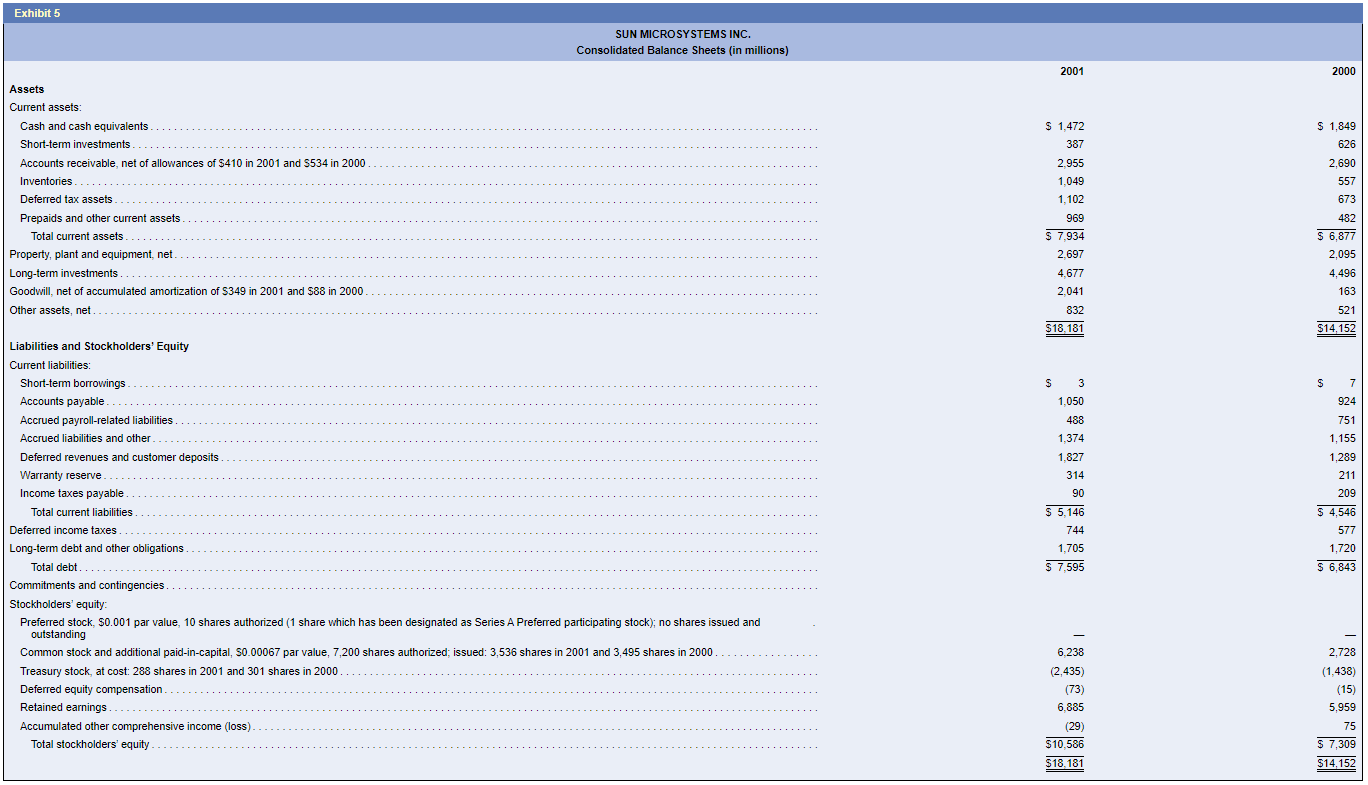
Exhibit 4 SUN MICROSYSTEMS INC. Summary Consolidated Statement of Income (in millions) 2001 Dollars $18,250 2000 Dollars $15,721 1999 Dollars $11,806 1998 Dollars $9,862 $10,041 2,016 4,544 261 $ 7,549 1,630 4,072 $ 5,670 1,280 3,196 19 $4,713 1,029 2,826 65 4 12 121 $10,286 1,520 77 $16,939 1,311 (90) 363 INet revenues Costs and expenses: Cost of sales Research and development Selling, general and administrative Goodwill amortization In-process research and development Total costs and expenses Operating income Gain (loss) on strategic investments Interest income, net Litigation settlement Income before taxes Provision for income taxes Cumulative effect of change in accounting principle, net Net income Net income per common share-diluted ......... Shares used in the calculation of net income per common share-diluted ......................... 176 $8,748 1,114 $13,328 2,393 208 170 85 48 $ 1,584 603 $ 2,771 917 $ 1,605 575 $1,162 407 (54) $ 927 $ 0.27 $ 1,854 $ 0.55 $ 1.030 $ 0.31 $ 755 $ 0.24 3,417 3,379 3,282 3,180 Exhibit 5 SUN MICROSYSTEMS INC. Consolidated Balance Sheets (in millions) 2001 2000 $ 1,472 387 $ 1.849 626 2.690 557 Assets Current assets Cash and cash equivalents. Short-term investments... Accounts receivable, net of allowances of $410 in 2001 and 5534 in 2000 Inventories Deferred tax assets Prepaids and other current assets Total current assets... Property, plant and equipment, net Long-term investments Goodwill, net of accumulated amortization of $349 in 2001 and $88 in 2000 Other assets, net. 2.955 1,049 1,102 969 673 482 $ 6,877 2,095 $ 7,934 2.697 4.677 2.041 832 4,496 163 521 $18,181 $14,152 S $ S 3 3 1,050 488 7 924 751 1.374 1,827 314 1,155 1.289 211 209 S 4,546 577 Liabilities and Stockholders' Equity Current liabilities: Short-term borrowings Accounts payable.... Accrued payroll-related liabilities Accrued liabilities and other.. Deferred revenues and customer deposits Warranty reserve Income taxes payable Total current liabilities Deferred income taxes. . Long-term debt and other obligations Total debt.. Commitments and contingencies Stockholders' equity Preferred stock. $0.001 par value, 10 shares authorized (1 share which has been designated as Series A Preferred participating stock); no shares issued and outstanding Common stock and additional paid-in-capital, S0.00067 par value, 7,200 shares authorized; issued: 3,536 shares in 2001 and 3,495 shares in 2000 Treasury stock, at cost: 288 shares in 2001 and 301 shares in 2000 Deferred equity compensation Retained earnings Accumulated other comprehensive income (loss) Total stockholders' equity 90 $ 5,146 744 1,705 S 7.595 1,720 $ 6,843 6.238 (2,435) (73) 6.885 (29) $10,586 2.728 (1,438) (15) 5.959 75 $ 7,309 $14.152 $18,181
Step by Step Solution
There are 3 Steps involved in it

Get step-by-step solutions from verified subject matter experts
 Study Help