







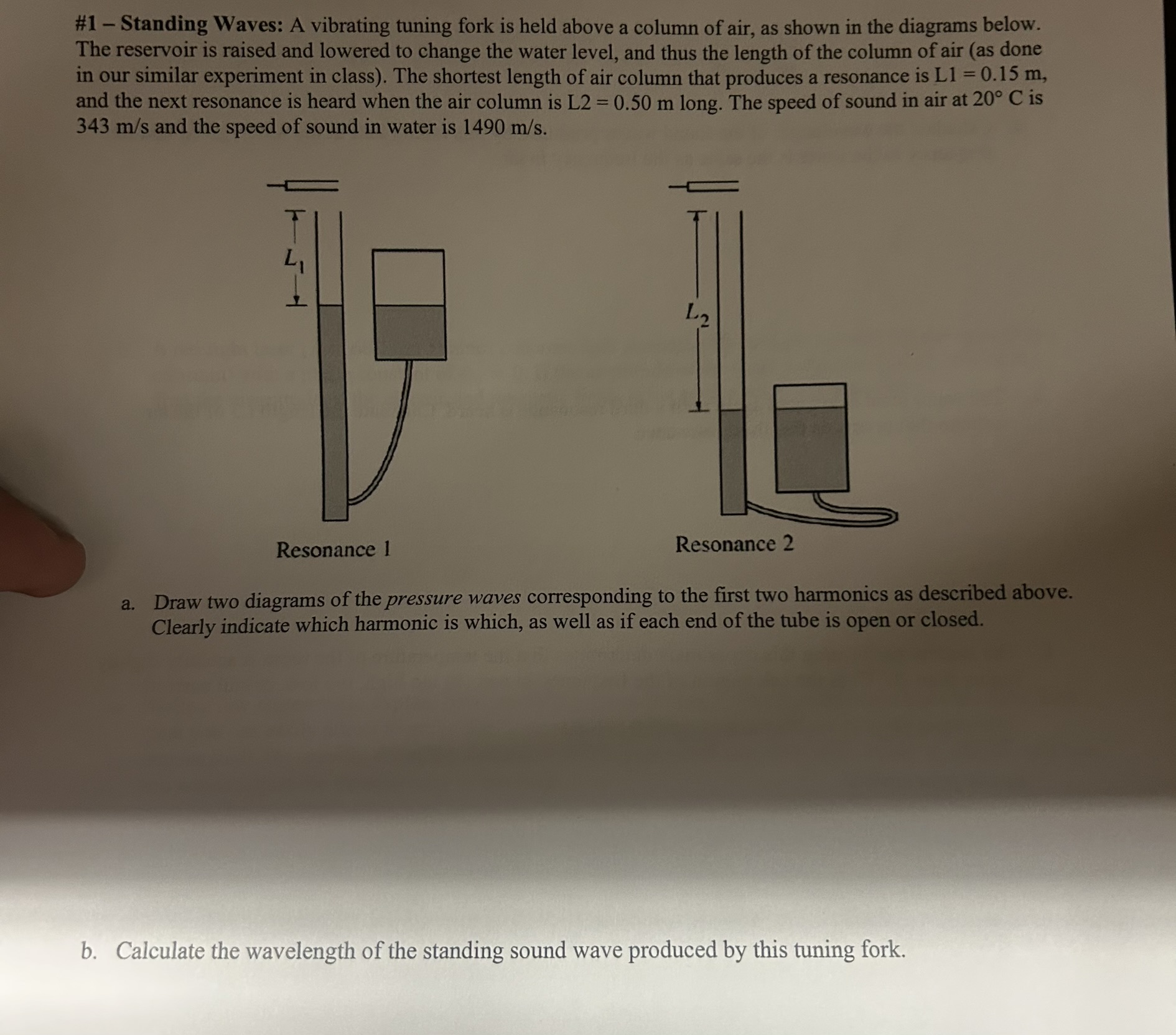
Question: # 1 - Standing Waves: A vibrating tuning fork is held above a column of air, as shown in the diagrams below. The reservoir
# Standing Waves: A vibrating tuning fork is held above a column of air, as shown in the diagrams below. The reservoir is raised and lowered to change the water level, and thus the length of the column of air as done in our similar experiment in class The shortest length of air column that produces a resonance is mathrmLmathrm~m and the next resonance is heard when the air column is mathrmLmathrm~m long. The speed of sound in air at circmathrmC is mathrm~mmathrms and the speed of sound in water is mathrm~mmathrms
a Draw two diagrams of the pressure waves corresponding to the first two harmonics as described above. Clearly indicate which harmonic is which, as well as if each end of the tube is open or closed.
b Calculate the wavelength of the standing sound wave produced by this tuning fork. c Calculate the frequency of the tuning fork that produces the standing wave. Assume the air is at circmathrmC
d Calculate the wavelength of the sound waves produced by this tuning fork in the water, given that the frequency in the water is the same as the frequency in air.
e The water level is lowered again until a third resonance is heard. Calculate the length L of the air column that produces this third resonance.
f The student performing this experiment determines that the temperature of the room is actually slightly higher than circmathrmC Is the calculation of the frequency in part b too high, too low, or still correct? Too high Too low Still correct
Justify your answer.
Step by Step Solution
There are 3 Steps involved in it
1 Expert Approved Answer
Step: 1 Unlock

Question Has Been Solved by an Expert!
Get step-by-step solutions from verified subject matter experts
Step: 2 Unlock
Step: 3 Unlock
 Study Help