







Question: 1. State the Maximum Theorem. (30 points) 2. Give an example of a differentiable utility function and a continuous but not differentiable utility function that
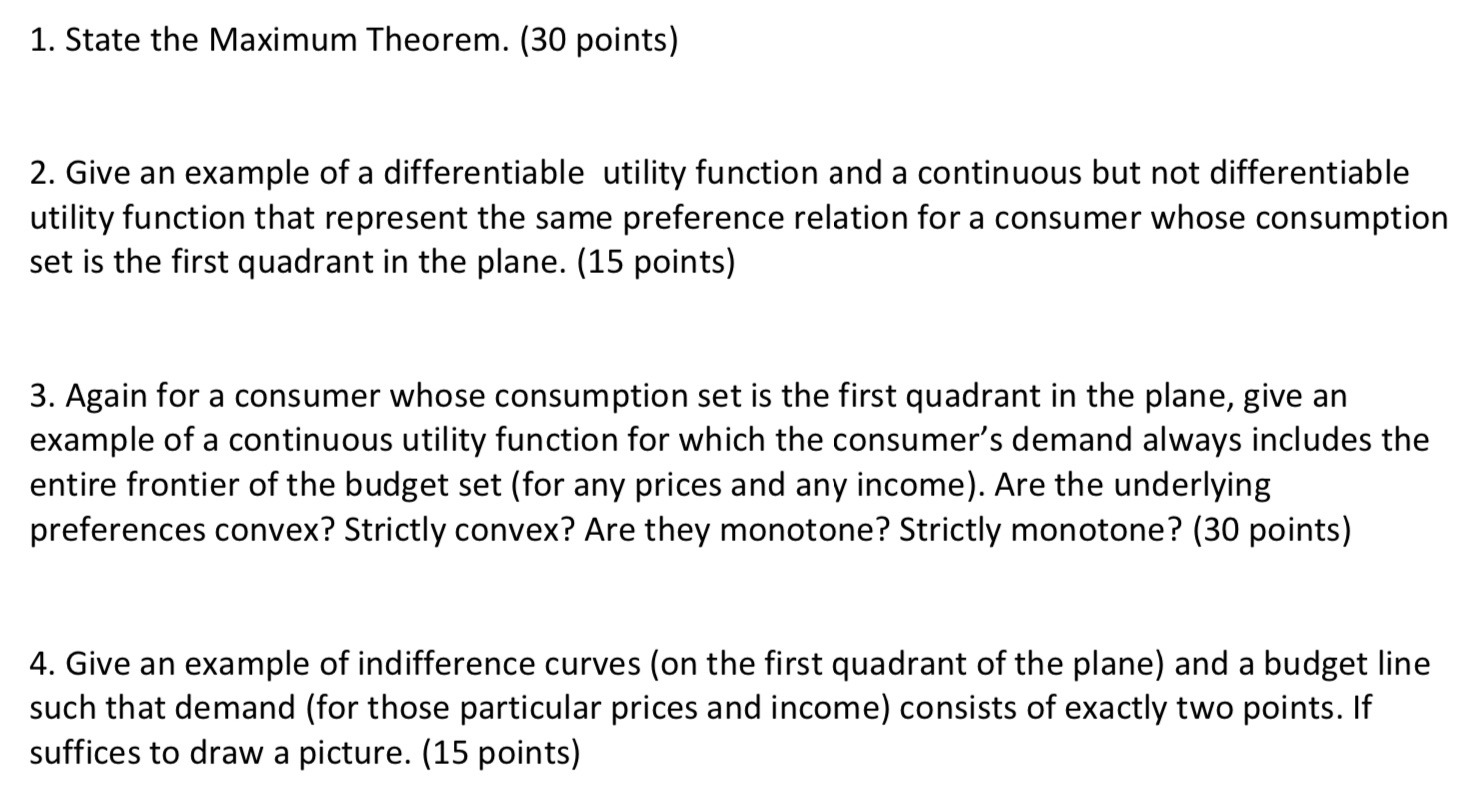
1. State the Maximum Theorem. (30 points) 2. Give an example of a differentiable utility function and a continuous but not differentiable utility function that represent the same preference relation for a consumer whose consumption set is the first quadrant in the plane. (15 points) 3. Again for a consumer whose consumption set is the first quadrant in the plane, give an example of a continuous utility function for which the consumer's demand always includes the entire frontier of the budget set (for any prices and any income). Are the underlying preferences convex? Strictly convex? Are they monotone? Strictly monotone? (30 points) 4. Give an example of indifference curves (on the first quadrant of the plane) and a budget line such that demand (for those particular prices and income) consists of exactly two points. If suffices to draw a picture. (15 points)
Step by Step Solution
There are 3 Steps involved in it

Get step-by-step solutions from verified subject matter experts
 Study Help