





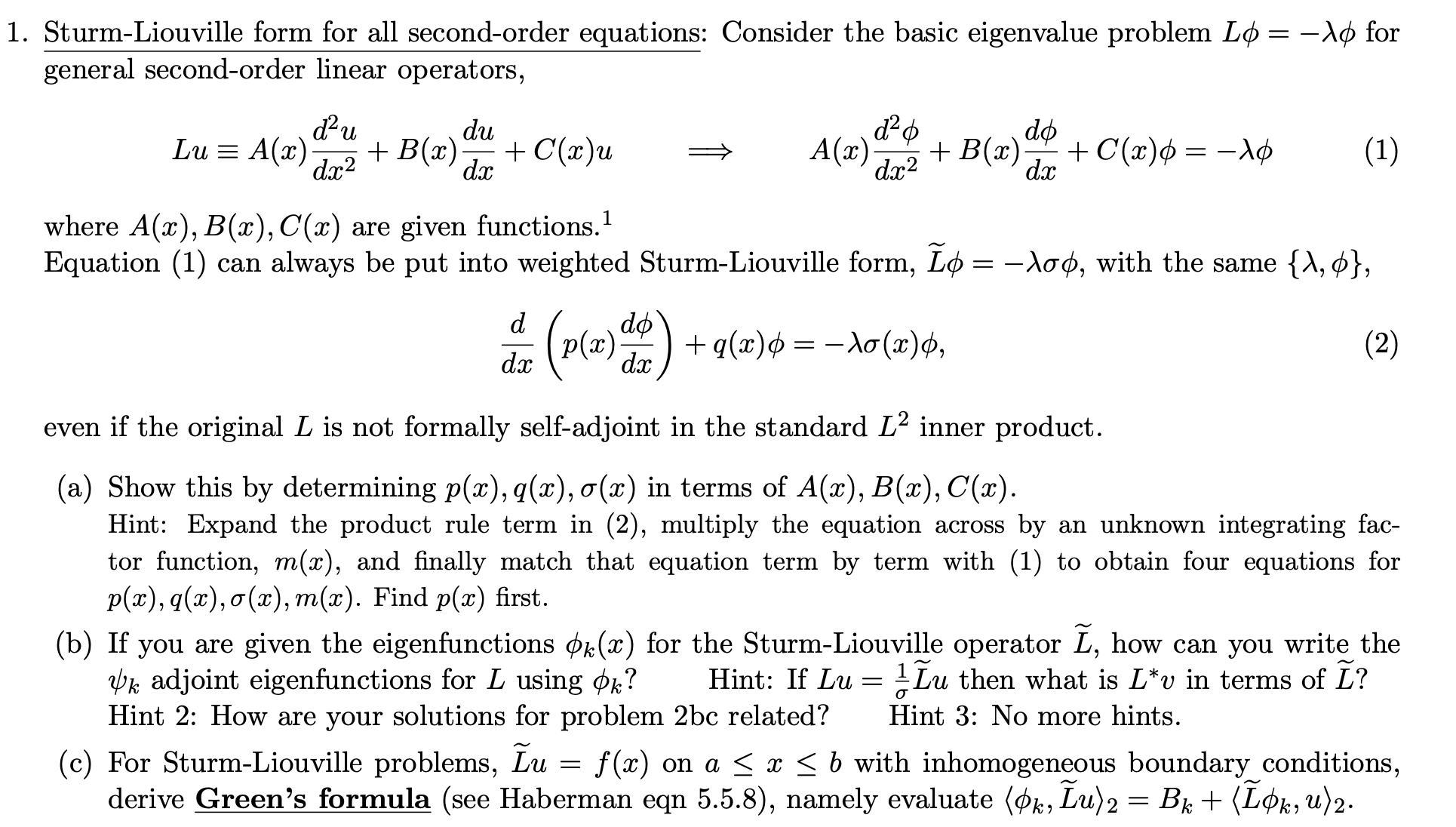
Question: 1. Sturm-Liouville form for all second-order equations: Consider the basic eigenvalue problem Lo = -Ad for general second-order linear operators, Lu = A(x) du +
1. Sturm-Liouville form for all second-order
1. Sturm-Liouville form for all second-order equations: Consider the basic eigenvalue problem Lo = -Ad for general second-order linear operators, Lu = A(x) du + C(x)u A(x ) d-$ do dx2 + B(x) dx dx2 + B(x)- dx + C(x) 0 = -10 (1) where A(x), B(x), C(x) are given functions. Equation (1) can always be put into weighted Sturm-Liouville form, Lo = -doo, with the same {1, 4}, d dx (P( 2 ) do dx + 9(20) 0 =-10(2)$, (2) even if the original L is not formally self-adjoint in the standard L2 inner product. (a) Show this by determining p(x), q(x), o(x) in terms of A(x), B(x), C(x). Hint: Expand the product rule term in (2), multiply the equation across by an unknown integrating fac- tor function, m(x), and finally match that equation term by term with (1) to obtain four equations for p(z), q(2), o(x), m(x). Find p(x) first. (b) If you are given the eigenfunctions ok(x) for the Sturm-Liouville operator L, how can you write the 2k adjoint eigenfunctions for L using ok? Hint: If Lu = _Lu then what is L*v in terms of L? Hint 2: How are your solutions for problem 2bc related? Hint 3: No more hints. (c) For Sturm-Liouville problems, Lu = f(x) on a

Step by Step Solution

There are 3 Steps involved in it

1 Expert Approved Answer
Step: 1 Unlock blur-text-image

Question Has Been Solved by an Expert!

Get step-by-step solutions from verified subject matter experts

Step: 2 Unlock
Step: 3 Unlock

Students Have Also Explored These Related Mathematics Questions!