







Question: 1. summarize the case 2. explain how Marijuana can be classified an illegal drug, and yet be legalized in some states, Using the principles of
1. summarize the case 2. explain how Marijuana can be classified an illegal drug, and yet be "legalized" in some states, Using the principles of Constitutional Law, and Federal Supremacy of State Law, 3. How many states have legalized recreational marijuana and what affect if any has there been on their population? (references) 4. attach a link to a recent Supreme Court decision (past year) - references - Summarize the case. 5. summarize the an ethical issue related to a Supreme Court Justice.
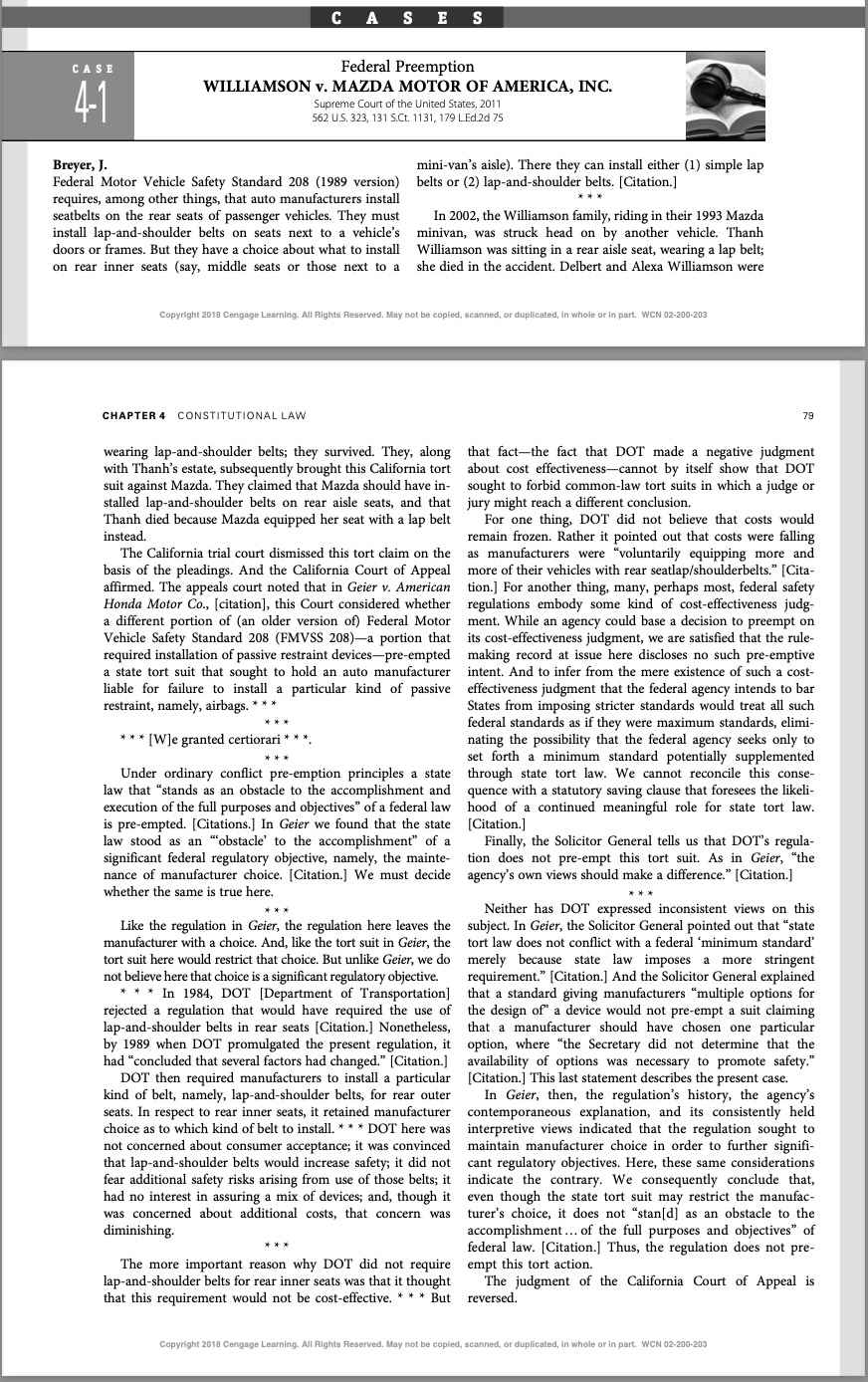
Federal Preemption ~ WILLIAMSON v. MAZDA MOTOR OF AMERICA, INC. Supreme Court of the United States, 2011 562 US. 333,131 S.Ct. 1131, 179 LEd2d 75 Breyer, J. Federal Motor Vehicle Safety Standard 208 (1989 version) requires, among other things, that auto manufacturers install seatbelts on the rear seats of passenger vehicles. They must install lap-and-shoulder belts on seats next to a vehide's doors or frames. But they have a choice about what to install on rear inner seats (say, middle seats or those next to a mini-van's aisle). There they can install either (1) simple lap belts or (2) lap-and-shoulder belts. [Citation. ] In 2002, the Williamson family, riding in their 1993 Mazda minivan, was struck head on by another wvehicle. Thanh Williamson was sitting in a rear aisle seat, wearing a lap belt; she died in the accident. Delbert and Alexa Williamson were Copyright 2018 Cengage Learning. All Rights Reserved. May nol be copied, scanned, or duplicated, in whole or in part. WCN 02-200-203 CHAFTER 4 CONSTITUTIOMAL LAW wearing lap-and-shoulder belts; they survived. They, along with Thanh's estate, subsequently brought this California tort suit against Mazda. They claimed that Mazda should have in- stalled lap-and-shoulder belts on rear aisle seats, and that Thanh died because Mazda equipped her seat with a lap belt instead. The California trial court dismissed this tort claim on the basis of the pleadings. And the California Court of Appeal affirmed. The appeals court noted that in Geier v. American Honda Motor Co., [citation], this Court considered whether a different portion of (an older version of) Federal Motor Vehicle Safety Standard 208 (FMVSS 208)a portion that required installation of passive restraint devicespre-empted a state tort suit that sought to hold an auto manufacturer liable for failure to install a particular kind of passive restraint, namely, airbags. * * * * *x *** [W]e granted certiorari * * *. * Under ordinary conflict pre-emption principles a state law that \"stands as an obstacle to the accomplishment and execution of the full purposes and objectives\" of a federal law is pre-empted. [Citations.] In Geier we found that the state law stood as an \"obstacle' to the accomplishment\" of a significant federal regulatory objective, namely, the mainte- nance of manufacturer choice. [Citation.] We must decide whether the same is true here. Like the regulation in Gefer, the regulation here leaves the manufacturer with a choice. And, like the tort suit in Gefer, the tort suit here would restrict that choice. But unlike Geier, we do not believe here that choice is a significant regulatory objective. * % * In 1984, DOT [Department of Transportation] rejected a regulation that would have required the use of lap-and-shoulder belts in rear seats [Citation.] Nonetheless, by 1989 when DOT promulgated the present regulation, it had \"concluded that several factors had changed.\" [Citation.] DOT then required manufacturers to install a particular kind of belt, namely, lap-and-shoulder belts, for rear outer seats. In respect to rear inner seats, it retained manufacturer choice as to which kind of belt to install. * * * DOT here was not concerned about consumer acceptance; it was convinced that lap-and-shoulder belts would increase safety; it did not fear additional safety risks arising from use of those belts; it had no interest in assuring a mix of devices; and, though it was concerned about additional costs, that concern was diminishing. The more important reason why DOT did not require lap-and-shoulder belts for rear inner seats was that it thought that this requirement would not be cost-effective. * * * But 78 that factthe fact that DOT made a negative judgment about cost effectivenesscannot by itself show that DOT sought to forbid common-law tort suits in which a judge or jury might reach a different conclusion. For one thing, DOT did not believe that costs would remain frozen. Rather it pointed out that costs were falling as manufacturers were \"voluntarily equipping more and more of their vehicles with rear seatlap/shoulderbelts.\" [Cita- tion.] For another thing, many, perhaps most, federal safety regulations embody some kind of cost-effectiveness judg- ment. While an agency could base a decision to preempt on its cost-effectiveness judgment, we are satisfied that the rule- making record at issue here discloses no such pre-emptive intent. And to infer from the mere existence of such a cost- effectiveness judgment that the federal agency intends to bar States from imposing stricter standards would treat all such federal standards as if they were maximum standards, elimi- nating the possibility that the federal agency seeks only to set forth a minimum standard potentially supplemented through state tort law. We cannot reconcile this conse- quence with a statutory saving clause that foresees the likeli- hood of a continued meaningful role for state tort law. [Citation.] Finally, the Solicitor General tells us that DOT's regula- tion does not pre-empt this tort suit. As in Geier, \"the agency's own views should make a difference.\" [Citation.] W Neither has DOT expressed inconsistent views on this subject. In Geier, the Solicitor General pointed out that \"state tort law does not conflict with a federal 'minimum standard' merely because state law imposes a more stringent requirement.\" [Citation.] And the Solicitor General explained that a standard giving manufacturers \"multiple options for the design of\" a device would not pre-empt a suit claiming that a manufacturer should have chosen one particular option, where \"the Secretary did not determine that the availability of options was necessary to promote safety.\" [Citation.] This last statement describes the present case. In Geier, then, the regulation's history, the agency's contemporaneous explanation, and its consistently held interpretive views indicated that the regulation sought to maintain manufacturer choice in order to further signifi- cant regulatory objectives. Here, these same considerations indicate the contrary. We consequently conclude that, even though the state tort suit may restrict the manufac- turer's choice, it does not \"stan[d] as an obstacle to the accomplishment ... of the full purposes and objectives\" of federal law. [Citation.] Thus, the regulation does not pre- empt this tort action. The judgment of the California Court of Appeal is reversed. Capyright 2018 Cengage Learning. All Rights Reserved. May not be eopled, scanned, of duplicated, in whele or in part. WCN 02-200-203
Step by Step Solution
There are 3 Steps involved in it

Get step-by-step solutions from verified subject matter experts
 Study Help